

The 2027 AP exams start on Monday 3 May. Most families plan for the middle of the month, and that four-day error is the difference between a finished review and a rushed one. Knowing when to start studying for AP exams is almost entirely a matter of arithmetic: College Board fixes your exam date, your course's published unit weightings tell you what the review has to cover, and everything else follows from those two facts. The trouble is that neither one is a single answer for every student. A teenager sitting AP Biology and a teenager sitting AP Psychology are in the same school year and the same classes, and one of them has eleven fewer days. This post gives you the real dates, the real weightings, and a method for turning them into a plan that fits your subject rather than somebody else's.
Key takeaways
- The 2027 AP exams run 3 to 7 May and 10 to 14 May. College Board fixes one date and session per subject.
- Eleven days separate the first exam from the last. Biology sits on day one; Psychology sits on day ten.
- Count your review back from your own exam date. Six weeks before Biology is 22 March 2027; six weeks before Psychology is 2 April.
- Reviewing in the order the course was taught wastes time. AP U.S. History Units 1, 2 and 9 are worth about a sixth of that exam between them.
- The 13 November ordering deadline commits you financially. It decides nothing about whether you are ready.
When do the 2027 AP exams actually happen?
They run over two weeks in May: 3 to 7 May and 10 to 14 May 2027. College Board assigns every subject a single date and a single session, morning or afternoon, and publishes the whole grid well over a year ahead. Your school does not choose it and cannot move it.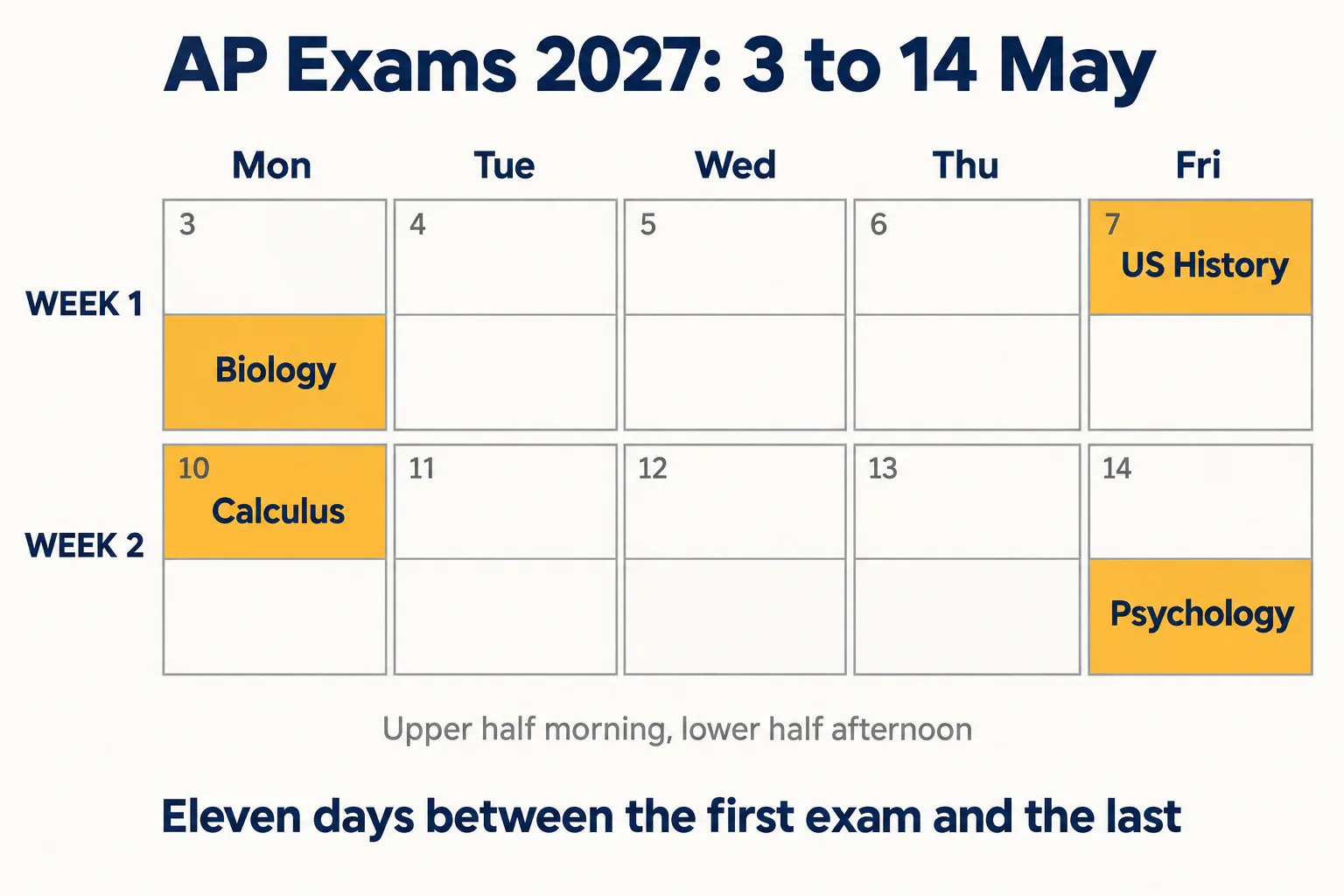
Four anchor dates are worth committing to memory, because they bracket the whole window:
| Subject | 2027 date | Session | Last full day to revise |
|---|---|---|---|
| Biology | Monday 3 May | Afternoon | Sunday 2 May |
| U.S. History | Friday 7 May | Morning | Thursday 6 May |
| Calculus AB and BC | Monday 10 May | Morning | Sunday 9 May |
| Psychology | Friday 14 May | Afternoon | Thursday 13 May |
Read the right-hand column again. A Biology student's last useful day of revision is Sunday 2 May. A Psychology student's is Thursday 13 May. Same school, same year, same teachers, and an eleven-day difference in deadline that no amount of planning can close.
So when should you start studying for AP exams?
Count back from your own exam date, not from a month somebody quoted you. College Board publishes no recommended review length, and any article that gives you a single confident number is inventing it.
What it does publish is everything you need to work it out yourself. Take a six-week dedicated review as a working figure, because that is roughly what a full-year course's worth of content takes to go back over without abandoning schoolwork, and apply it to the four anchor subjects:
- AP Biology, exam 3 May. Six weeks back is 22 March 2027.
- AP U.S. History, exam 7 May. Six weeks back is 26 March 2027.
- AP Calculus, exam 10 May. Six weeks back is 29 March 2027.
- AP Psychology, exam 14 May. Six weeks back is 2 April 2027.

The practical consequence is that a student carrying both Biology and Psychology cannot run one review plan. The Biology review has to be finished and tested while the Psychology review is still in its middle weeks. Students who plan a single undifferentiated "AP revision period" in April discover this in the last week of March, which is the worst possible moment to find it out.
Why does reviewing from Unit 1 waste time?
Because the units are not worth the same, and College Board says so in public. Every course page on AP Central lists each unit with an exam weighting expressed as a percentage range, and in some subjects that range varies by a factor of nearly three.
Here are two popular courses, with the published ranges:
| AP U.S. History unit | Published exam weighting |
|---|---|
| Unit 1, 1491 to 1607 | 4% to 6% |
| Unit 2, 1607 to 1754 | 6% to 8% |
| Units 3 to 8, 1754 to 1980 | 10% to 17% each |
| Unit 9, 1980 to present | 4% to 6% |
Take the midpoint of each published range and the shape is stark. Units 1, 2 and 9 come to roughly 17% of the exam between them, while the six middle units come to roughly 81%. Three of the nine units, a third of the course, are worth about a sixth of the paper. A student who starts at Unit 1 and works forward in course order spends the first days of a six-week review on the single lightest-weighted period in the syllabus.
Now the same exercise on AP Biology:
| AP Biology unit | Published exam weighting |
|---|---|
| Unit 1, Chemistry of Life | 8% to 11% |
| Unit 2, Cells | 10% to 13% |
| Unit 3, Cellular Energetics | 12% to 16% |
| Unit 4, Cell Communication and Cell Cycle | 10% to 15% |
| Unit 5, Heredity | 8% to 11% |
| Unit 6, Gene Expression and Regulation | 12% to 16% |
| Unit 7, Natural Selection | 13% to 20% |
| Unit 8, Ecology | 10% to 15% |

This is the contrarian part, and it is the reason generic AP advice fails. There is no universal rule about where the marks sit, so the advice to "prioritise the heavily weighted units" means something completely different in each course. In U.S. History it means skipping lightly over three of nine periods. In Biology it means almost nothing, because the flattest unit is 8% to 11% and the heaviest is 13% to 20%: a Biology student genuinely cannot afford to drop a unit. Notice also that Biology's heaviest unit, Natural Selection, usually arrives late in the teaching sequence, so the "leave the recent stuff, you just learned it" instinct is exactly wrong there and roughly right in U.S. History.
Read your own course page before you write a single line of a revision plan. It takes two minutes and it changes the order of everything that follows.
Not sure where your teen stands? A free consultation with Catalyst Test Prep maps exactly which AP units need the most work, so you're never guessing about study time.
Book a Free Consultation →What does the 13 November deadline actually decide?
It decides whether the exam is ordered, and nothing else. 13 November 2026 is the final deadline for AP coordinators to submit orders for full-year and first-semester courses, and cancelling after it can attract a fee. That makes November feel like the moment everything is settled, which is precisely the trap.
The ordering deadline is an administrative and financial commitment made by your school on your behalf. It is six months before the exam and it tells you nothing about readiness. We cover the deadline structure and the fee detail separately in our guide to AP exam registration deadlines and fees, including the waiver route that applies to homeschooled students and students whose school does not administer the exam.
Treat November as the date you commit, and the exam date as the date you plan from. Families who conflate the two tend to do nothing between the order and the spring, because the big decision already feels made.
How do you turn an exam date into a plan?
Four steps, in this order. None of them takes long, and doing them out of order is what produces a plan built on the wrong month.
- Write down your exact date and session. Not the week. Not "early May". The date and whether it is morning or afternoon, for every subject your teen is sitting.
- Pull the unit weightings from each course's page on AP Central and sort the units by published weighting rather than by teaching order.
- Count your review back from the earliest exam, because that is the one that constrains everything. If Biology is on 3 May, the plan starts in March whatever the other subjects say.
- Find your collisions before March. Two exams two days apart, or a morning and an afternoon exam on one date, change what is realistic.
Then use material that matches the real exam. Our guide to which AP exams are actually released covers what genuine past material exists per subject, which matters because for several courses the honest answer is less than students assume. For the commercial options, the AP prep books worth buying are reviewed separately.
What about students sitting two or three AP exams?
Check every date against every other date first, because the 2027 grid puts some predictable pairings uncomfortably close together. Two specific collisions catch students every year.
Physics C: Mechanics is on Monday 3 May and Physics C: Electricity and Magnetism is on Wednesday 5 May. Students commonly take both, and they fall two days apart at the very start of the window. There is no week between them to pivot in.
Some dates carry two exams. Thursday 6 May has French Language and Culture, Physics 2 and World History: Modern in the morning, then African American Studies and Chemistry in the afternoon. A student taking World History and Chemistry sits both on one day. That is survivable, but only if it was planned for in March rather than discovered in May.
If the SAT is also in the picture, the sequencing question gets harder, and we have written about balancing SAT prep with school and AP exams in its own right. The short version: the AP dates are fixed and the SAT dates are chosen, so the SAT moves.
Where does this actually go wrong?
Three failure modes, and all three are about timing rather than effort.
The first is treating the class pace as the prep plan. An AP course is built to run a full academic year, and the exam lands in the first two weeks of May while many courses are still teaching. A student who simply keeps up finishes the syllabus after the exam and reviews none of it.
The second is reviewing in course order, covered above. It front-loads the lightest material in most humanities courses and it is the default because it feels tidy.
The third is finding the date in April. Every year students discover in the second week of April that their exam is on day one of the window rather than day ten, which converts a planned six-week review into a four-week one. The date has been published since 2026. Looking it up in November costs nothing and removes the whole class of error.
None of this is an argument for starting earlier in the abstract. A student who begins "revising" in January without weightings or a date burns out and still arrives unprepared. The argument is for starting on the right day, in the right order, which you can only work out from your own two numbers. If you want context on what the score you are aiming at actually represents, our breakdown of what AP pass rates hide is the companion piece to this one.
Conclusion
Knowing when to start studying for AP exams comes down to three things you can look up today. Your exam date, which College Board fixed long ago and which varies by eleven days across the window. Your course's unit weightings, which are published per unit and are uneven in a different way in every subject. And your collisions, which decide what is realistic once you have more than one exam. Get those three on paper in November and the plan writes itself in March. Skip them and you will be building a revision schedule in April around a date you have just discovered.
Ready to turn a prep plan into real score gains? Catalyst's 1:1 live online AP programme starts with a free consultation to benchmark your teen's starting point and build a personalised path to their goal score.
Book a Free ConsultationExam dates and unit weightings checked against College Board's published 2027 AP exam dates and the AP U.S. History course page on AP Central, both checked 2 November 2026.