Thirteen days. That is how long every single weekend SAT on the 2026 calendar takes to return a score, five administrations out of five, and it is a more useful answer than the one College Board publishes. The official language is "two to four weeks", which is technically true and practically vague. If your teen sat the September 12 test, their SAT scores arrive on September 25, six days from now.
Knowing the date is the easy half. The harder half is what to do in the two days after it, because a score report contains far more than a number, and the decision it should trigger has a deadline of its own. This guide gives every 2026 release date, explains why the wait exists at all, and sets out what to do the moment the score lands.
Key Takeaways
- Every 2026 weekend SAT releases scores 13 days after test day, not the two to four weeks usually quoted.
- The next release is September 25 for the September 12 test, then October 16, November 20 and December 18.
- Educators see scores three to four days after students, so a counsellor may not have them when your teen does.
- PSAT/NMSQT and SAT School Day scores follow submission windows, not test dates, and can land three weeks after testing.
- The question level breakdown, not the total score, is the part that tells you what to do next.
When do SAT scores come out?
Scores for a weekend SAT are released 13 days after test day, at which point they appear in the student's College Board account. There is no published release time, and scores arrive in waves across that day rather than at a single moment.
Here is the full published 2026 schedule, taken from College Board's score release dates page.
| Test date | Scores to students | Scores to educators | Days to release |
|---|---|---|---|
| Aug. 22, 2026 | Sept. 4, 2026 | Sept. 8, 2026 | 13 |
| Sept. 12, 2026 | Sept. 25, 2026 | Sept. 28, 2026 | 13 |
| Oct. 3, 2026 | Oct. 16, 2026 | Oct. 19, 2026 | 13 |
| Nov. 7, 2026 | Nov. 20, 2026 | Nov. 23, 2026 | 13 |
| Dec. 5, 2026 | Dec. 18, 2026 | Dec. 21, 2026 | 13 |
Two things in that table are worth pausing on. The interval is identical every time, which means you can plan around a date rather than a range. And students see scores three to four days before educators do, so there is a window in which your teen knows their score and their school counsellor does not.
What the 13-day pattern does and does not promise
College Board's own wording is that most scores from weekend tests are released two to four weeks after test day, and that hedge exists for a reason. A small number of scores are held for review, for irregularities at a test centre, or because an answer sheet needs manual handling. Those cases do not follow the calendar.
So treat 13 days as the planning number and four weeks as the safety margin. If you are working backwards from a college deadline, use the longer figure. If you are deciding when to book a tutor, use the shorter one.
Why does a digital test take two weeks to score?
Because the delay is not the marking. Raw answers are machine read quickly. The slow step is equating, the statistical process that makes a 1340 on one form mean the same as a 1340 on another, across different questions and different weekends.
The adaptive format makes that harder rather than easier. A student who clears the threshold in Module 1 receives a harder Module 2, so two students with the same number of correct answers can finish with different scaled scores. Reconciling that requires the full cohort's performance data, which does not exist until everyone has tested. The two-week wait is the price of a score that compares fairly across the year.
Not sure where your teen stands? A free consultation with Catalyst Test Prep maps exactly which SAT topics need the most work, so you're never guessing about study time.
Book a Free Consultation →PSAT and SAT School Day run on a different clock
In-school testing does not work from a test date at all. It works from the date your school submits its answers, and the gap is longer than most families expect.
| School submits answers by | Students see scores | Educator reports |
|---|---|---|
| Oct. 9, 2026 | Oct. 22, 2026 | Oct. 28, 2026 |
| Oct. 23, 2026 | Nov. 5, 2026 | Nov. 11, 2026 |
| Oct. 30, 2026 | Nov. 12, 2026 | Nov. 18, 2026 |
A student who sits the PSAT/NMSQT in the first week of October and a classmate who sits it in the last week will get scores three weeks apart, through no choice of their own. State administered programmes run on their own timelines again. If National Merit eligibility is in play, this matters, and our guide to what the PSAT/NMSQT is and why it counts explains what happens to those scores next.
What the score report actually contains
Most families look at the total, feel something about it, and close the tab. The total is the least actionable number in the document.
- Total score out of 1600, and two section scores out of 800.
- Percentile ranks, showing where the score sits nationally.
- Question level detail: every question answered incorrectly, its difficulty level, and the knowledge area it belonged to.
- Knowledge and skills breakdown across the four content domains in each section.
The third item is where the next eight weeks of work is decided. A student who missed six hard algebra questions and a student who missed six easy questions spread across every domain have similar totals and opposite problems. One needs content teaching. The other needs to stop rushing. You cannot tell which from the score, and you can tell instantly from the breakdown. Our SAT score calculator is useful for modelling what a target raw performance would produce, once you know which questions are actually in play.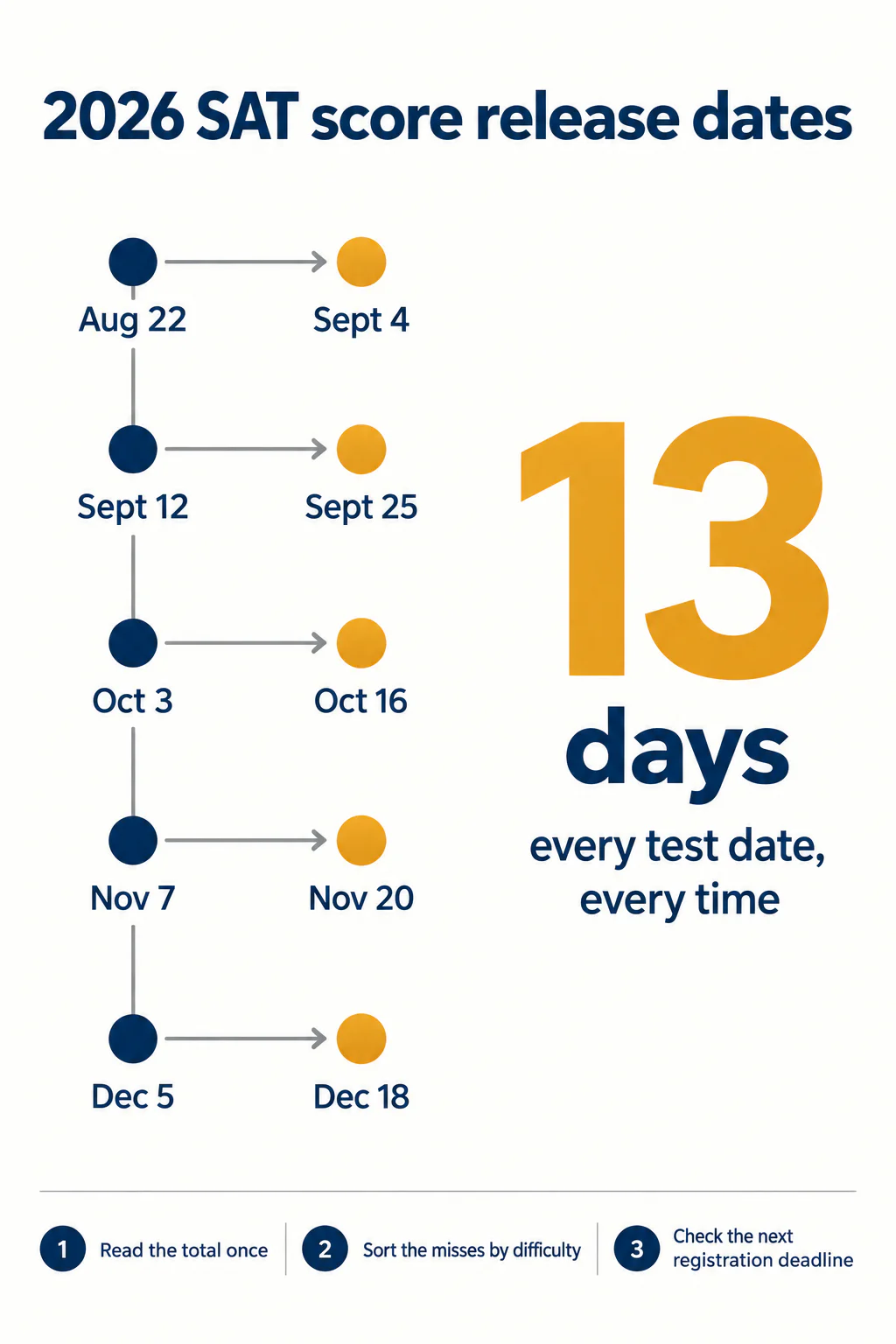
Should you send scores before you have seen them?
Usually not, and this is the decision most students get wrong by default. Free score sends are attached to registration, which means they are used before anyone knows the result.
For a student on a second or third attempt who already has a score they are content with, using the free sends is sensible. For a first attempt, or a test taken while ill, or a test sat without much preparation, holding the sends keeps the choice in your hands. Paying a fee later to send a score you are happy with beats having a score on file you would rather not discuss. The mechanics of which scores a college sees, and what superscoring changes, are covered in our guide to superscore and Score Choice.
What to do in the first 48 hours
Release day has an emotional shape to it, and the useful work happens just after it. Three steps, in order.
- Read the total once, then put it down. The number is information, not a verdict, and nothing useful gets decided in the first hour.
- Open the question level breakdown and sort the misses. Count how many were easy or medium, and how many were clustered in one knowledge area. Easy misses point at timing and carelessness. Clustered misses point at content.
- Check the next test date against the registration deadline, not the test date. The October 3 SAT closed for regular registration on September 18, with late registration until September 22. The November 7 test closes October 23. Deciding to retake is only half a decision if the seat is gone.
Deciding whether to stop or retake
A retake is worth booking when you can name what will be different. If the answer is "more practice tests", the score usually lands within about 30 points of the first one, which is inside the noise. If the answer is "I lost 40 points to unfinished questions in Module 2 and I have eight weeks to fix pacing", that is a plan with a mechanism.
Two things also belong in the decision. Scholarship thresholds are often set at round numbers, so a 1390 sitting 10 points below a cutoff is worth another attempt in a way that a 1420 comfortably above one is not, and our guide to SAT scores and merit scholarships shows how much those bands are worth. And the higher the starting score, the harder the gain: moving from 1400 to 1500 is a different project from moving 1200 to 1300, as breaking the 1400 to 1500 barrier sets out. If you do commit, our guide to retaking the SAT strategically covers how to structure the gap.
What to hold on to
Three things. The 2026 weekend SAT returns scores 13 days after test day, every time, so September 12 lands on September 25 and December 5 lands on December 18. In-school PSAT and SAT School Day scores follow submission windows instead, which can put three weeks between classmates. And the total score is the least useful number in the report: the question level breakdown is what tells you whether the next eight weeks belong to content or to pacing.
Read the number, then read the detail. The second one is where the next 60 points are.
Ready to turn a prep plan into real score gains? Catalyst's 1:1 live online SAT programme starts with a free consultation to benchmark your teen's starting point and build a personalised path to their goal score.
Book a Free Consultation