
There is no national PSAT score release day, and that single fact explains most of the confusion every October. PSAT scores come out on three different dates in autumn 2026: 22 October, 5 November and 12 November. Which one you get has nothing to do with the morning you sat the test. It depends entirely on how quickly your school returns its answer files to College Board.
That means two students who tested on the same day, in the same district, can be three weeks apart on results. It also means the countdown you should be watching is your school's submission deadline, not your test date. Below are the exact dates, where the scores actually appear now that most students never log into a College Board account to see them, and what the numbers on the report are really telling you about National Merit and about your SAT.
Key Takeaways
- Three release dates, not one: 22 October, 5 November or 12 November 2026, set by your school's answer submission deadline of 9, 23 or 30 October.
- Counselors see scores two days before you do. The K-12 portal opens 20 October, 3 November and 10 November respectively.
- The Selection Index is weighted, not averaged: (2 × Reading and Writing + Math) ÷ 10, on a 48 to 228 scale. Reading and Writing counts double.
- An asterisk beside your Selection Index means you are out of the National Merit competition, and it is fixable through an NMSC webform.
- You cannot opt out of National Merit screening. College Board sends scores to NMSC automatically unless you contact NMSC yourself.
When do PSAT scores come out in 2026?
PSAT/NMSQT scores reach students on 22 October, 5 November or 12 November 2026. College Board publishes a submission table that maps the date your school sends in answer files to the date you see results, and schools choose their own testing day inside a window that runs from 1 October to 30 October 2026.
| School submits answer files by | Counselors see scores | Students see scores |
|---|---|---|
| 9 October 2026 | 20 October 2026 | 22 October 2026 |
| 23 October 2026 | 3 November 2026 | 5 November 2026 |
| 30 October 2026 | 10 November 2026 | 12 November 2026 |
Source: College Board SAT Suite score release dates, checked 13 October 2026.
Why your friend at another school got scores first
Schools that test early in October and process quickly land in the first band. Schools that test in the last week of the window, or that batch their paperwork, land in the third. The gap between the earliest and latest student release is 21 days, which is long enough to matter if you are a senior deciding whether to sit the December SAT.
If you want to know your date, ask your counselor one question: when did the school submit answer files? That is the only input. Guessing from your test day will be wrong for most students.
Where do PSAT scores actually appear?
For most students the scores arrive by text message and open in the BigFuture School mobile app, not in a College Board account. This caught a lot of families out when it changed, because the old habit was to log in and look.
- BigFuture School app. Requires the mobile number you gave during testing. College Board texts you when scores are ready, and the app shows everything on the score report PDF plus percentile detail.
- A personal College Board account. Available to students aged 13 and over for additional insights online.
- Your counselor. They can print the full score report PDF, and they have had access since two days before you did.
What to do if the text never arrives
Three things break this, in order of how often they happen: the mobile number was entered wrongly on test day, the number given belonged to a parent rather than the student, or no number was given at all. None of them affects your score or your National Merit entry. Go to your counselor and ask for the PDF, then fix the number before the next administration.
What the PSAT score report actually shows
The report carries four numbers that do different jobs, and students routinely read the wrong one as the headline.
- Total score, 320 to 1520. The sum of the two sections. Note the ceiling: the PSAT tops out 80 points below the SAT's 1600, so a 1520 PSAT is a perfect score, not a near miss.
- Section scores, 160 to 760 each. Reading and Writing, and Math.
- Selection Index, 48 to 228. The only number National Merit uses.
- Section benchmarks. College readiness indicators, which are a floor check rather than a competitive measure.
How the Selection Index is calculated
Double the Reading and Writing section score, add the Math section score, then divide the total by 10. A student with 700 Reading and Writing and 700 Math scores (1400 + 700) ÷ 10, which is 210.
The weighting is the part worth sitting with. Reading and Writing counts twice and Math counts once, so ten points gained in Reading and Writing move the Selection Index by two, while ten points in Math move it by one. If you are chasing a state cutoff and have limited hours, that is the whole argument for where those hours go. It is also why a lopsided 760 Math and 640 Reading and Writing student can sit below a balanced 700 and 700 student on the Index while beating them on total score.
Not sure where your teen stands? A free consultation with Catalyst Test Prep maps exactly which SAT topics need the most work, so you're never guessing about study time.
Book a Free Consultation →Does your score put you in the running for National Merit?
Only juniors are competing. Of roughly 1.2 million eligible students who take the PSAT/NMSQT, about 50,000 receive any recognition at all. More than 16,000 of those are named Semifinalists; the remaining 34,000 become Commended Students and do not continue in the scholarship competition.
There is no single qualifying number to aim at, and anyone quoting one is guessing. Semifinalists are the highest scoring entrants in each state, and each state has a preset allocation, so the cutoff is set after the scores are in. A Selection Index that wins Semifinalist standing in one state misses in another.
The timeline is slower than most families expect. Semifinalists are notified through their schools in early September of senior year, nearly eleven months after testing. Finalists are notified in early February by post, after completing an application, writing an essay, securing a school endorsement and earning an SAT or ACT score that confirms the PSAT performance. That confirming score requirement is the step that catches students who treated the PSAT as a one off.
The asterisk that quietly removes you from the competition
This is the detail almost nobody checks, and it is the single most useful thing on the report. NMSC's own guidance is blunt: "Students should check their PSAT/NMSQT Score Reports to see whether an asterisk appears next to their Selection Index score. If an asterisk is present, then the student does not meet entry requirements for the National Merit Scholarship Program."
The asterisk usually comes from the entry requirement questions answered on test day, which students rush through in about ninety seconds: expected graduation year, citizenship, whether they are in their penultimate year of secondary school. Get one wrong and a qualifying score is simply not considered. NMSC provides a webform to correct the record, and the time to use it is the week scores land, not the following September when the Semifinalist list is published.
One related fact that surprises people: you cannot opt out of having your scores sent to NMSC. College Board states it plainly and says students who do not wish to be considered must contact NMSC directly.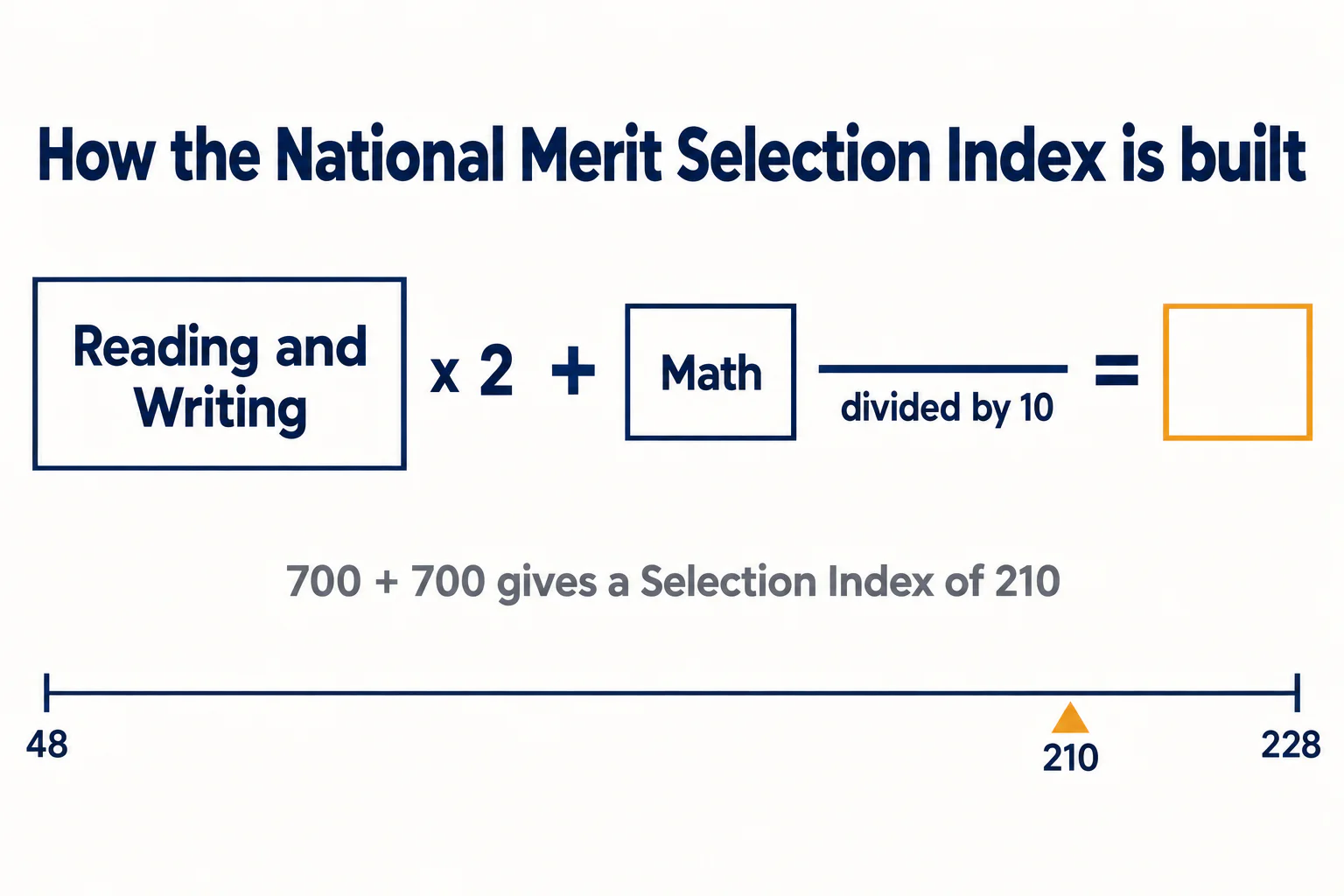
What should you do in the fortnight after scores land?
The report is at its most useful in the two weeks after it arrives, while the test is still fresh enough that you remember which questions hurt. After that it becomes a number you quote.
If you are a junior, the window to act is now
- Check for the asterisk beside the Selection Index before anything else. If it is there, use NMSC's webform.
- Split the total into its two sections and work out which one is costing you Selection Index points, remembering the double weighting.
- Read the question level detail, not the headline. The report identifies which skills lost points, and that is the actual study list.
- Pick a first SAT date. March is the realistic target for a junior starting now, and a serious plan needs roughly twelve weeks.
If you are a sophomore, treat it as a rehearsal
Sophomore PSAT scores do not enter the National Merit competition. NMSC is explicit that a student who takes the test as a sophomore must take it again as a junior if they are spending the usual four years in grades 9 through 12. So the score is pure diagnostic, and the right use of it is to pick two or three skills to build over the next twelve months rather than to celebrate or panic about a number that counts for nothing.
If you want the fuller picture of how the two versions differ, our breakdown of PSAT 10 versus PSAT/NMSQT covers which one your school gave you and what each is for.
How well does a PSAT score predict your SAT score?
Better than most students want to believe, and that is the point of taking it seriously. The PSAT and SAT sit on the same underlying scale, which is why a 1300 PSAT and a 1300 SAT represent roughly the same level of achievement. The difference is the ceiling: the PSAT stops at 1520 because its hardest questions are not as hard as the SAT's.
So the honest reading is this. Your PSAT total is a reasonable estimate of what you would score on the SAT today, with no preparation, and it is the starting line rather than a prediction of the finish. How far that line moves depends on the work between now and test day, and our guide to how long it takes to improve an SAT score sets out realistic timelines by starting point.
Two further pieces are worth reading once you have the number in front of you: the Selection Index explained in full, and what SAT score merit scholarships actually ask for, which is a separate and usually more winnable target than National Merit.
What the PSAT does not do
It does not go to colleges. No admissions office receives a PSAT/NMSQT score, and it has no bearing on an application. That is worth saying plainly because every year students treat a disappointing PSAT as a mark on a permanent record, and it is not one.
It also does not qualify you for anything by itself. National Merit recognition opens a door; the scholarship still requires the application, the essay, the endorsement and a confirming SAT or ACT score. A student who stops preparing after a strong PSAT can lose Finalist standing on the confirming score alone. If you are weighing retakes and superscoring at that stage, how superscore and Score Choice work is the piece to read next.
What to do this week
Find out which of the three release dates applies to your school, because that determines whether you are planning around 22 October or 12 November. The moment the scores appear, check the asterisk, split the total into sections, and read the question level detail while you can still remember the test. Juniors should have an SAT date chosen within a fortnight; sophomores should pick two skills to build and leave the number alone.
A PSAT score is a measurement, and measurements are only useful if something changes afterwards.
Ready to turn a prep plan into real score gains? Catalyst's 1:1 live online SAT programme starts with a free consultation to benchmark your teen's starting point and build a personalised path to their goal score.
Book a Free ConsultationSources checked 13 October 2026: College Board SAT Suite score release dates; National Merit Scholarship Corporation competition steps.