
Ask four people what a good SAT score is and you will get four numbers, all of them confidently stated and none of them wrong. The question only has an answer once you say who is doing the judging. College Board has published its own bar and it is lower than almost anyone expects. Your score report prints a percentile that compares you against a specific group of students. And the colleges on your list publish the range that actually decides anything.
Those three numbers can sit hundreds of points apart for the same student. This post gives you all three, says plainly which one matters for your situation, and shows you how to look up the only figure that counts without trusting a table that went stale two admissions cycles ago.
Key Takeaways
- College Board's readiness benchmarks are 480 for Reading and Writing and 530 for Math, a combined 1010, and meeting them predicts a 75% likelihood of a C or higher in related first-year college courses.
- Your score report shows an All Tester Percentile, based on the last three cohorts of 12th-grade testers worldwide, not the friendlier comparison group older articles quote.
- The number that decides an admissions outcome is the middle 50% range published by each college, found in section C9 of its Common Data Set.
- College Board reports a score range around every score because one sitting is an estimate, so 1290 and 1300 are not meaningfully different.
- Set the target before the studying. A score goal chosen after three months of prep is a rationalisation, not a plan.
What does College Board itself call a good score?
College Board publishes two numbers it calls the College and Career Readiness Benchmarks: 480 for Reading and Writing, and 530 for Math. In its own words, these "predict a 75% likelihood of achieving a C or higher in related first semester, credit-bearing college courses." A student who meets both is described as on track to be college ready.
Add them and you get 1010. That is the organisation that writes the test telling you what a sufficient score looks like, and it lands close to the middle of the testing population rather than anywhere near the top.
Two details matter. The benchmarks are set at section level, so you meet them one section at a time rather than on your total. A 1010 made of 600 Reading and Writing and 410 Math meets one benchmark and misses the other, and that is a different situation from a balanced 1010. And College Board is explicit that benchmarks "shouldn't be used to assign academic tracks, to discourage students from pursuing college, or to keep students from participating in challenging courses."
So the honest version of the first answer is this: if your question is "can I handle first-year college work", 480 and 530 is the published bar. If your question is "will this score get me into the college I want", the benchmarks are almost irrelevant.
Why is the percentile on your report lower than the one you read online?
Here is where a lot of students get quietly misled. Your score report shows an All Tester Percentile, and College Board defines its basis precisely: these percentiles "are based on the actual scores of the past 3 cohorts of students who took the SAT in 12th grade for tests completed anywhere in the world."
That is a comparison against people who actually sat the test, globally, recently. A percentile means what you would expect: if your score is in the 70th percentile, 70% of the comparison group scored at or below you.
Plenty of articles still quote percentile figures drawn from a broader comparison group that includes students who never took the SAT at all. The same score looks better against that group. Neither number is dishonest, but only one of them is printed on your report, and the one on your report is the stricter of the two. If your percentile came in lower than the blog post promised, this is usually why, and nothing has gone wrong.
The online score portal adds more comparisons that the downloadable PDF does not carry: percentile ranks for your country, your state, and all testers, with your score "ranked among SAT testers in the last three years, including all SAT Weekend and SAT School Day administrations." Those are worth a look, because a national percentile and a state percentile can tell noticeably different stories.
Stop treating your score as a single number
This is the part that would change how most students behave, and almost nobody mentions it.
College Board reports a score range alongside every score, and explains why: a student's ability "is better represented by score ranges than points", with the range derived from the standard error of measurement. It shows how much the score would be expected to move if the same student sat the test again without learning anything new.
One sitting is an estimate. It has a margin. Which means the student agonising over the difference between 1290 and 1300 is reading precision into a number that does not have it, and the student who retakes and moves up thirty points has not necessarily improved at all.
Use this practically. Judge progress on a run of practice tests rather than one result, treat a thirty-point swing as noise, and set your target as a band rather than a point.
Not sure where your teen stands? A free consultation with Catalyst Test Prep maps exactly which SAT topics need the most work, so you're never guessing about study time.
Book a Free Consultation →The only number that decides anything
A good SAT score, in the sense that gets a student admitted, is a score inside or above the published range at the colleges they are applying to. Not a national figure. Not a percentile. The range at those specific institutions.
Colleges publish this as the middle 50% range, meaning the 25th and 75th percentile scores of students who actually enrolled. A quarter of admitted students scored below the lower figure, which is the fact that makes the range useful rather than frightening.
Read it like this:
- Above the 75th percentile figure. Your score is doing its job. Spend your remaining effort on the rest of the application.
- Inside the range. Your score is not the thing standing between you and an offer. It is also not an advantage.
- Below the 25th percentile figure. The score is a real gap. That is worth knowing in September rather than in January, because it is still fixable in September.
How to look it up in about ninety seconds
- Search the college's name plus Common Data Set.
- Open the most recent year available.
- Find section C9, which carries SAT and ACT percentiles for enrolled students.
- Write down the 25th and 75th percentile totals, and the section figures if they are listed.
- Repeat for every college on the list, then take the highest 75th percentile figure you find. That is your target.
This takes longer than reading a table someone else assembled, and it is the only version that is current and specific to you. Admissions data moves every cycle. A college's own reporting moves with it.
If your list is score-optional or score-free, the question shifts rather than disappears. Our breakdown of whether SAT scores still matter covers which colleges have reinstated requirements and from which application year, because several announced a change in one cycle that starts in another.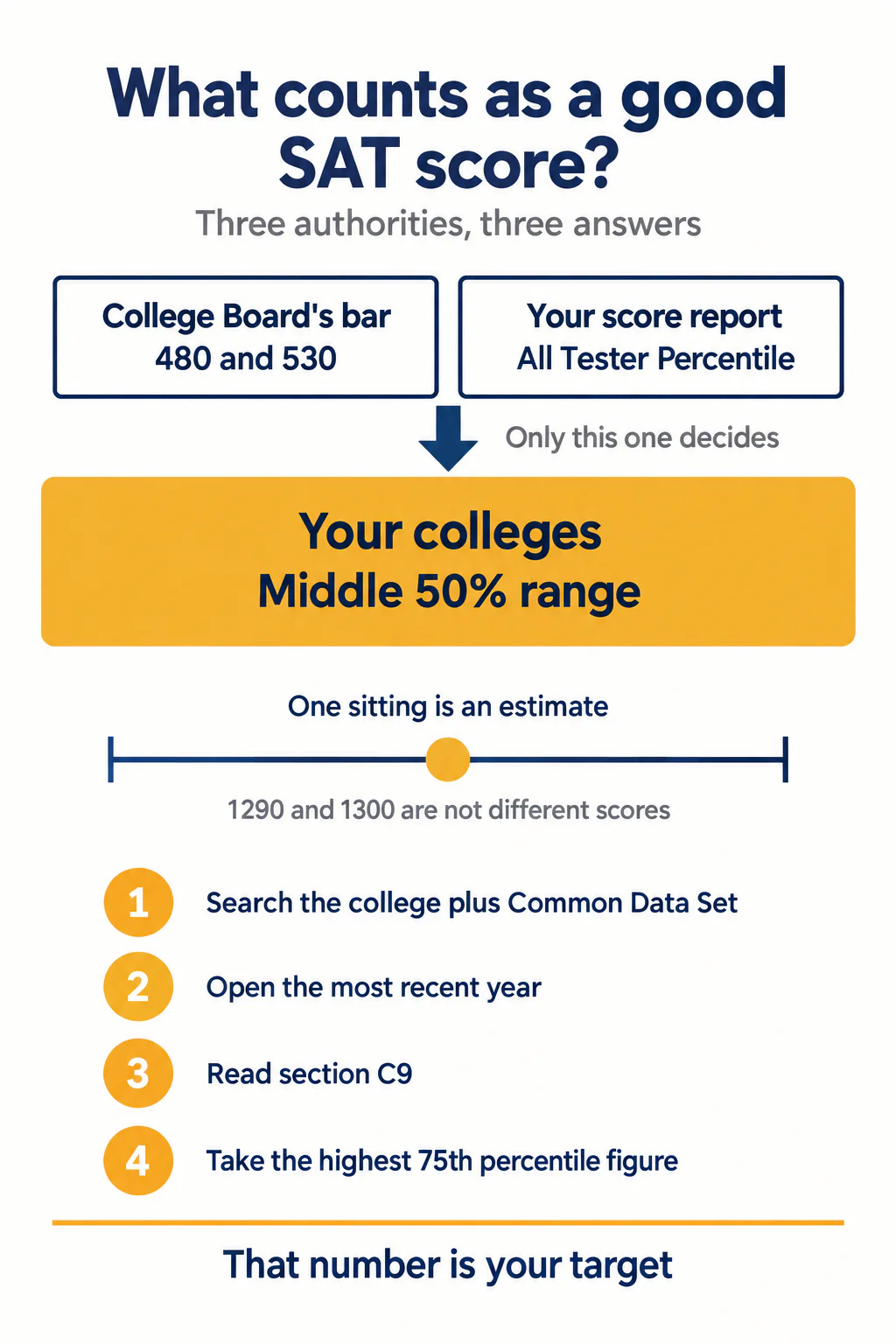
Is a good score the same as an average score?
No, and conflating them causes real damage.
College Board reports an average score for all testers based on the last three years of test takers. That figure describes who sits the test. It is not a goal, and it carries no information about whether a particular student should be satisfied.
A score at the average clears the readiness benchmarks and sits below the published range at most selective colleges simultaneously. Both statements are true at once, which is exactly why "is this a good score" cannot be answered without a college list.
What should you do with a score you are not happy with?
Three things, in this order.
First, check the section split rather than the total. A 1150 made of 640 and 510 and a 1150 made of 570 and 580 need completely different work. The benchmarks are set by section for the same reason.
Second, work out whether a retake is worth it. Scores move most when there is an identified, fixable cause, and least when a student simply sits the test again and hopes. Our guide to reviewing an SAT practice test properly sets out how to separate a content gap from a pacing problem from a careless-error pattern, because all three feel identical when you look at a score and look very different once you look at the questions.
Third, understand how your scores will be reported. Many colleges superscore, taking your highest section results across sittings, which changes the maths of a retake considerably. Our explainer on superscoring and Score Choice covers which policy applies where, and the SAT score calculator will convert a practice-test raw result into a scaled estimate.
One more practical point from College Board's own documentation: when students take the SAT they can choose up to four colleges, universities or scholarship programmes to send scores to. That is a decision with a deadline attached, and it is easier to make once you know your target range.
A good score for a scholarship is a different number again
Merit aid often runs on explicit thresholds rather than ranges, and those thresholds are frequently published more precisely than admissions data. A score that sits comfortably inside a college's middle 50% can still miss an award tier by twenty points, and a score that looks unremarkable for admissions can trigger a substantial award at a less selective institution.
If money is part of the reason you are testing, treat the scholarship threshold as a separate target and look it up separately. Our guide to SAT scores for merit scholarships covers how those tiers tend to be structured and why the published ones are worth hunting down.
Set the target first
The students who make the biggest gains are not usually the ones who study hardest. They are the ones who knew what number they were aiming at before they started, because that number decides how much work is needed, which section deserves the time, and when to stop.
A goal chosen after three months of prep is not a goal. It is whatever the practice tests happened to produce, relabelled as a plan. Pick the colleges, read their ranges, take the highest one, and work backwards from there. If you are starting from a 1200 and the highest figure on your list is 1400, our breakdown of going from 1200 to 1400 sets out what that gap actually requires.
So: a good SAT score is 1010 if you are asking College Board whether you are ready for college, somewhere around the middle of the pack if you are asking the percentile on your report, and whatever the 75th percentile figure is at the most selective college on your list if you are asking the only question with consequences attached. Go and look that last number up. Then you have a target instead of an opinion.
Ready to turn a prep plan into real score gains? Catalyst's 1:1 live online SAT programme starts with a free consultation to benchmark your teen's starting point and build a personalised path to their goal score.
Book a Free ConsultationScore report definitions, readiness benchmarks and score-range guidance in this post come from College Board's Understanding Scores publication for students and families.