

Stanford will read your application without ever receiving an official SAT score. Georgetown will not open it. Both policies are current, both are published on the universities' own websites, and the gap between them decides whether you need to spend anything at all on score reports this autumn. Self-reported SAT scores are now the normal route into a large part of the selective sector, and the rule is set one college at a time rather than nationally.
That matters this week. The 1 November early deadlines are days away and students are deciding what to order from College Board before the window shuts. Read it right and you may pay nothing until the moment you enrol. Read it wrong and you either spend money you never needed to spend, or you miss a requirement that quietly voids an otherwise finished application.
Below are four policies we checked at source on 24 October 2026, the exact phrases to look for on any college's testing page, and the one mistake that can cost an offer after it has already been made.
Key takeaways
- MIT and Stanford both say in their own words that applicants self-report and that official scores are verified on enrolment.
- Princeton and Georgetown both require official reports sent directly from the testing agency.
- Additional SAT score reports cost $15 each through June 2027, and the four free ones expire 9 days after the test date.
- If every college on your list self-reports, the right number of reports to buy now is zero, and the right number after you commit is one.
- Princeton forbids a self-reported SAT and recommends a self-reported AP score, in the same application.
What does self-reporting an SAT score actually mean?
It means you type the numbers into the testing section of the application yourself, and the admissions office reads your file on those numbers alone. No report is ordered, nothing is transmitted by College Board, and nothing is charged. The official report is required later, and only if you are admitted and choose to go.
The distinction people miss is that self-reporting is not a lesser version of sending a score. At a college that allows it, a self-reported 1480 is read exactly as a sent 1480 would be. The verification simply moves to the far end of the process, after you have committed, when there is only one college left to satisfy.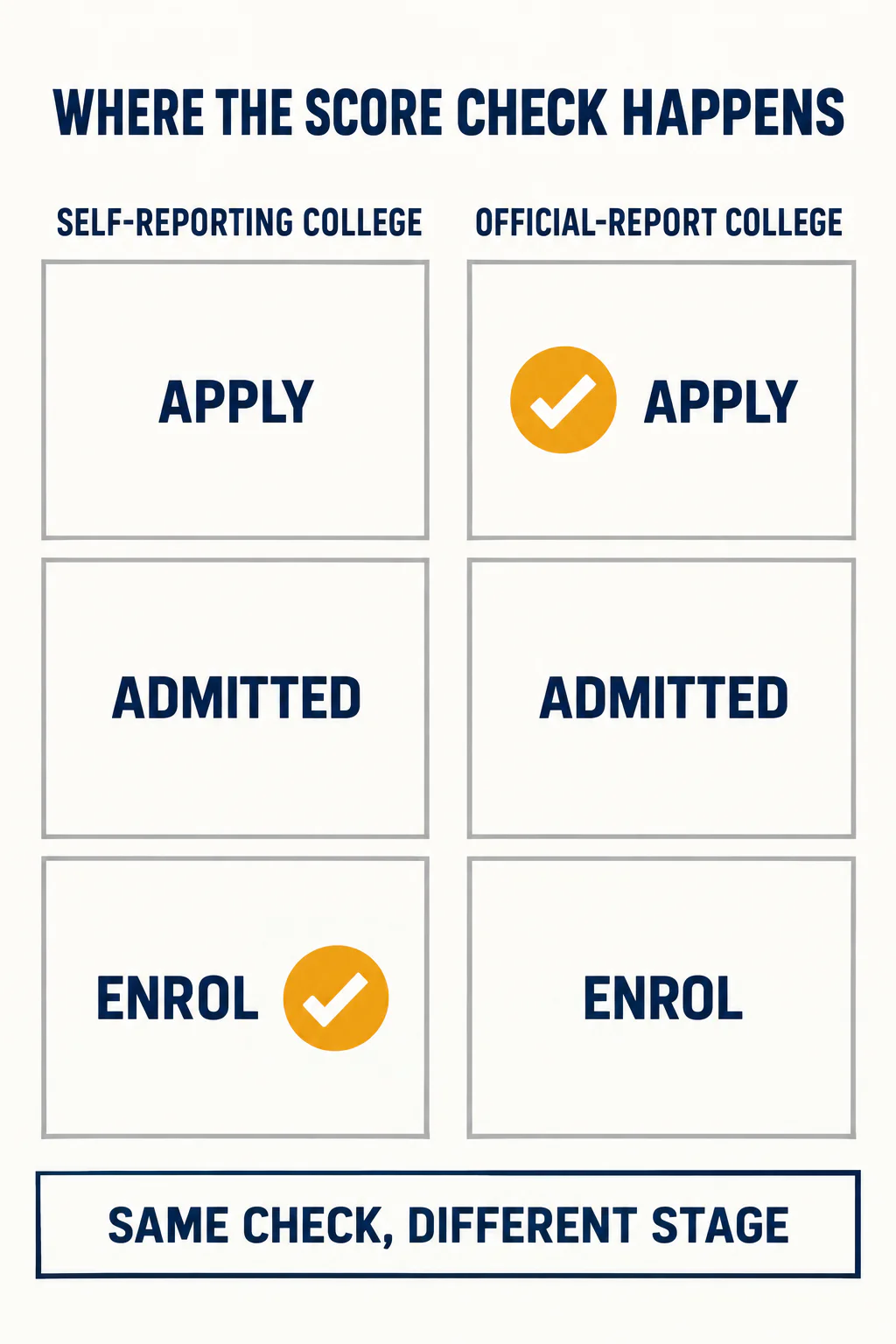
Which colleges accept self-reported SAT scores?
Some do, some do not, and the only reliable source is the college itself. Here are four, quoted from their own admissions pages and checked on 24 October 2026.
| College | Test required? | Self-report allowed? | In their own words |
|---|---|---|---|
| MIT | Required | Yes | "We do not require applicants to officially send their SAT, ACT, or English proficiency test scores as part of their application. Instead, you will self-report your scores on the application, and we'll verify these scores upon enrollment." |
| Stanford | Required | Yes | "You do not need to have official scores sent to Stanford for us to review your application." Official scores are required "if you are offered admission and choose to enroll." |
| Princeton | Test optional for 2026-27 | No | "You must submit your SAT and/or ACT scores to Princeton directly from the testing firms." |
| Georgetown | Required | No | "Georgetown requires submission of official standardized test scores." |
Two things in that table are worth sitting with. The first is that requiring a test and requiring an official report are separate decisions: MIT requires the test and not the report, while Princeton requires the report and not the test. The second is that the two strictest colleges here are not the two most selective. There is no pattern you can reason your way to, which is why the list has to be checked rather than guessed.
We deliberately have not reproduced one of the long "colleges that accept self-reported scores" tables that circulate every autumn. They go stale within a cycle, and a wrong row costs a student either money or an application. Four verified policies and a method beat ninety unverified ones.
Why Princeton treats AP scores and SAT scores differently
Princeton's testing page does two apparently contradictory things on the same screen. It requires SAT and ACT results to arrive "directly from the testing firms", and then it says: "we recommend that you self-report all of your AP or IB scores on your application."
Same applicant, same application, same company issuing both results, opposite rules. The reason is what each score is being used for. An SAT score is comparative evidence inside a selection decision, so the university wants it from the source, unmediated. An AP score is mostly a placement and credit matter that is settled after admission, so an applicant's own account of it is good enough at the application stage and can be checked later.
The practical lesson generalises past Princeton. Do not assume one college has one policy. Read the testing page for the specific test you are reporting, because a page can say "official required" in one paragraph and "self-report" in the next.
How many score reports should you actually buy?
Fewer than you think, and very possibly none this term. College Board's published fees, effective through June 2027, are $68 to register for the SAT and $15 for each additional score report. Four reports are free only if you order them within 9 days of the test date, and a rush report costs $31 on top of the report fee. Students with a fee waiver get unlimited free reports, so none of this applies to them. Our guide to who qualifies for an SAT fee waiver covers that route.
Send nothing yet, if your list self-reports
If every college you are applying to takes self-reported scores, the correct number of reports to order during application season is zero. You will need exactly one, to the one college you eventually attend, after you commit in the spring. That is one report instead of eight or ten.
Order only for the colleges that demand it
Where a college requires an official report, order one for that college and no others. This is the step families most often get wrong, usually by sending to the whole list for consistency. Consistency is not a requirement; each college reads only its own file.
Pay for a rush report only against a hard date
A rush report speeds up dispatch, not scoring, so it cannot beat the score release calendar. It is worth the money only when a college's own score deadline falls inside the standard dispatch window, which is rare. We set out the full mechanics in how to send SAT scores.
Not sure where your teen stands? A free consultation with Catalyst Test Prep maps exactly which SAT topics need the most work, so you're never guessing about study time.
Book a Free Consultation →The mismatch that can cost you a place
Self-reporting is not an honour system with no audit. Every college that allows it verifies the numbers against the official report, and the verification happens after you have turned down your other offers. That is the whole risk in one sentence: the check lands at the worst possible moment to fail it.
Colleges treat a discrepancy as an integrity question rather than a clerical slip, and an offer can be withdrawn over it. The failure mode is almost never deliberate. It is a student typing a superscore where the form asked for a single sitting, mixing up two test dates, or remembering a section score slightly generously six weeks later.
The fix takes two minutes. Open your College Board account, put it beside the application, and copy each number across while looking at it. If you are reporting a superscore, check whether the college asked for one; our explainer on superscoring and Score Choice covers which combinations are allowed to be combined.
How to check any college's policy in one minute
Go to the college's admissions site and find the page called Standardized Testing, Application Requirements, or First-Year Applicants. Then search the page for one of these phrases, because the wording is remarkably consistent across institutions.
- "directly from the testing agency" or "directly from the testing firms" means an official report is required. Order one.
- "self-report" means it is not required at the application stage. Order nothing.
- "upon enrollment" or "if you choose to enroll" tells you when the official report will eventually be needed.
- "we will accept" next to a test name tells you the test is considered, not that a report must be sent.
Do this once per college and write the answer in the same spreadsheet you are using for deadlines. The policy is fixed for the cycle, so the minute you spend now is not repeated. Whether a college considers scores at all is a separate question again, which we track in colleges requiring SAT scores.
The dates that bind this autumn
Three deadlines interact in the next five weeks, and only one of them is set by College Board.
The application deadline, 1 November
Application deadlines come first: 1 November for most early decision and early action rounds, with the restrictive variants on the same date. If you are still choosing between those plans, early decision versus early action sets out what each one commits you to.
The 9-day free report window
The 9-day score report window is next, and it is attached to the test date rather than to any college. For the 7 November SAT, the free report window closes on 16 November, which is before scores release on 20 November. That ordering is not an accident of this one date; it holds across the calendar, and it means "use your free reports" and "wait until you see the score" cannot both be done.
The college's own score deadline, which is usually later
Last come the colleges' own score deadlines, which are often later than the application deadline and are published separately. A college that wants the application on 1 November may accept scores from a November sitting. That is the single most common thing students get wrong in this window, and it is worth one email to the admissions office rather than an assumption either way.
Conclusion
Self-reporting has quietly become the default at a large part of the selective sector, and it changes the arithmetic of application season. The question is no longer how to get your scores to ten colleges. It is which of those ten actually want a report at all, and the answer for many students is none of them until April.
Check each college's testing page against the four phrases above, order reports only where one is demanded, and copy your numbers from the screen rather than from memory. Then put the saved money and the saved attention into the thing that still moves the decision, which is the score itself.
Ready to turn a prep plan into real score gains? Catalyst's 1:1 live online SAT programme starts with a free consultation to benchmark your teen's starting point and build a personalised path to their goal score.
Book a Free ConsultationSources checked 24 October 2026: MIT Admissions, Tests and Scores; Stanford Undergraduate Admission, Testing; Princeton Admission, Standardized Testing; College Board SAT test fees.