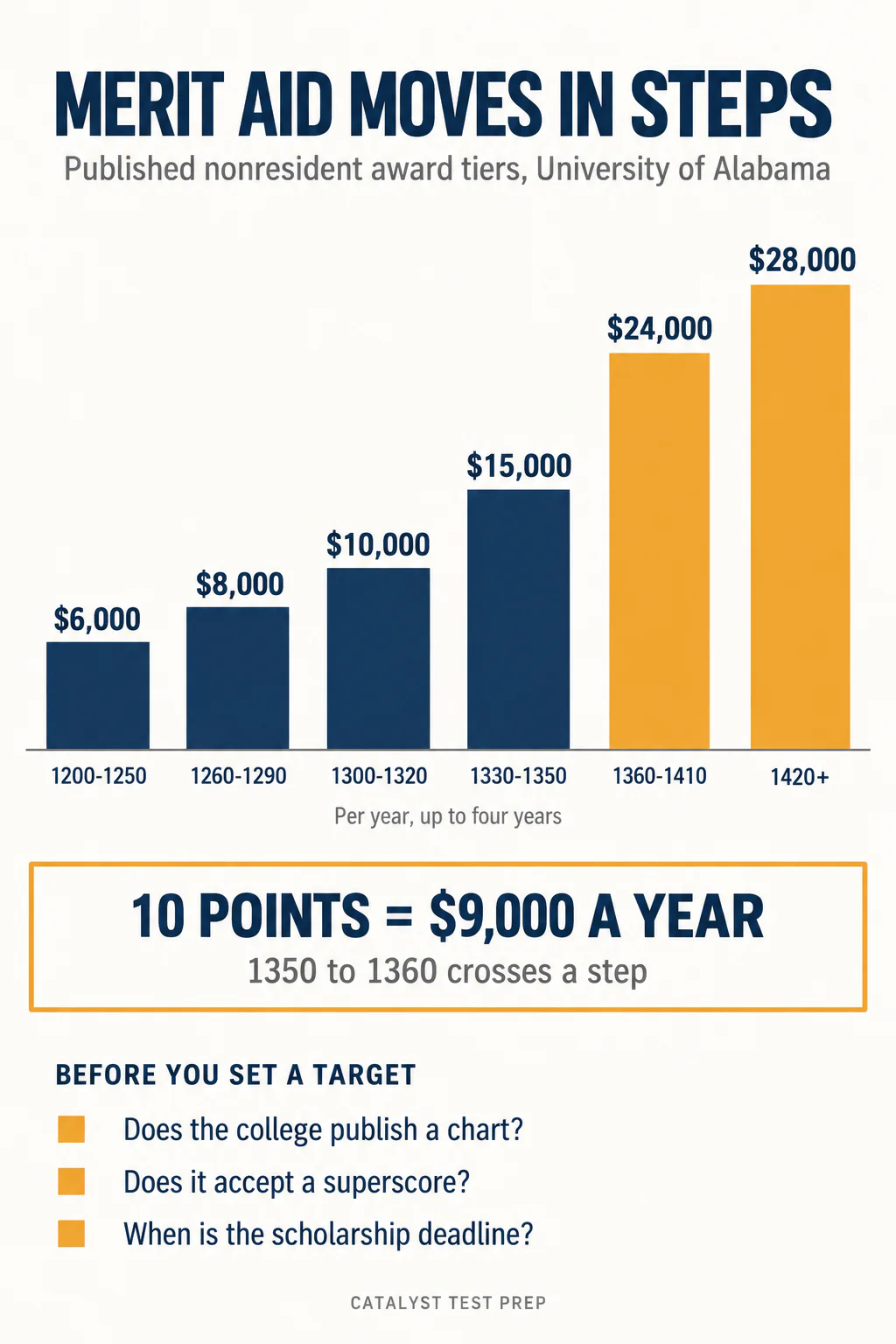
Ten SAT points can be worth $36,000. Not as a motivational figure, but as published policy: at the University of Alabama, a nonresident applicant with a 1350 qualifies for an automatic award of $15,000 a year, and one with a 1360 qualifies for $24,000 a year. Both run up to four years. Nothing else about the two students has to differ. That is the thing most families never get told about the SAT score for merit scholarships: the money does not rise smoothly with the score. It sits in steps, and the whole game is which side of a step your teen lands on.
This is a parent's guide to that mechanism. Which colleges publish thresholds and which do not, why your teen's carefully assembled superscore may be worthless for scholarship purposes, and how to work out whether prep pays for itself on your actual college list rather than in the abstract.
Key takeaways
- Score-based merit aid is stepped, not continuous. Crossing a threshold by one point pays the same as crossing it by fifty.
- Many large public universities publish their full award charts. Most selective private colleges publish nothing and decide holistically.
- Some universities refuse superscores for scholarship purposes, accepting only a total from a single sitting.
- Test-optional applies to admission. It does not automatically apply to every scholarship, and score-based charts require a score.
- Scholarship deadlines frequently fall before admission deadlines, and missing one is unrecoverable.
Two completely different systems, wearing the same name
"Merit scholarship" describes two mechanisms that behave nothing alike. Confusing them is the most common and most expensive mistake families make.
The first is an automatic, published chart. The college states a grid of GPA and test-score bands with dollar values, and if your teen's numbers land in a band, the award follows without a separate application. This is common at large public universities recruiting strong out-of-state students. It is transparent, it is predictable, and it is the only part of college funding you can plan against with any precision.
The second is competitive, holistic merit aid. A committee reads the file, weighs the essays and the activities alongside the numbers, and awards from a limited pool. Selective private colleges work this way. A high SAT helps, but it buys consideration rather than a sum.
If your teen's list is entirely the second kind, no chart in this post applies to them and the honest answer is that no specific number is promised. If even one college on the list is the first kind, a very specific target exists, and it is almost certainly not the round number your teen has in their head.
What a published award chart actually looks like
The University of Alabama publishes one of the clearest in the country. These are its automatic awards for nonresident first-year students, all requiring a 3.50 GPA or above, all renewable up to four years or eight semesters, and none requiring a separate application.
| Scholarship | SAT total | ACT composite | Value per year |
|---|---|---|---|
| Crimson Legends | 1200–1250 | 25–26 | $6,000 |
| Capstone | 1260–1290 | 27 | $8,000 |
| Collegiate | 1300–1320 | 28 | $10,000 |
| Foundation in Excellence | 1330–1350 | 29 | $15,000 |
| UA Scholar | 1360–1410 | 30–31 | $24,000 |
| Presidential | 1420–1600 | 32–36 | $28,000 |
Read down the SAT column and the shape of the thing becomes obvious. Between 1200 and 1320 the awards climb in $2,000 steps. Then the chart changes character: 1330 is worth $15,000, and 1360 is worth $24,000. A student at 1355 and a student at 1360 are, for every practical purpose, identically able. One of them receives $36,000 more across four years.
Alabama also publishes a Presidential Elite award, which carries the value of tuition plus first-year on-campus housing, a $1,500 annual supplemental scholarship and a one-time $2,000 research or study allowance, at a 1600 with a 4.0 GPA. You can read the full nonresident freshman scholarship chart on the university's own site, and you should, because charts change annually and the one above is the version published for the 2027 intake.
Not sure where your teen stands? A free consultation with Catalyst Test Prep maps exactly which SAT topics need the most work, so you're never guessing about study time.
Book a Free Consultation →Why does the superscore your teen worked for sometimes not count?
Because scholarship rules and admissions rules are written separately, and nobody tells you. Alabama's policy is unambiguous: it does not use superscores for scholarship purposes, and accepts only official total scores from a single test date, sent by the testing agency.
Think about what that does to a common strategy. A student sits the SAT three times, ends with a superscore of 1370 built from a strong Math sitting and a strong Reading and Writing sitting, and never once scored above 1340 on a single day. For admission, the 1370 may well be what the college reads. For the automatic scholarship chart, the number is 1340, and the award is $15,000 rather than $24,000.
This is not an argument against superscoring, which is genuinely valuable at the many colleges that use it. It is an argument for finding out which policy applies before planning the testing calendar. Our guide to SAT superscore and Score Choice covers how the two policies interact, and the rule of thumb it produces is simple: if a single-sitting chart is in play, one strong complete test matters more than three partial ones.
Does test-optional mean scholarship-optional?
Sometimes, and you cannot assume it. The policies genuinely differ from one university to the next, which is exactly why this needs checking per college rather than reasoning about in general.
- The University of Missouri reviews test-optional applicants for scholarships holistically, but states that a test score is still required for some awards, including Perfect Score, National Merit and Stamps Scholars.
- The University of Alabama at Birmingham requires no score for admission or merit scholarship consideration for its 2027 intake if the applicant has a 3.5 or higher weighted GPA, but requires a score below that.
- Arizona State does not require scores for scholarship eligibility, while noting that providing them may increase the award.
- Vanderbilt and the University of South Carolina both consider all applicants for merit aid regardless of whether scores were submitted.
The pattern worth extracting: a college can be test-optional for admission and still run score-gated awards underneath. And a published chart is, by definition, unavailable to a student who submits nothing. Going test-optional is a reasonable decision for a student whose score undersells them. It is a costly default for a student whose score sits one band below a threshold they could reach.
How to work out whether prep pays for itself
This is arithmetic, not faith. Four steps, in order.
- Take the college list and sort it. Which of these colleges publish a score-based chart, and which award holistically? Fifteen minutes on each financial aid site settles it. Do this before setting any target score.
- Find the nearest threshold above your teen's current score. Not their goal score. Their most recent real score. The gap between those two numbers is the only one that matters financially.
- Multiply the step by the years. An $8,000 annual step over four years is $32,000. Compare that with the cost of prep and the answer usually stops being ambiguous.
- Check the calendar backwards from the scholarship deadline. Alabama's 2027 scholarship deadlines are 2 November for spring entry and 4 December for summer and fall. Scores have to arrive before that, which means the last useful test date may be earlier than your teen assumes.
Where the gap is 30 to 60 points, it is usually closable within a single testing cycle with focused work, because gains at that scale tend to come from eliminating repeated error types rather than learning new content. Our post on moving from 1200 to 1400 covers what that work actually consists of, and our ROI analysis of test prep runs the wider numbers.
The scholarship route that does not run through the SAT
One correction worth making, because families conflate these constantly. The National Merit programme is decided by the PSAT/NMSQT taken in eleventh grade, not by the SAT. The corporation's own scholarships are modest; the large awards attached to finalist status come from individual universities choosing to offer them.
If your teen is a sophomore or a rising junior, that route is still open and the timing is tight. Our explainer on the National Merit Selection Index covers how the qualifying number is calculated, and it is not the number most families expect.
What to do this week
Pull up the financial aid page for the three colleges on your teen's list that are most likely to be affordable, and find out whether each publishes a chart. If any do, note the band immediately above your teen's current score and the scholarship deadline. That single page of notes will tell you more about what the SAT is worth to your family than any national average will.
Where this leaves you
The SAT score for merit scholarships is not one number, and treating it as one is what costs families money. Score-based awards move in steps, so a target set three points below a threshold is a target set entirely wrong. Some colleges ignore superscores when the money is at stake, which changes how many times it is worth sitting the test. And test-optional policies cover admission far more reliably than they cover scholarships.
Check the charts on your teen's own list, find the nearest step, and aim just past it.
Ready to turn a prep plan into real score gains? Catalyst's 1:1 live online SAT programme starts with a free consultation to benchmark your teen's starting point and build a personalised path to their goal score.
Book a Free Consultation