
Most students who sit SAT School Day never chose to. The school picked a Tuesday in October, sent a letter home, and that was the decision made. Which is fine, because it is the same test. What is not fine is applying weekend SAT advice to it, and that is what almost everybody does.
The two administrations share a test and differ on almost everything around it: who registers you, when you sit, what you can control, and how many days you have to cancel a score. This guide sets the two side by side using College Board's own comparison of the weekend and school day administrations, and says which differences actually change what a student should do.
Key Takeaways
- It is the same digital SAT, same Bluebook app, same adaptive modules, same 400 to 1600 scale.
- Your school registers you and picks the date from a window, not from the published weekend calendar.
- Score cancellation is five days for school day and seven days for weekend. Almost nobody knows this.
- The autumn window runs across school days in October, the spring window across March and April.
- School day and weekend sittings both count, so taking one costs you nothing in attempts at the other.
Is SAT School Day the same test as the weekend SAT?
Yes, in every respect that affects your score. Same digital format, same two adaptive modules per section, same Bluebook application, same scoring scale.
College Board is unambiguous on this point: the SAT taken during a school day is an actual SAT, and whether it is offered is a decision your school makes. Nothing in the test itself is softened, shortened or graded on a different curve. If you want the mechanics of the format itself, our guide to how the digital SAT's adaptive modules work applies identically to both.
One exception is worth flagging early. In a small number of states an essay section forms part of the school day administration. That is not a feature of the weekend SAT anywhere, and it changes the length of the day. Ask your counsellor whether your state is one of them.
What actually differs between the two administrations?
The differences are administrative, and they matter more than students expect because they govern timing and control rather than difficulty.
| SAT School Day | SAT Weekend | |
|---|---|---|
| Who registers you | Your school or district | You, through your College Board account |
| Where you test | Your own school, with school staff | A test centre |
| When | A school day inside an October window, or a March to April window | A published national date you choose |
| Score cancellation | Within 5 days of your test date | By 11:59 p.m. ET one week after test day |
| If something goes wrong | Two retest opportunities in case of an irregularity | You are contacted with your options |
| Who pays | Usually the state or district | You, unless you hold a fee waiver |
Read that table as a trade. You give up control of the date and gain a test you do not have to organise or, in most cases, pay for. For a student juggling a weekend job, a sibling to mind, or a forty-minute drive to the nearest test centre, that trade is heavily in their favour. Those barriers are exactly what the programme exists to remove.
The five day cancellation window is the trap
This is the one thing in this article worth writing down. School day scores can be cancelled within five days of the test date. Weekend scores get seven.
Two days does not sound like much until you notice where those days fall. Sit the test on a Tuesday and your window closes on Sunday, across a weekend when nobody is at school to ask. Every piece of advice a student is likely to find, including ours, is written around the seven day rule, because the weekend SAT is what most people write about. We covered the weekend deadline and why cancelling is almost always the wrong call in the SAT score cancellation deadline, and the reasoning holds here with two fewer days to act.
The reasoning, briefly: scores do not arrive inside either window. You are deciding whether to destroy a result you have not seen, on the strength of how the test felt. Students are poor judges of their own performance on an adaptive test, because a harder second module is evidence you did well in the first, not evidence you are failing.
Not sure where your teen stands? A free consultation with Catalyst Test Prep maps exactly which SAT topics need the most work, so you're never guessing about study time.
Book a Free Consultation →When is SAT School Day held?
Not on a fixed national date. College Board opens windows and schools choose a day inside them: school days across October in the autumn, and school days across March and April in the spring.
The practical effect is that there is no such thing as "the October School Day date". Your school has a date. The school in the next district has a different one. A student who builds a study plan around a nationally published SAT calendar has built it around the wrong day, and by the time they notice, the real date is a fortnight away.
The autumn and spring windows also map onto different year groups. Autumn school day testing is typically aimed at seniors, spring at juniors. If you are a junior sitting in March, your result arrives in good time to plan a weekend retake before applications. If you are a senior sitting in October, you are much closer to the wire, and a retake plan has to exist before you sit rather than after.
Does a school day score look different to colleges?
No. Colleges receive a score, not a story about the room it was earned in.
There is a persistent worry among parents that a school-administered test carries less weight, on the theory that anything the school arranges must be a lesser version. It does not. The score report does not flag the administration in any way an admissions office acts on, and the test that produced it was identical. A 1380 is a 1380.
Where a difference does exist, it runs the other way. Because the school day test is often paid for by the state, students sit it who would otherwise not have taken the SAT at all. That is the programme working as intended, and it is the reason to take it seriously rather than to treat it as a practice run.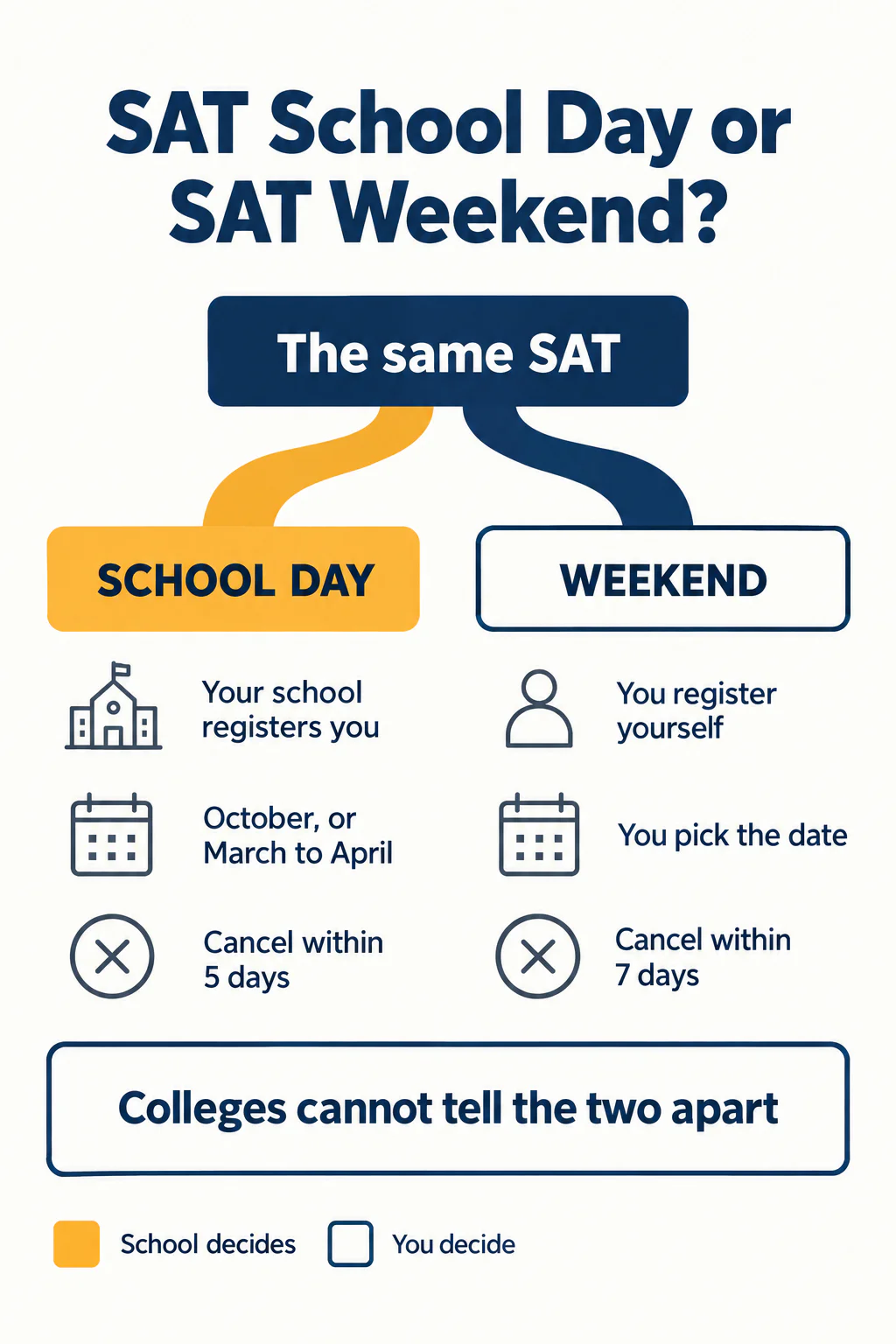
Should you take both?
Usually, yes. They are separate sittings and both count, so a school day test in October does not consume a weekend attempt in December.
That makes the school day test a genuinely free first real attempt for most students, in a familiar building, with no travel and no registration deadline to miss. Treat it as the baseline that a retake is measured against. The score sits in your College Board account alongside every other sitting and feeds superscoring wherever a college allows it, which we work through in SAT superscore and Score Choice.
There is one honest caveat. A test you did not choose to sit tends to be a test you did not prepare for, and an unprepared first attempt sets a baseline that is lower than your real starting point. That does not cost you anything with colleges, because you control which scores you send. It does cost you information, which is the thing a diagnostic is for.
What about fee waivers?
If your school pays, you do not need a waiver to sit the school day test. Claim one anyway if you are eligible, because the registration fee is the smallest thing a waiver covers. Unlimited score sends and college application fee waivers in senior year are worth far more, and they apply regardless of where you sat the test. The full list is in our guide to SAT fee waivers and who qualifies.
How to prepare for a date you did not choose
The preparation problem is different, and it is the part nobody adapts.
A weekend test is a date you selected, presumably with some thought about what else is happening that month. A school day test lands inside term, often in the same fortnight as coursework deadlines, and the date arrives by letter. So the plan has to be built backwards from a fixed point that sits in the middle of a busy term, rather than forwards from whenever you feel ready.
- Get the exact date from the school now, not in September of next year. Everything else depends on it.
- Ask whether an essay is included. In some states it is, and it changes the length of the day and what you practise.
- Sit one full-length practice test at least three weeks out, in Bluebook, timed. Not the week before.
- Plan the weekend retake before you sit, especially as a senior in October. Booking it afterwards is usually too late.
- Diarise the five day cancellation window so the decision is deliberate rather than a panic on day four.
Point four is where seniors lose the most ground. An October school day score that disappoints leaves very little runway, and the December weekend date fills up. Deciding in advance that you will sit it, and cancelling later if the first score is strong, costs nothing but the change fee and buys a month of options.
The case against treating it as a formality
Here is the contrarian point, and it runs against how most schools present the day.
Schools tend to describe the school day SAT in low-stakes language, partly to reduce anxiety and partly because the school is measured on participation rather than on scores. Students hear "everyone is doing it" and prepare accordingly, which is to say not at all. Then the score is real, it is permanent in their College Board account, and for a senior in October it may be the last SAT they ever sit.
The low-stakes framing is about attendance. It was never about the score. A test you did not pay for and did not choose still produces a number that colleges will read, and the students who gain most from the programme are the ones who prepare for it exactly as they would for a Saturday in a strange building.
What to do with this
Three things carry the weight. SAT School Day is the same digital SAT and produces a score colleges read identically, so it deserves real preparation rather than a shrug. The date comes from your school and sits inside a window, not on a national calendar, so the plan has to be built backwards from a date you did not pick. And the cancellation window is five days, not seven.
Both administrations count, and taking one does not spend an attempt at the other. The students who do best out of the programme treat the school day test as a genuine first sitting with a retake already planned, rather than as a school activity that happens to produce a number.
College Board publishes the full side by side in its comparison of SAT Weekend and SAT School Day, and the programme overview sits on its in-school assessments page.
Ready to turn a prep plan into real score gains? Catalyst's 1:1 live online SAT programme starts with a free consultation to benchmark your teen's starting point and build a personalised path to their goal score.
Book a Free Consultation