
Three SAT prep companies, three completely different products, and a price spread of roughly ten to one. The comparison that actually matters is not which is best. It is which one is built for the way your teen will really study between now and test day.
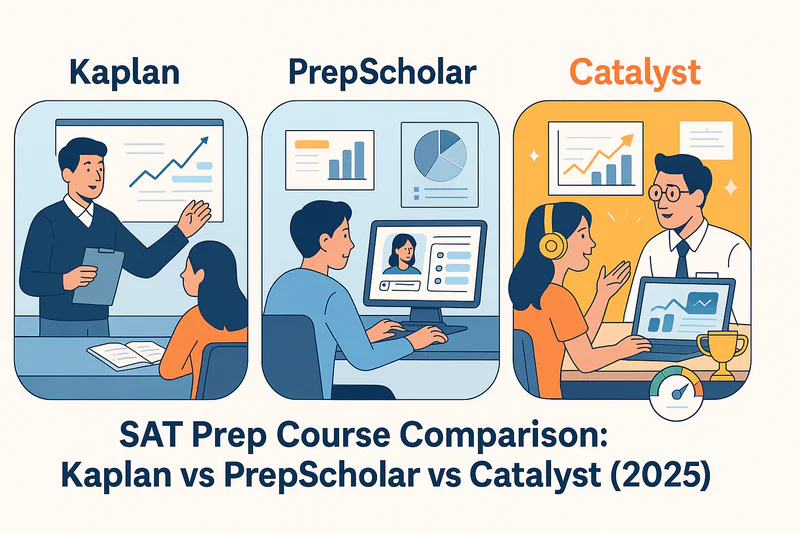
This guide compares Kaplan vs PrepScholar vs Catalyst on the four things that change the outcome: what format you get, who teaches it, what each score guarantee genuinely promises, and what it costs. Every figure here was re-checked in October 2026, and where a number could not be verified against the company that owns it, it is described rather than invented.
Key Takeaways
- PrepScholar is adaptive self-study with the strongest published guarantee: 160 points or a full refund, capped at a 1530 ceiling.
- Kaplan is the broadest range of formats, from on-demand up to unlimited live prep. Its Higher Score Guarantee sets no point threshold.
- Catalyst is 1:1 live teaching with a plan built from a diagnostic, and it guarantees 150 points above your initial test score or your money back.
- The deciding question is not budget. It is whether your teen will do the work with nobody expecting them to.
- Prices move constantly and are discounted often. Treat any comparison table, including this one, as a starting point and check the provider's own page.
What are you actually buying from each one?
These three are not competing products in the way a table implies. They are three different answers to the question of where the structure comes from.
| Kaplan | PrepScholar | Catalyst | |
|---|---|---|---|
| Core format | On-demand, live online classes, bootcamps, tutoring | Adaptive self-paced platform, with live and 1:1 add-ons | 1:1 live online teaching |
| Who sets the pace | A timetable | The algorithm, and your own discipline | The teacher, weekly |
| Plan built from | A fixed syllabus | Diagnostic-driven question selection | A diagnostic, then revised as you go |
| Guarantee | Higher score than your baseline, no point threshold | 160 points or full refund, 1530 ceiling | 150 points above your initial test score, money back |
| Typical spend | Low hundreds to around two thousand | From $397 self-paced | Quoted after the consultation |
That guarantee row is the one most people skim, and it is the row where the three differ most. All three publish a promise, but they promise different things. Kaplan asks only that you beat your own diagnostic baseline, with no minimum. PrepScholar names the largest number, 160 points, and attaches the tightest conditions to it. Catalyst guarantees 150 points above your initial test score, with money back if you do not get there. A smaller headline number than PrepScholar's, measured from a baseline we set with you at the start rather than from an old official score you may not have.
PrepScholar: the strongest guarantee, if you will work alone
PrepScholar's Complete Online SAT Prep is $397, with an AI assistant tier at $495, live instructor-led classes at $895, and 1-on-1 tutoring packages starting around $995 for four hours and rising to roughly $4,795 for thirty-two. Those are the figures PrepScholar publishes itself.
The platform is genuinely good at what it does. It diagnoses weak areas and keeps feeding questions at them, which is more than most self-paced products manage, and the question bank is large enough that a motivated student will not run out.
The guarantee is the real draw and it is worth reading precisely. PrepScholar promises a 160-point increase over a previous official SAT score, or a converted PSAT score, with a full refund if you miss it. The ceiling is 1530: above that, the guarantee does not apply. That is the largest specific published promise in the category, and PrepScholar attaches it to the $397 self-paced tier rather than reserving it for an expensive upsell.
Where it fits best: a self-directed student with a documented baseline score, a few months of runway, and the discipline to open the platform on a Tuesday evening when nobody has asked them to. For that student this is the best value on this page, and it is not close.
Where it struggles: every self-paced product has the same failure mode, which is that it cannot notice avoidance. A platform will keep serving you geometry questions. It will not notice that you have quietly stopped doing them. We go through that trade-off in more detail in whether Khan Academy is enough for the SAT, and the logic applies to any self-study tool.
Kaplan: the widest range of formats
Kaplan's strength is choice. The range runs from a self-paced on-demand course in the low hundreds, through live online classes with scheduled contact hours in the high hundreds, up to an unlimited prep package near two thousand. Kaplan discounts frequently and the published figures move, so check Kaplan's own SAT page for today's number rather than trusting any comparison table.
What a Kaplan live course buys that a platform does not is a timetable. For a large number of students that is the active ingredient. A class at seven on a Wednesday happens whether or not you felt like it, and that single fact separates students who finish a course from students who buy one.
The Higher Score Guarantee needs care. Kaplan establishes a baseline from a diagnostic at the start of the course, and if you do not beat that baseline you can claim a refund or a free repeat, with terms that vary by programme. It sets no point threshold: beating your baseline by ten points satisfies it. That is a weaker promise than PrepScholar's in substance, and it is worth knowing before a guarantee tips your decision.
Where it fits best: a student who needs somebody to expect them on a Wednesday, and whose gaps are broadly typical for their score band.
Not sure where your teen stands? A free consultation with Catalyst Test Prep maps exactly which SAT topics need the most work, so you're never guessing about study time.
Book a Free Consultation →Catalyst: the plan is built after the diagnostic, not before
Catalyst runs 1:1 live online sessions for the Digital SAT and the ACT. The structural difference from the other two is simple and it drives everything else: the course does not exist until the diagnostic has been read.
A pre-built course has to assume an average student, because it was written before anybody enrolled. That is why it can be inexpensive and why it is consistent. It is also why a student who is already strong in Reading and Writing and weak in the algebra domain spends a substantial share of their paid hours being taught things they can already do.
The more uneven the profile, the worse that arithmetic gets. A student twenty points off their target across the board is well served by a group course. A student eighty points off in one domain and on target in the other is paying for coverage they do not need. That is the case 1:1 teaching is actually for, and we work through the economics in 1:1 tutoring versus group classes and what 1:1 SAT tutoring costs.
Catalyst's pricing is quoted after the consultation, because the number of hours depends on the gap. The guarantee is 150 points above your initial test score, or your money back, with the baseline established from the diagnostic at the start of the programme. Confirm the current terms at enrolment before you rely on them.
Which one should you choose?
Three students, three different answers. Find the one you recognise.
- The self-starter with a known baseline. Has sat an official SAT or PSAT, works without supervision, wants maximum value. PrepScholar. The $397 tier plus the 160-point guarantee is the strongest value proposition on this page and nothing here beats it for this student.
- The student with an uneven profile. Strong in one section, well short in another, or stuck at a plateau that a general course has already failed to move. Catalyst. A pre-built syllabus spends its hours in the wrong place for this student, and that is exactly the problem a diagnostic-led 1:1 plan exists to fix.
- The capable student who will not start. Has the ability, does not open the book, has already abandoned one self-paced course. Catalyst, or Kaplan Live if budget is the binding constraint. Both put a human on the other side of a scheduled appointment, which is the active ingredient here. A cheaper platform this student will not use is not the cheaper option.
How to read any SAT prep guarantee
Guarantees sell courses, and almost nobody reads the conditions before buying. Four questions separate a real promise from a marketing line.
- What counts as the baseline? A proctored official score is a far stronger basis than a score from the provider's own first practice test, which has an obvious incentive to run low.
- Is there a point threshold, or just "higher"? Two of the three guarantees on this page name a number, 160 and 150. The third only asks you to beat your baseline, which is a much weaker promise.
- Refund or free repeat? A free repeat of a course that did not work the first time is worth considerably less than money back.
- What must you have completed? Most guarantees require full completion, logged hours, and a claim inside a deadline. A student who did three quarters of the course has usually voided it.
A guarantee is evidence of how a provider's average student performs. It is not a forecast for yours, and it should never be the only reason you pick a course.
What to do next
Sit a full timed practice test before you buy anything. The shape of the gap, not its size, decides which of these three products is right, and you cannot see the shape without a diagnostic. If the gaps are even and your teen is self-directed, PrepScholar at $397 is excellent value. If they need a timetable, Kaplan Live does that job. If the profile is lopsided or a general course has already failed, that is when 1:1 earns its cost.
For a wider view across the market, including the free options, see our comparison of the main SAT prep options and our guide to choosing an SAT prep partner.
Ready to turn a prep plan into real score gains? Catalyst's 1:1 live online SAT programme starts with a free consultation to benchmark your teen's starting point and build a personalised path to their goal score.
Book a Free Consultation