
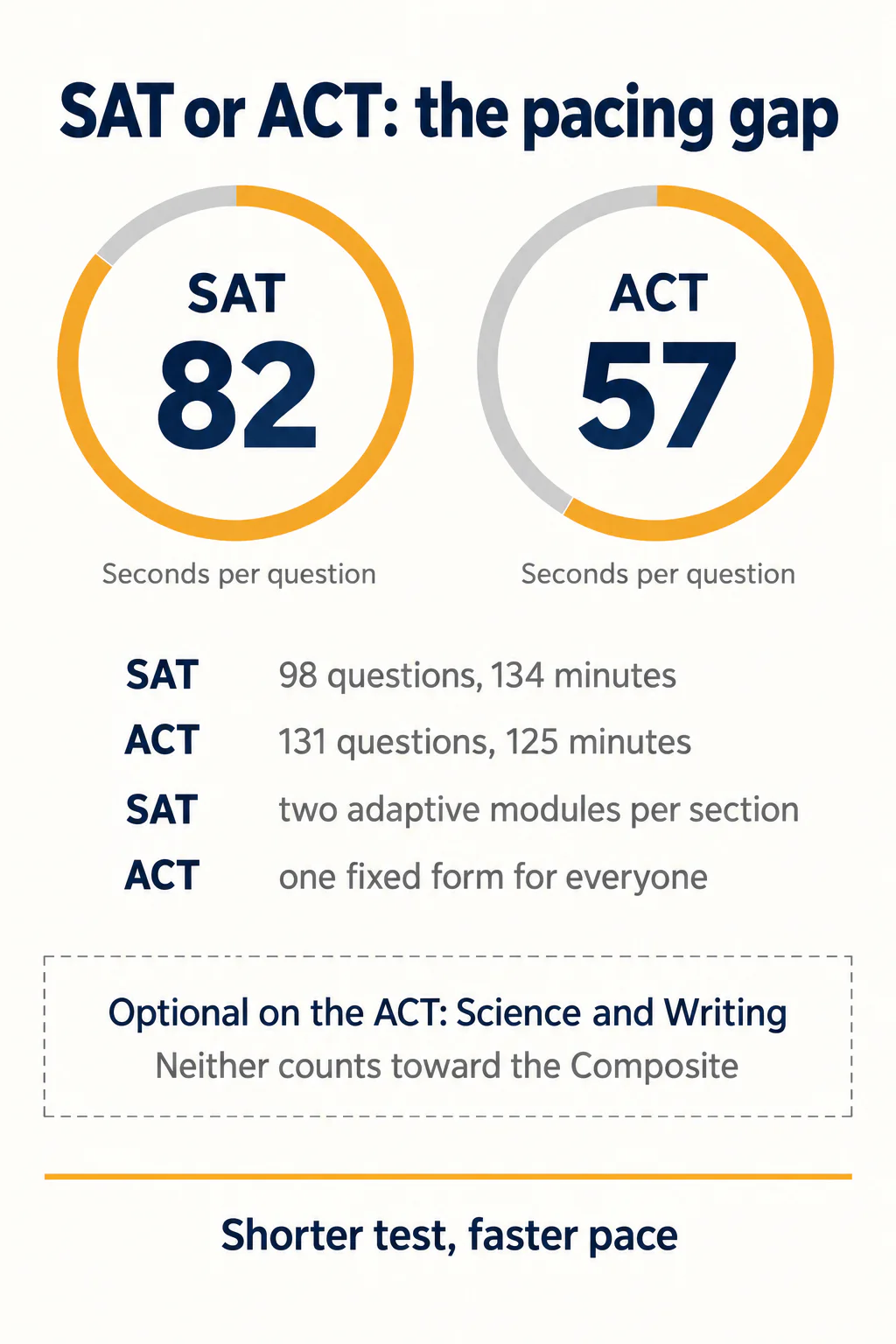
The ACT got shorter. That is the headline every student has heard, and it is true: ACT cut 75 minutes and 44 questions from the test. What almost nobody mentions is that the shorter ACT still asks you to work faster than the SAT does, by a margin of roughly 25 seconds per question. If the SAT or ACT decision is going to be made on one number, that is a better number than total test length.
Here is the comparison built from the two organisations' own published specifications, with the arithmetic done rather than implied.
Key Takeaways
- The digital SAT runs 134 minutes for 98 questions. The required ACT sections run 125 minutes for 131 questions.
- That works out at about 82 seconds per SAT question against 57 on the ACT, so the SAT is the slower-paced test despite being longer.
- ACT science and writing are now optional and do not affect the Composite, which changes the risk calculation on science entirely.
- No US college prefers one test. Admissions offices concord between them, and ACT warns that a concorded score is not a perfect prediction.
- Decide with one timed practice test of each, not with a personality quiz about whether you are a "science person".
What each test now looks like
Start with the specifications, because a surprising amount of advice online still describes formats that no longer exist.
| Digital SAT | Questions | Minutes |
|---|---|---|
| Reading and Writing (two 32-minute modules) | 54 | 64 |
| Math (two 35-minute modules) | 44 | 70 |
| Total | 98 | 134 |
| Enhanced ACT | Questions | Minutes |
|---|---|---|
| English | 50 (40 scored) | 35 |
| Mathematics | 45 (41 scored) | 50 |
| Reading | 36 (27 scored) | 40 |
| Required total | 131 | 125 |
| Science (optional) | 40 (34 scored) | 40 |
| Writing (optional) | 1 essay | 40 |
Two details in that ACT table deserve more attention than they get. First, a meaningful share of ACT questions are unscored field-test items, 23 of the 131 required ones. You cannot tell which, so it changes nothing about strategy, but it does explain why raw-to-scale conversions look odd. Second, ACT math now has four answer choices instead of five, which quietly improves the odds on a genuine guess from 20% to 25%.
Which test gives you more time to think?
The SAT, and it is not close.
| Section | Seconds per question |
|---|---|
| SAT Math | 95 |
| SAT Reading and Writing | 71 |
| ACT Reading | 67 |
| ACT Mathematics | 67 |
| ACT English | 42 |
Those numbers come straight from dividing the official minutes by the official question counts. They are the most useful single comparison in this entire decision, because pace is the variable students cannot bluff. Content gaps can be taught in eight weeks. A student who reads carefully and slowly does not become a fast reader in eight weeks, and ACT English at 42 seconds a question punishes that student relentlessly.
Run the test in reverse too. A student who gets bored, rushes, and makes careless errors often does better under ACT time pressure, because the format leaves no room for second-guessing an answer they had right the first time. If your practice tests show a pattern of changing correct answers to incorrect ones, the faster test may genuinely suit you. Our breakdown of how SAT and ACT reading differ goes further into what that speed difference feels like in the passages themselves.
Not sure where your teen stands? A free consultation with Catalyst Test Prep maps exactly which SAT topics need the most work, so you're never guessing about study time.
Book a Free Consultation →What the optional science section really changed
ACT's own wording is that "the science and writing sections are optional and do not affect your Composite score." The Composite now averages English, math and reading. Opt in to science and you receive a separate science score plus a STEM score.
Most coverage treats this as a reason to skip science. Look at the incentives again. Under the old format a weak science section pulled the Composite down, so avoiding it was defensive. Under the new one science cannot touch the Composite at all, which makes it additive rather than risky. A student targeting engineering or pre-med can add a STEM score to their file with no downside to the headline number.
The real costs of opting in are 40 minutes of stamina and one more section to prepare. That is a genuine cost late in a long test, and it is the reason to say no. "I might do badly at it" is no longer the reason, because badly no longer shows up where it hurts. We looked at this in more detail in what the optional ACT science section means for your score. Before you decide, check the published requirements of the colleges on your list, since a handful of programmes still ask for specific sections.
How the scores compare
The SAT is scored 400 to 1600. The ACT Composite is 1 to 36. The official ACT and College Board concordance lines them up like this:
| ACT Composite | SAT Total |
|---|---|
| 36 | 1590 to 1600 |
| 30 | 1360 to 1380 |
| 20 | 1030 to 1050 |
| 10 | 620 to 640 |
ACT is careful about what this table is for, and so should you be: "A concorded score is not a perfect prediction of how a student would perform on the other test." Concordance compares scores after the fact. It does not forecast a score you have not earned. Students who take one practice SAT, concord it, and conclude they would get the equivalent ACT score without ever sitting one are reasoning backwards.
Both tests superscore, but not identically, and the difference matters if you plan to retake. Read how ACT superscoring works next to SAT superscoring and Score Choice before you commit, because a retake strategy that works on one test can be wasted effort on the other.
Screen or paper, and why it is not a trivial question
The SAT is digital only. You take it in Bluebook, on a laptop or tablet, with a built-in Desmos calculator available on every math question and an on-screen countdown you cannot turn off. The ACT is still offered on paper as well as online at national test centres.
For most students this is a preference. For some it is decisive. If you annotate heavily, underline as you read, and think by scribbling in the margin, paper is doing real cognitive work for you and a screen takes it away. If your handwriting slows you down and you are faster with a keyboard and a highlighter tool, the reverse holds. This is a cheap thing to test: sit one section of each in its native format and notice which one you finished.
The other format difference is adaptivity. The SAT adjusts the second module of each section based on how you did on the first, which means two students can see different questions and the harder set is the better sign. The ACT is a fixed form: everyone sees the same test. Students who find adaptive testing unsettling should know that going in, and our guide to how the digital SAT works explains the routing in full.
How to actually decide, in two weeks
- Sit one full official practice test of each, timed, in the real format. Bluebook for the SAT, a printed or online official form for the ACT. No half sections.
- Concord the two results so you are comparing like with like. Our SAT score calculator and ACT score calculator will do the raw-to-scale part.
- Count what you did not reach. Unanswered questions at the end of a section are the clearest signal in the whole exercise. Whichever test you finished is usually the test you should take.
- Commit. Pick one and prepare for it. The concorded gap has to be large before splitting your preparation across two formats makes sense.
A difference of 20 or 30 concorded points is noise on a single practice test. A difference of 80 points, or a section you ran out of time on twice, is signal.
What to do with this
The SAT and ACT test similar material at similar difficulty, and the interesting differences are structural: pace, format, and what the optional sections now cost you. The SAT gives you more time per question. The ACT is shorter in total, offers paper, and has made its science section a free option rather than a liability.
Pick on evidence. Two timed practice tests and an honest look at what you left blank will tell you more than any comparison article, including this one. If the results come back close, that is when a second opinion earns its keep, because the tie-breaker is usually a pattern in your own answers that is hard to see from the inside.
Ready to turn a prep plan into real score gains? Catalyst's 1:1 live online SAT programme starts with a free consultation to benchmark your teen's starting point and build a personalised path to their goal score.
Book a Free ConsultationSources: ACT, ACT exam sections and structure, The Enhanced ACT Explained and the ACT and SAT concordance; College Board, How the SAT is structured. All checked 24 September 2026.