
Most lists of SAT math formulas make the same mistake. They hand you forty equations and leave you to work out which ones the test already gives you, which is the only question that changes how you should study. The digital SAT provides a reference sheet inside Bluebook, available on every math question, and it is shorter and narrower than almost anyone expects.
Here is the whole of it, taken from College Board's own test materials, followed by the list of formulas that are genuinely absent and therefore genuinely your responsibility. The second list is shorter than the forty you have been handed elsewhere, and it is the one worth your time.
Key Takeaways
- The reference sheet holds ten formulas, two triangle diagrams and three stated facts, and every single item is geometry.
- No algebra is provided. Slope, vertex form, the circle equation, exponent laws and the quadratic formula are all on you.
- Five volume formulas are given and no surface area formulas at all.
- The sheet states that a circle holds 360 degrees and 2π radians of arc, but gives you no arc length or sector formula. You build the proportion.
- The directions confirm figures are drawn to scale, which makes estimating from the diagram a legitimate check rather than a guess.
What is actually on the digital SAT reference sheet?
All of it, grouped the way the sheet groups it.
Area and circumference
- Circle area: A = πr2
- Circle circumference: C = 2πr
- Rectangle area: A = ℓw
- Triangle area: A = ½bh
Right triangles
- Pythagorean theorem: c2 = a2 + b2
- Two labelled special right triangles: the 30-60-90 with sides x, x√3 and 2x, and the 45-45-90 with sides s, s and s√2
Volume
- Rectangular prism: V = ℓwh
- Cylinder: V = πr2h
- Sphere: V = &frac43;πr3
- Cone: V = ⅓πr2h
- Pyramid: V = ⅓ℓwh
Three stated facts, printed as sentences rather than equations:
- "The number of degrees of arc in a circle is 360."
- "The number of radians of arc in a circle is 2π."
- "The sum of the measures in degrees of the angles of a triangle is 180."
That is the complete sheet. Fifteen items, all of them geometric, and you can open it at any moment during either math module.
Why does memorising the sheet waste your time?
Because it is sitting there. A student who drills the volume of a cone has spent that effort on a lookup, and the SAT is not testing lookups.
The useful version of "knowing" the sheet is different and takes about ten minutes. Learn what is on it, so that you recognise within a second or two whether a formula you need is available or whether you have to produce it. That recognition is what saves time under pressure. The retrieval is free.
Try it on yourself. Cone volume: on the sheet. Equation of a circle: not on the sheet. Sector area: not on the sheet. If the second and third answers took you more than a moment, that is the gap worth closing.
The formulas that are genuinely absent
This is the list that matters, and it has an obvious shape to it: the sheet covers geometry, so everything else is yours.
Algebra and functions
- The quadratic formula, plus the discriminant and what its sign tells you
- Vertex form of a parabola and how to read the vertex straight out of it
- Sum and product of the roots of a quadratic
- Factoring patterns, difference of squares in particular
- The laws of exponents, including fractional and negative exponents
- Exponential growth and decay in the form y = a(1 + r)t
Coordinate geometry
- Slope between two points, and slope-intercept form
- Parallel and perpendicular slope relationships
- The distance and midpoint formulas
- The standard equation of a circle, (x − h)2 + (y − k)2 = r2
Trigonometry
- Sine, cosine and tangent as side ratios. The sheet gives you two triangles and no ratios at all.
- The relationship between degrees and radians as a conversion, rather than just the count of each in a circle
Statistics and rates
- Mean, and the fact that the mean times the count gives the total, which is how most average questions are actually solved
- Percent change, and percent increase or decrease as a multiplier
- Probability as a ratio of outcomes
Around a dozen things, depending on how you count. That is a realistic revision list. Forty is not.
Not sure where your teen stands? A free consultation with Catalyst Test Prep maps exactly which SAT topics need the most work, so you're never guessing about study time.
Book a Free Consultation →Two gaps in the sheet that catch students out
Volumes without surface areas
The sheet gives you five volume formulas and not one surface area formula. So a question about the area of a label wrapped round a tin, or the paint needed for a box, has to be assembled from the area formulas higher up the sheet.
A cylinder's surface is two circles and a rectangle whose width is the circumference. Both pieces are on the sheet, and the sheet will not tell you to combine them. Knowing in advance that surface area is a construction job rather than a lookup is most of the battle.
Circle facts without arc length
This one is sharper. The sheet states that a circle contains 360 degrees and 2π radians of arc. It does not give you arc length, and it does not give you sector area.
What it has given you is the raw material for a proportion: the fraction of the full turn that your central angle represents is the same fraction of the circumference, and the same fraction of the area. Students who learned two more formulas are carrying extra load. Students who understand the proportion need nothing beyond what is printed.
The directions nobody reads, and why they matter
Above the reference sheet, every math module carries a short NOTES block. It states that unless otherwise indicated, all variables and expressions represent real numbers, figures provided are drawn to scale, all figures lie in a plane, and the domain of a given function is the set of all real numbers for which the output is real.
The second of those is a strategy, handed to you in the directions and almost universally ignored.
Because figures are to scale, a diagram is evidence. An angle that looks obtuse is obtuse. A side that looks about twice another is about twice another. That will not produce an exact answer, and it will eliminate two wrong choices in five seconds and catch an algebra slip that would otherwise go through. Use it as a check on geometry work rather than as a substitute for it.
The fourth note is quieter and still useful: it tells you the default domain in any function question, which settles a surprising number of "which values are permitted" problems before you start.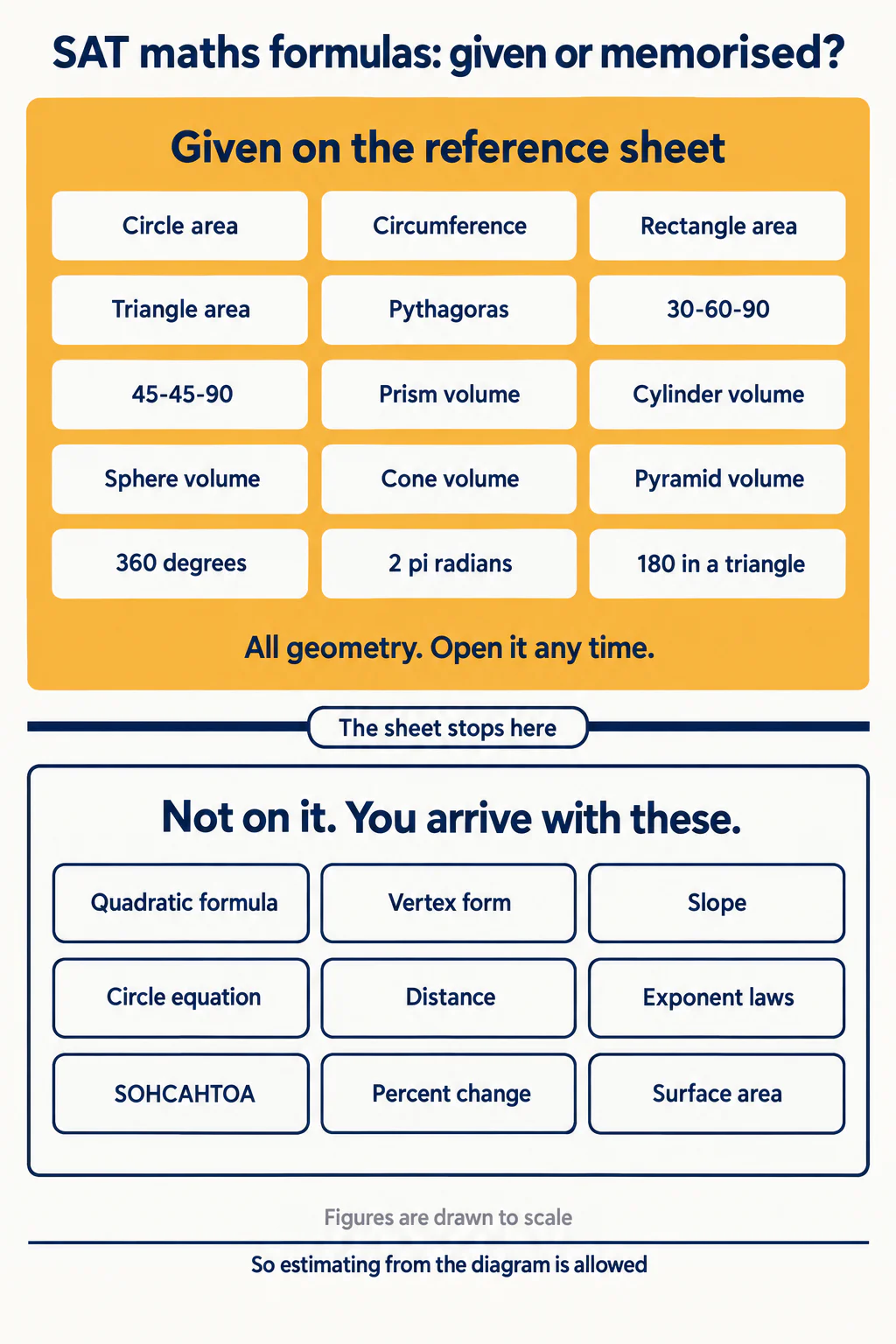
Where the calculator changes the answer
A calculator is permitted on every question in the math section, and Bluebook's built-in graphing calculator changes which formulas you need to recall at all.
A quadratic that will not factor can be graphed and its roots read off. A system of two equations can be graphed and its intersection taken. The vertex of a parabola can be found visually. None of that removes the value of knowing the algebra, and it does mean a forgotten formula is rarely fatal if you are fluent with the tool.
The trade-off is time. Typing an equation carefully is slower than recognising a factorable quadratic. Our guide to using the Desmos calculator on the digital SAT sets out which question types are genuinely faster graphed and which are faster by hand, which is the judgement that decides whether the calculator helps you or costs you.
For the full picture of what the math section covers, our SAT math syllabus breakdown maps every topic area, and our Bluebook walkthrough covers where the reference sheet, the calculator and the other built-in tools actually live on screen. If you have not seen how the two modules interact, the adaptive module explainer is worth ten minutes, because it changes how much an early-module slip costs you.
How to use all of this in the next week
- Read the sheet once, properly. Not to memorise it. To be able to answer "is this on the sheet" instantly for any formula you meet.
- Write out the absent list from memory. Algebra, coordinate geometry, trigonometry, rates. Whatever you cannot produce is this week's revision.
- Do ten geometry questions with the sheet open. You will find you reach for it less than you expected, and that the reaching costs almost nothing.
- Do ten algebra questions and mark every formula you had to recall. That list is short, specific and worth drilling.
- On your next practice test, estimate from one diagram deliberately before solving it, and see whether your estimate and your answer agree. When they disagree, one of them is wrong and you have caught it.
The reference sheet is not generous and it is not stingy. It covers the part of the test where a forgotten constant would be unfair, and it leaves the part the SAT is genuinely assessing to you. Study the second part. Open the first one when you need it.
Ready to turn a prep plan into real score gains? Catalyst's 1:1 live online SAT programme starts with a free consultation to benchmark your teen's starting point and build a personalised path to their goal score.
Book a Free ConsultationThe reference sheet contents and the NOTES block quoted here are transcribed from College Board's own official SAT practice test materials.