Registration for the 3 October SAT closes today, 18 September. If you are reading this outside the United States and that sentence made your stomach drop, the useful thing to know is that the deadline was never your real constraint. Seats were. The SAT for international students is the same test on the same days at the same price of admission to the same universities, but the logistics around it run on a different set of rules, and almost all of the ways it goes wrong are administrative rather than academic.
This guide covers the parts nobody tells you until you are already stuck: what the fees actually total, which identification your country requires, why registering early matters far more abroad than at home, and how to build a testing calendar that survives a cancelled centre.
Key takeaways
- The test is identical worldwide. Only the logistics, the fee and the identification rules differ.
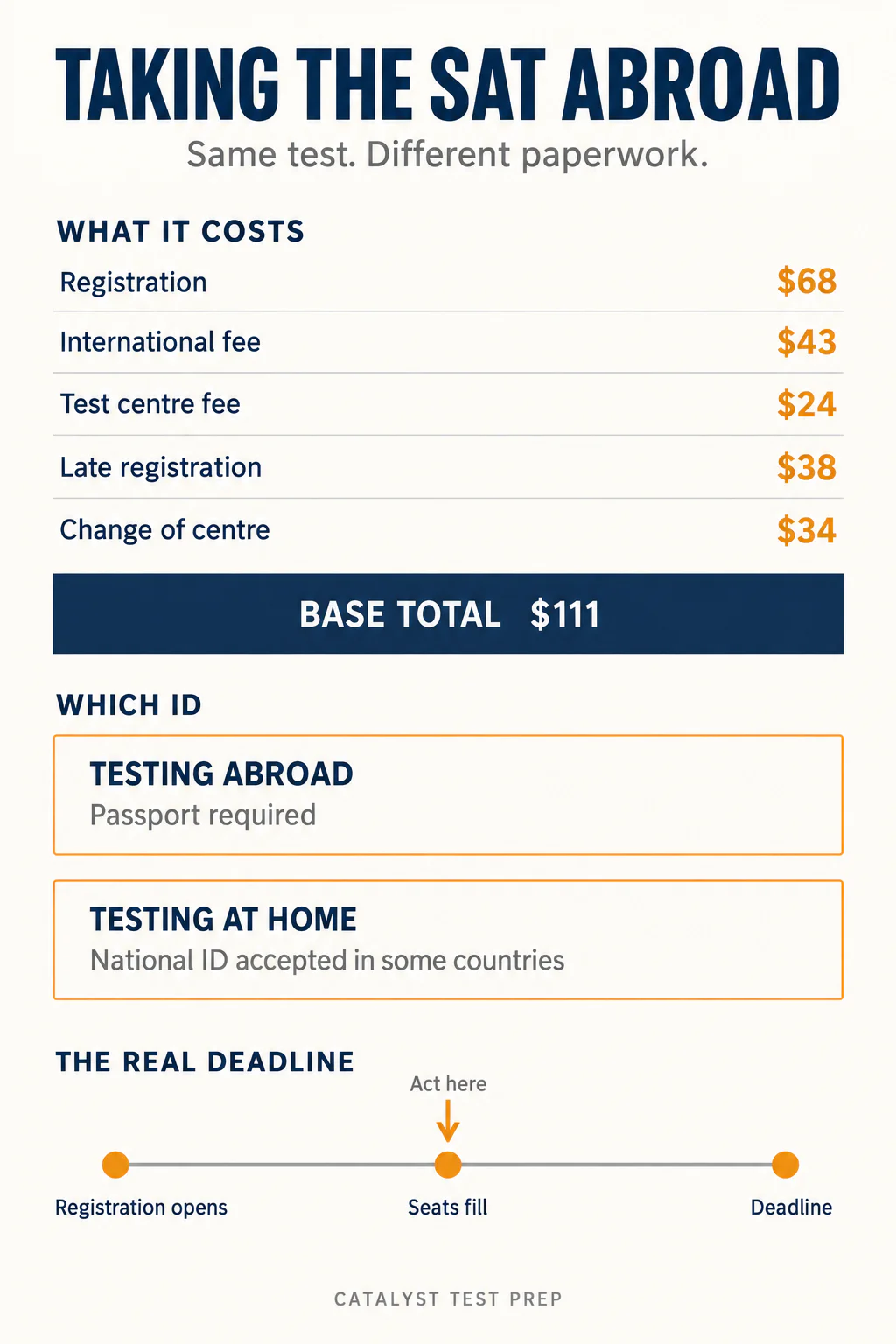
- Budget $111 minimum: $68 registration plus a $43 international fee, before any centre fee or change fee.
- Travel to another country to test and you must use a passport. Several countries accept a national ID only if you test at home.
- Test dates and deadlines are the same worldwide, but seats at individual centres are not, and they run out first.
- Sunday testing is not offered everywhere, and is specifically unavailable in India and Pakistan.
The test is the same. Everything around it is not.
There is no international version of the SAT. You sit the same digital SAT through the same Bluebook application, 98 questions across two adaptive sections in 2 hours 14 minutes, scored on the same 400 to 1600 scale. A 1450 earned in Hanoi means exactly what a 1450 earned in Houston means. If the format is new to you, our guide to the digital SAT covers the structure in full.
What changes is everything surrounding the two and a quarter hours. You pay more. You prove who you are differently. And the single scarcest resource in the whole process is not a test date but a chair in a building near enough to reach on a Saturday morning.
2026-27 test dates and the deadlines that matter
College Board states plainly that its test dates and deadlines "apply to all students, U.S. and international." There is no separate international calendar to hunt down.
| Test date | Registration deadline | Late registration deadline |
|---|---|---|
| 3 October 2026 | 18 September 2026 | 22 September 2026 |
| 7 November 2026 | 23 October 2026 | 27 October 2026 |
| 5 December 2026 | 20 November 2026 | 24 November 2026 |
| 6 March 2027 | 19 February 2027 | 23 February 2027 |
| 1 May 2027 | 16 April 2027 | 20 April 2027 |
| 5 June 2027 | 21 May 2027 | 25 May 2027 |
Late registration is available worldwide for an additional fee, so a missed deadline is recoverable by four days and $38. What is not recoverable is a centre that has already filled. Check the official dates and deadlines page before you plan, because dates for later years are published well in advance and are easy to misread.
Why does registering early matter more outside the US?
Because test centre density is the real difference between testing at home and testing abroad. A student in suburban Ohio has a dozen centres within an hour. A student in Lagos, Ho Chi Minh City or Bogotá may have three in the country, each with a fixed capacity, all serving a rising number of applicants.
The practical consequence is that the registration deadline is a poor guide to when you should act. By the time it arrives, the nearest centres are often full, and the seats still showing are two flights away. Register the week a date opens, not the week it closes. If you are choosing between a slightly less convenient date with a nearby seat and an ideal date with a seat 400 kilometres away, take the nearby seat every time. Test-day fatigue after an overnight journey costs more points than a fortnight of extra revision earns.
One more thing worth knowing: changing your test centre later costs $34, and it only works if a seat exists somewhere else. It is not a safety net.
Not sure where your teen stands? A free consultation with Catalyst Test Prep maps exactly which SAT topics need the most work, so you're never guessing about study time.
Book a Free Consultation →What it actually costs
The advertised number is not the number. Here is the full published fee schedule for international testing.
| Item | Fee |
|---|---|
| SAT registration | $68 |
| International fee | $43 |
| Test centre fee (select locations) | $24 |
| Late registration | $38 |
| Change of test centre | $34 |
| Cancellation | $34 |
| Late cancellation | $44 |
| Additional score report | $15 each |
| Rush score report | $31 |
The base is $111. A student who registers late, at a centre carrying the additional fee, and then has to move centres, pays $207 for one sitting before a single travel cost. That is not an unusual sequence; it is the standard result of leaving registration until the deadline.
Two savings worth claiming. Your first four score reports are free if you order them within nine days of the test date, so decide your college list before results arrive rather than paying $15 a report afterwards. And if you are planning multiple sittings, read our guide to superscoring and Score Choice first, because the answer to "how many times should I sit this" changes the budget considerably.
Which ID will they accept?
The rule turns on whether you are testing in your own country or travelling to another one. College Board is unambiguous about the travelling case: "If you travel to another country to test, you must use a valid passport as your ID."
If you are testing in the country where you live, several countries permit an alternative:
- India: a valid passport, or a valid Aadhaar PVC card showing your name and photograph. The physical PVC card only.
- Jordan, Korea, Thailand, the UAE and Vietnam: a valid national ID card from the country where you are testing, or a valid passport from any country.
- Ghana and Nigeria: country-specific national ID cards are accepted alongside passports.
- Hong Kong: government-issued photo ID only. School IDs are not accepted.
Check your own country against College Board's ID requirements before registering, not the night before the test. A passport application takes weeks in most countries, and no proctor has discretion on this point. The name on your ID must match your registration exactly.
Country-specific rules people find out too late
Three that catch students out every year.
- Hong Kong registration runs through a third party. Applicants register through the Hong Kong Examinations and Assessment Authority, and College Board specifically asks students not to contact test centres directly.
- Sunday testing is not universal. It exists for students who cannot test on a Saturday for religious reasons, but College Board states it is unavailable in India and Pakistan. If you need it, confirm before you build a plan around a date.
- Sanctions can block a registration outright. College Board states it is prohibited from providing testing services to or accepting registrations from sanctioned persons without specific authorisation, and that registrations or payments may be blocked and cancelled without a refund. This affects a small number of students, but for those it affects, it is absolute.
Building a calendar that survives a surprise
Work backwards from your earliest application deadline and leave one spare sitting in the plan. The standard international mistake is to target a single date late in the cycle, which leaves no room for a cancelled centre, a visa delay or an illness.
A workable shape for a student applying in autumn 2027 looks like this: a diagnostic now, focused preparation through the winter, a first real sitting in March or May 2027, then a retake in August or October 2027 if the first score sits below target. That leaves two chances before most deadlines and avoids the December scramble entirely. Our SAT prep timeline maps the whole cycle, and the three-month prep plan fits neatly into a single school term.
One adjustment specific to testing abroad: because each sitting costs more and may involve travel, the economics favour fewer, better-prepared attempts. A student in Ohio can afford to treat an early sitting as reconnaissance. A student flying to a neighbouring country cannot. Prepare as though you get two attempts, because in practice you do.
What does not change
Admissions officers do not discount a score because of where it was earned, and there is no separate international curve. The content, the adaptive routing and the scoring are identical. Everything in this guide is logistics, and logistics are solvable by a calendar and a passport application. The score is solved by preparation, and that part works exactly the same wherever you sit.
Where this leaves you
The SAT for international students is the same exam with a heavier administrative tail. Budget $111 as a floor and assume a centre fee. Sort your identification now rather than in the week of the test, because a passport cannot be produced at short notice. And treat the registration deadline as the last possible date rather than the right one, because the seat, not the date, is what runs out.
Pick your two target dates, register for the first one this week, and spend the saved anxiety on practice instead.
Ready to turn a prep plan into real score gains? Catalyst's 1:1 live online SAT programme starts with a free consultation to benchmark your teen's starting point and build a personalised path to their goal score.
Book a Free Consultation