
An SAT fee waiver is worth considerably more than the $68 it saves on test day. Most families hear "free SAT" and stop reading there, which is how thousands of dollars in score reports and college application fee waivers go unclaimed every year. The test fee is the smallest benefit in the package.
This guide covers exactly who qualifies for an SAT fee waiver in 2026, every benefit it carries, what each one is worth in dollars, and the three mistakes that quietly waste it. Every figure here comes from College Board's own fee and fee waiver pages, checked this week.
Key Takeaways
- One fee waiver code covers two free SAT tests, not one, even though the code is redeemed once per lifetime.
- Eligibility is limited to 11th and 12th graders, so a sophomore sitting the SAT early pays full price.
- Unlimited score reports are the hidden value: without a waiver you get four free within nine days, then pay $15 each.
- Six separate routes qualify a student, and families routinely miss the ones that are not about income directly.
- The waiver covers the SAT only. AP exams and the ACT run entirely separate reduction programs.
What does an SAT fee waiver actually cover?
An SAT fee waiver covers two free SAT registrations, unlimited score reports to colleges, free CSS Profile applications, and college application fee waivers at participating colleges once the student is a senior. It also removes late registration and cancellation charges on the covered tests.
Here is the full benefit list as College Board states it on its fee waiver benefits page:
- Two free SAT tests.
- Unlimited score reports to send to colleges.
- Waived application fees at participating colleges, for seniors who have taken the SAT.
- Free CSS Profile applications for financial aid.
- No international fees on the free tests, for US students testing abroad.
- No late registration fees on the free tests.
- No cancellation fees, and unused benefits are returned to you when you cancel.
- Reduced fees for score verification reports.
Read that third line again. The college application fee waivers are a separate benefit that opens up in senior year, and at institutions charging $70 to $90 per application, a student applying to eight colleges is looking at a larger saving than the test fees ever were.
What is an SAT fee waiver worth in dollars?
Between roughly $250 and well over $800, depending on how many score reports the student sends and how many colleges they apply to. The test fees are the floor, not the ceiling.
College Board's published test fee schedule gives the arithmetic:
| Charge | Standard fee | With a fee waiver |
|---|---|---|
| SAT registration | $68 each | $0 for two tests |
| Late registration | $38 | $0 on covered tests |
| Change test center | $34 | Reduced or waived |
| Cancellation | $34 or $44 | $0, benefits returned |
| Score reports beyond the first four | $15 each | Unlimited, $0 |
| Rush score report | $31 | Reduced |
| Score verification | $55 | Reduced |
| Archived scores | $35 | Standard |
Two SATs alone come to $136. A student sending twelve score reports pays $120 out of pocket without a waiver, because only the first four are free and only if ordered within nine days of the test. Add one late registration and one test center change and you are past $220 before anyone has applied anywhere.
Not sure where your teen stands? A free consultation with Catalyst Test Prep maps exactly which SAT topics need the most work, so you're never guessing about study time.
Book a Free Consultation →Who qualifies for an SAT fee waiver?
SAT fee waivers are available to low-income 11th and 12th grade students in the United States and its territories, and to US citizens living abroad. A student qualifies by meeting any one of six conditions, not all of them.
College Board's eligibility page lists these routes:
- The student participates in the federal National School Lunch Program.
- Household income falls within the USDA's Income Eligibility Guidelines.
- The student is enrolled in a federal, state or local program serving students from low-income families, such as a TRIO program like Upward Bound.
- The family receives public assistance.
- The student is unhoused, lives in federally subsidized public housing, or lives in state-arranged care.
- The student is a ward of the state or an orphan.
Routes three and four are the ones families miss. A student already enrolled in Upward Bound is eligible on that basis alone, with no income calculation required. Parents who would never describe themselves as low income sometimes qualify through a benefit the household already receives.
Why the grade restriction matters more than it sounds
Waivers start in 11th grade. Sophomores pay the full $68. That single rule should shape when your teen first sits the SAT, because a 10th grade attempt is a $68 test that the waiver would have covered for free six months later. If the goal of an early attempt is a baseline, a proctored practice test achieves the same thing at no cost, and our guide to when to start SAT prep sets out the timeline that works.
How do you get an SAT fee waiver?
Through your school counselor, in almost every case. There is no public application a student can submit on their own, which is the single biggest reason eligible students go without one.
- Ask the counselor directly. Use the phrase "SAT fee waiver" and name which of the six routes applies. Counselors process these constantly, but they do not chase students.
- Get the benefits attached to the College Board account, not just handed over as a code on paper. Benefits applied to the account survive a lost printout.
- Register while the waiver is live, before the regular deadline where possible, so the late registration benefit stays in reserve.
- Check the account shows two tests remaining after the first registration. This is the step that catches the "I thought I had used it" error.
The three mistakes that waste a fee waiver
Treating one test as the whole benefit. The code redeems once per lifetime, and that phrasing on College Board's main fee waiver page leads students to believe the benefit is spent after one sitting. It is not. Two tests are covered. A student who sits once, scores below target, and then decides they cannot afford a retake has thrown away a free attempt. Our guide to retaking the SAT strategically covers what to do between the two.
Sending only four score reports. Without a waiver, four free reports is the ceiling and students ration accordingly. With a waiver it is unlimited, so the correct number is every college on the list plus the ones under consideration. Students carry the rationing habit across from the standard rules and send four anyway.
Forgetting the senior-year half. The application fee waivers and free CSS Profile only become relevant in the autumn of senior year, roughly eighteen months after the waiver was first issued. By then most families have stopped thinking about it. Write it down somewhere you will find it in October of senior year.
Does the waiver cover AP exams or the ACT?
No. The SAT fee waiver covers the SAT and SAT-related score services only. AP exams and the ACT each run their own separate reduction program with its own paperwork.
AP exam fee reductions are handled by College Board but applied through the school's AP coordinator, on a different timetable with different deadlines. We set out how that calendar works in our guide to AP exam registration deadlines and fees. The ACT operates an entirely independent fee waiver program administered by ACT, not College Board, so a student taking both tests needs both applications. Counselors will not always prompt for the second one.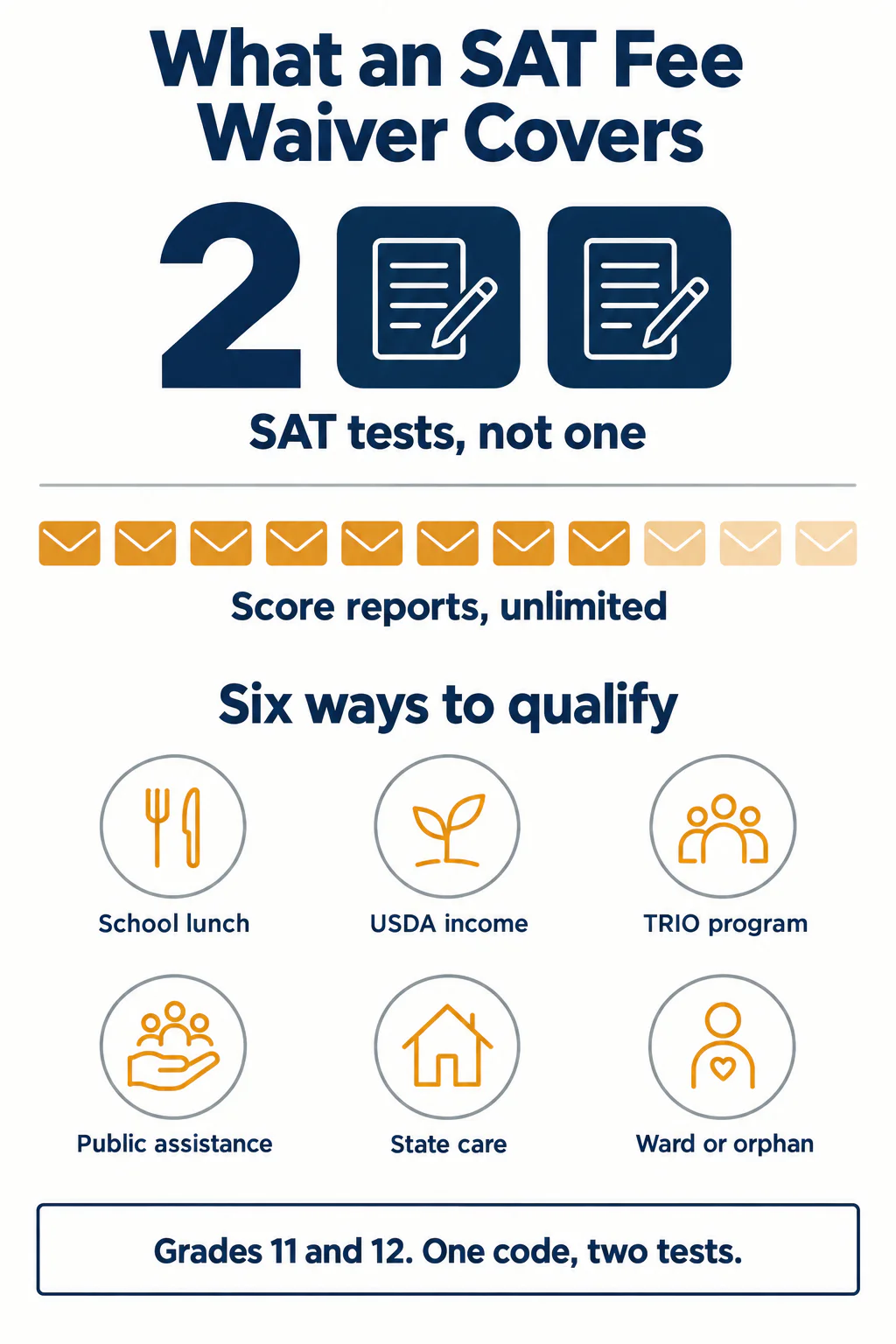
What a waiver does not fix
Here is the part nobody selling test prep usually says out loud, and it matters. A fee waiver removes the cost of sitting the SAT. It does absolutely nothing about the score.
Two free attempts with no plan in between produce two similar scores. The research on repeat testing is unglamorous: students who retake without changing how they prepare tend to move a modest amount, mostly from familiarity with the format rather than from any gain in skill. The free second attempt is only valuable if something changes between the two, and what changes has to be identified from the first score report rather than guessed at. Our breakdown of how long score improvement actually takes is the honest version of that timeline.
This is also why the score report benefit deserves more attention than it gets. Unlimited reports mean a student can apply more broadly, and applying more broadly is a better use of a strong score than sending it to four colleges chosen too early. If your teen's score is in the range where merit money comes into play, our guide to the SAT score you need for a merit scholarship shows which thresholds matter.
Planning around two free tests
The waiver gives a junior two attempts. Used well, that is a genuine advantage over a classmate paying $136 out of pocket and therefore rationing to one sitting.
The pattern that works: sit the first test early enough in junior year that the score report arrives with time to act on it, spend the gap working the specific weaknesses the report names, then sit the second test with a target rather than a hope. Scores arrive thirteen days after each weekend test date, so the calendar is tighter than most families assume. Our breakdown of when SAT scores come out has every 2026 release date.
The wrong pattern is sitting both tests close together in senior autumn because the deadline forced it. At that point the second attempt is not a second chance, it is a repeat under worse conditions.
The short version
An SAT fee waiver is a junior-and-senior benefit worth two free tests, unlimited score reports, free CSS Profile applications and college application fee waivers in senior year. Six separate routes qualify a student, and only one of them has to apply. The route families overlook is not income at all, it is enrolment in a program like Upward Bound or receipt of public assistance the household already has.
Ask the counselor. Confirm two tests are showing. Send every score report, not four. And put a note in the calendar for October of senior year, because the application fee waivers are the half everybody forgets.
Ready to turn a prep plan into real score gains? Catalyst's 1:1 live online SAT programme starts with a free consultation to benchmark your teen's starting point and build a personalised path to their goal score.
Book a Free Consultation