Yesterday, September 18, was the last day to request accommodations for the November 7, 2026 SAT. Anyone starting that paperwork today is already working toward December. That gap between what parents assume and how the calendar actually works is the single most expensive misunderstanding in this process, because SAT accommodations run on their own deadlines, weeks ahead of registration, and missing one does not cost you a form. It costs you a test date.
College Board says approval can take up to seven weeks, and longer if it comes back asking for more documentation. Most families discover this in Grade 11, after a practice test where their teen answered accurately and ran out of time. This guide covers who qualifies, what extra time actually looks like on the digital SAT, the 2026-27 deadlines in full, and the one decision that saves families the most trouble.
Key Takeaways
- Approval can take seven weeks, and another seven if documentation is requested or the request is resubmitted. Budget four months, not four weeks.
- The accommodations deadline is earlier than the registration deadline. For the December 5, 2026 SAT it is October 16, 2026.
- Fifty percent extra time turns the digital SAT into 96 minutes of Reading and Writing plus 106 minutes of Math: three hours and twenty-two minutes of testing, plus breaks.
- Extended time approved for reading applies to every section that requires reading, which on the SAT is both of them.
- An approval carries across the PSAT 8/9, PSAT/NMSQT, PSAT 10, SAT and AP Exams. Request it once, early, and it is settled for the rest of school.
What are SAT accommodations, and who qualifies?
SAT accommodations are changes to testing conditions for students whose documented disability makes standard conditions an unfair measure of what they know. Extended time is the best known. The category also covers extra or extended breaks, a reader or scribe, assistive technology, large print, and permission to test over more than one day.
Eligibility is decided by College Board's Services for Students with Disabilities office, usually through your school's SSD coordinator. A diagnosis on its own does not decide it. What decides it is whether the documentation shows a functional limitation on the specific thing the test asks a student to do. A teenager with an ADHD diagnosis who finishes every timed assignment in class has a weaker case than one whose teachers can describe, in writing, work left unfinished under time pressure.
Two practical consequences follow. First, the school is your route in, not a side channel: the coordinator submits the request and holds the documentation. Second, an existing IEP or 504 plan helps but does not transfer automatically. College Board runs its own review.
The deadline that binds is not the registration deadline
Every weekend SAT has two separate clocks. Registration closes a few weeks before test day. The accommodations deadline sits considerably earlier, and it is the one that removes options. Here is the published 2026-27 set.
| SAT test date | Accommodations request deadline | Status as of 19 September 2026 |
|---|---|---|
| October 3, 2026 | August 14, 2026 | Closed |
| November 7, 2026 | September 18, 2026 | Closed yesterday |
| December 5, 2026 | October 16, 2026 | Open, 27 days left |
| March 6, 2027 | January 15, 2027 | Open |
| May 1, 2027 | March 12, 2027 | Open |
| June 5, 2027 | April 16, 2027 | Open |
Fall in-school testing works on weekly windows with their own deadlines, all of which have now passed for October 2026. Spring 2027 in-school testing, which includes the PSAT 10, opens with a January 11, 2027 deadline for the first week of March. The 2027 AP Exams in May carry a single deadline of January 22, 2027. You can check any of these against College Board's accommodations dates and deadlines page, which is the only version that is guaranteed current.
How long does approval actually take?
Up to seven weeks from a complete submission. If College Board asks for additional documentation, or the request has to be resubmitted, approval can take another seven weeks on top. That is the number to plan around, not the first one.
Work backwards from the December 5 SAT. A request submitted on October 16, the last legal day, could still be in review in early December. A request submitted this week has slack for one round of follow-up questions. Same test, same paperwork, completely different risk, and the only variable is when you started.
Not sure where your teen stands? A free consultation with Catalyst Test Prep maps exactly which SAT topics need the most work, so you're never guessing about study time.
Book a Free Consultation →Extended time on the digital SAT, section by section
The standard digital SAT gives 64 minutes for Reading and Writing and 70 minutes for Math. Extended time is granted as time and one-half, as double time, or in rare cases more. The published totals look like this.
| Approval | Reading and Writing | Math | Total testing time |
|---|---|---|---|
| Standard | 64 minutes | 70 minutes | 2 hours 14 minutes |
| Time and one-half | 96 minutes | 106 minutes | 3 hours 22 minutes, plus breaks |
| Double time | 128 minutes | 140 minutes | 4 hours 28 minutes, plus breaks |
Read the right-hand column again, because it is the part nobody prepares for. Double time is most of a school day in a testing chair. Extra breaks come with it automatically on the SAT Suite, but stamina becomes a real variable, and a student who has only ever practised in 64-minute blocks will not know what hour four feels like. If your teen is approved for double time, at least one full-length practice run at the real length is not optional.
One approval that quietly changes every section
Extended time can be requested for particular areas: reading, math, writing, listening and speaking. The rule that surprises people is that students approved for extended time in reading receive extended time for all test sections that require reading. On the digital SAT, that is both sections. Math questions are read.
So a request framed around reading speed produces extra time in Math as well, whether or not anyone asked for it. That is usually welcome. It also means the request should be framed honestly around where the limitation genuinely sits, because the approval is not as surgical as the form implies. Details are on College Board's extended time page.
What happens if the decision arrives after test day?
The approval survives. The test date does not. Approved accommodations may not be available on test day if the approval lands less than fourteen days before it, and a student who shows up without confirmed accommodations tests under standard conditions.
The approval then applies to every future College Board test, so nothing is wasted in the long run. But a Grade 12 student sitting the December SAT for a January application deadline does not have a long run. This is the scenario that turns a paperwork delay into a missed application cycle, and it is entirely avoidable by starting earlier.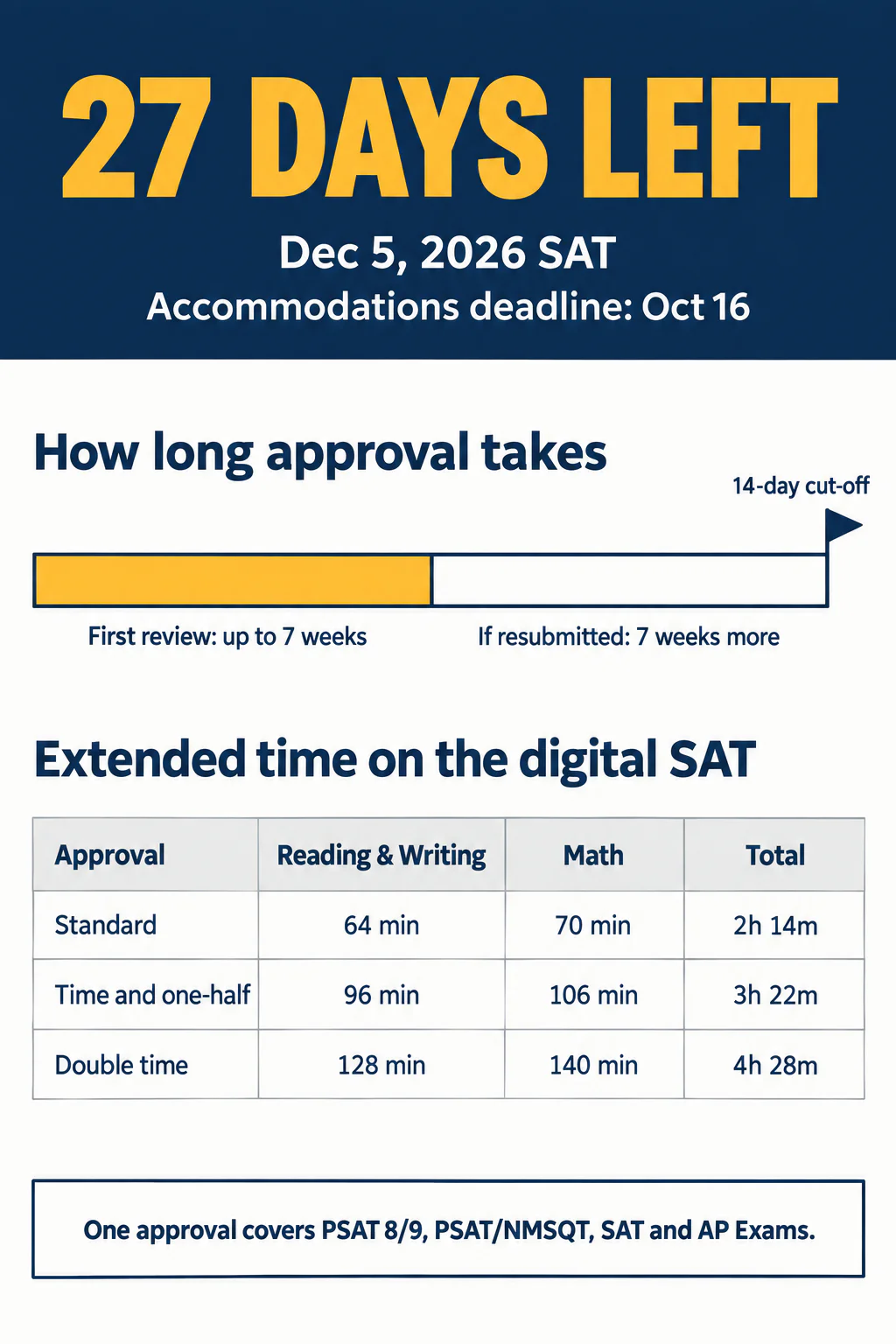
The mistake that costs families a whole test date
Here is the thing page one of Google will not tell you. Almost every family treats accommodations as a Grade 11 problem, triggered by a disappointing practice score. That is the worst possible time to start, because Grade 11 is when the deadlines are tightest and the stakes are highest.
An approval is not tied to one exam. It carries across the PSAT 8/9, the PSAT/NMSQT, the PSAT 10, the SAT and AP Exams. A student approved in Grade 9 walks into every College Board test for the next four years with the question already settled, including the PSAT/NMSQT that decides National Merit eligibility. A student who waits until Grade 11 has to win the argument under time pressure, and may sit the PSAT that mattered most under conditions they were entitled to change.
If your teen has any documented condition affecting reading speed, attention, writing or health, the request belongs in Grade 9 or 10. Not because the SAT is imminent, but because it is the only point at which a seven-week review carries no consequences.
How to submit a request that clears the first time
Most delays are documentation problems, not eligibility problems. A request that comes back for more evidence has effectively doubled its own timeline, so the goal is to submit something complete.
- Start with the school's SSD coordinator. Usually a counsellor or the special education lead. They submit the request and know what College Board has accepted before.
- Gather the evaluation, not just the diagnosis. A current psychoeducational or medical evaluation carries far more weight than a letter naming a condition.
- Document the functional limitation. Teacher observations about unfinished timed work, and the accommodations already in use at school, are the connective evidence reviewers look for.
- Name the specific accommodation. Fifty percent extra time, extra breaks, a reader. Vague requests invite follow-up questions.
- Submit at least three months before the target date. That leaves room for one round of questions without losing the test date.
- Get the eligibility letter in writing and keep it. It is the proof the test centre will ask for.
One more thing worth knowing before you invest in this: extra time solves a timing problem, not an accuracy problem. If your teen is leaving questions blank, it helps enormously. If they are finishing the section and getting questions wrong, another 32 minutes changes very little, and the work belongs in content and pacing strategy instead. Those two problems look identical on a score report and need opposite responses, which is why the diagnosis comes before the paperwork. Students testing outside the US should also read our guide to SAT registration for international students, where seat availability adds a second constraint. For the current test structure and timing, start with our complete guide to the 2026 digital SAT.
Where to go from here
Three things decide how this goes. The accommodations deadline, not the registration deadline, is the one that closes your options, and for the December 5 SAT it falls on October 16. Review takes up to seven weeks and can take fourteen if documentation comes back, so three months of lead time is the realistic minimum. And because an approval carries across every College Board test a student will ever sit, the cheapest version of this process is the one that happens in Grade 9 rather than Grade 11.
Then there is the question the form never asks: whether extra time is what your teen actually needs.
Ready to turn a prep plan into real score gains? Catalyst's 1:1 live online SAT programme starts with a free consultation to benchmark your teen's starting point and build a personalised path to their goal score.
Book a Free Consultation