
Comparing Revolution Prep vs Catalyst Test Prep on price per hour will send you to the wrong answer. The two are not the same product sold at different rates. One is a broad tutoring company that happens to do test prep well, and the other is a test prep company that does one thing.
Which matters because the decision is not really about brands. It is about whether your teen's problem is a knowledge gap, a pacing problem, or a discipline problem, and those three need different formats. A family that gets the format right and the brand wrong usually does fine. A family that gets the format wrong pays for sessions that cannot fix what is actually broken.
What follows uses what each company publishes on its own site as of October 2026, with the gaps named rather than filled in. Where Revolution Prep has a genuine advantage, it is said plainly.
Key takeaways
- Revolution Prep is broader: over 100 academic subjects, plus SSAT and ISEE for private school admissions.
- Catalyst is narrower on purpose: Digital SAT, ACT, PSAT and AP, with the plan built from a diagnostic.
- Both use vetted, trained tutors rather than a marketplace, which is the first thing to screen any provider for.
- Revolution Prep offers small group test prep of up to 10 students. Catalyst is 1:1 only, by design.
- A group of ten is a different product, not a discount. It cannot adapt to one student's recurring error, and that is the whole decision.
- If you are comparing these two at all, you have already decided you want test prep, and that is the ground Catalyst is built for.
What does Revolution Prep actually offer?
Three things, according to its tutoring page: 1:1 private tutoring across more than 100 subjects for K-12, small group test prep for grades 9 to 12 with "expert tutor, up to 10 students", and academic private tutoring on a customised schedule.
On tests, it lists the SAT, ACT, PSAT/NMSQT, AP, SSAT and ISEE. The last two are private school admissions exams, usually sat in middle school, and they put Revolution Prep in a market Catalyst is not in at all.
Published starting prices, which is more transparency than most of this industry offers: academic private tutoring from 990 dollars, test prep private tutoring from 1,990 dollars, and group test prep from 499 dollars. Those are programme starting points rather than hourly rates, so the figure you end up paying depends on the number of hours in the package.
One claim deserves to be quoted rather than paraphrased, because it is the strongest thing on the page. Revolution Prep states its tutors "are employees, not contractors, and receive continuous training in the latest techniques and research."
Both clear the bar that most providers fail
The problem that ruins most tutoring purchases is the marketplace model. There you are not buying a company's teaching method, you are buying whoever is available, and the variance between the best and worst tutor on the same platform at the same price is enormous. A company cannot train people it does not employ.
Revolution Prep states its tutors "are employees, not contractors, and receive continuous training in the latest techniques and research." Catalyst works the same way: dedicated tutors, every session 1:1 and live, no matching pool and no rotating cast. We make the same argument about marketplaces in our comparison of Varsity Tutors and Catalyst.
So neither of these two is the risky choice, and the tutor-sourcing question does not separate them. Once both providers clear that bar, the decision moves entirely to format and focus, which is where they genuinely differ.
Not sure where your teen stands? A free consultation with Catalyst Test Prep maps exactly which SAT topics need the most work, so you're never guessing about study time.
Book a Free Consultation →How the two compare, side by side
| Revolution Prep | Catalyst Test Prep | |
|---|---|---|
| Formats | 1:1, and small group up to 10 students | 1:1 live online only |
| Tests covered | SAT, ACT, PSAT/NMSQT, AP, SSAT, ISEE | Digital SAT, ACT, PSAT, AP |
| Academic subjects | Over 100, K-12 | Not offered |
| Tutor model | Employees, not contractors, continuously trained | Dedicated tutors, 1:1 throughout |
| How the plan is set | Customised schedule | Diagnostic first, then a plan targeting the losses |
| Published pricing | Yes, programme starting points | Quoted after a free consultation |
| Score guarantee | None stated | None stated |
| Entry point | Free practice test | Free consultation |
Two rows deserve a note. Revolution Prep publishes programme starting prices, which makes it easy to compare on a spreadsheet; Catalyst quotes after a free consultation, because the number depends on how many hours a diagnostic says your teen actually needs. A published floor is useful for budgeting and tells you nothing about what you will end up paying, which is why the row says "starting points" rather than "price". If you want the industry context before any call, we have written up what 1-on-1 SAT tutoring actually costs across providers.
And neither company advertises a score guarantee, so if you have been told one exists by anybody in this market, get it in writing with the baseline score and the remedy specified.
Is a group of ten the same product at a lower price?
No, and this is the part of the comparison that actually decides it. A small group is a different teaching format with a different failure mode, not a volume discount on the same thing.
In a group of ten, the tutor teaches to the middle. That works well when the content is new to everybody, because the explanation lands for most of the room at once and the cost per student falls by an order of magnitude. It works badly when one student's problem is specific. If your teen loses eight marks a test to misreading the question rather than to not knowing the maths, no amount of group instruction on quadratics touches that, and you will pay for a term of it before anyone notices.
The reverse case is real too. A student who already knows the content and simply has not started is short of a schedule rather than of teaching, and a group can supply that. The trouble is that most students do not know which of the two they are, which is exactly what a diagnostic settles before any money is spent.
We have argued the format question at length in 1-on-1 SAT tutoring versus group classes. The conclusion is the same here: match the format to the diagnosis, and get the diagnosis first.
Which one fits your teen?
Work from the problem rather than the provider. Three cases cover most families, and the first two are where almost everyone reading this page actually sits.
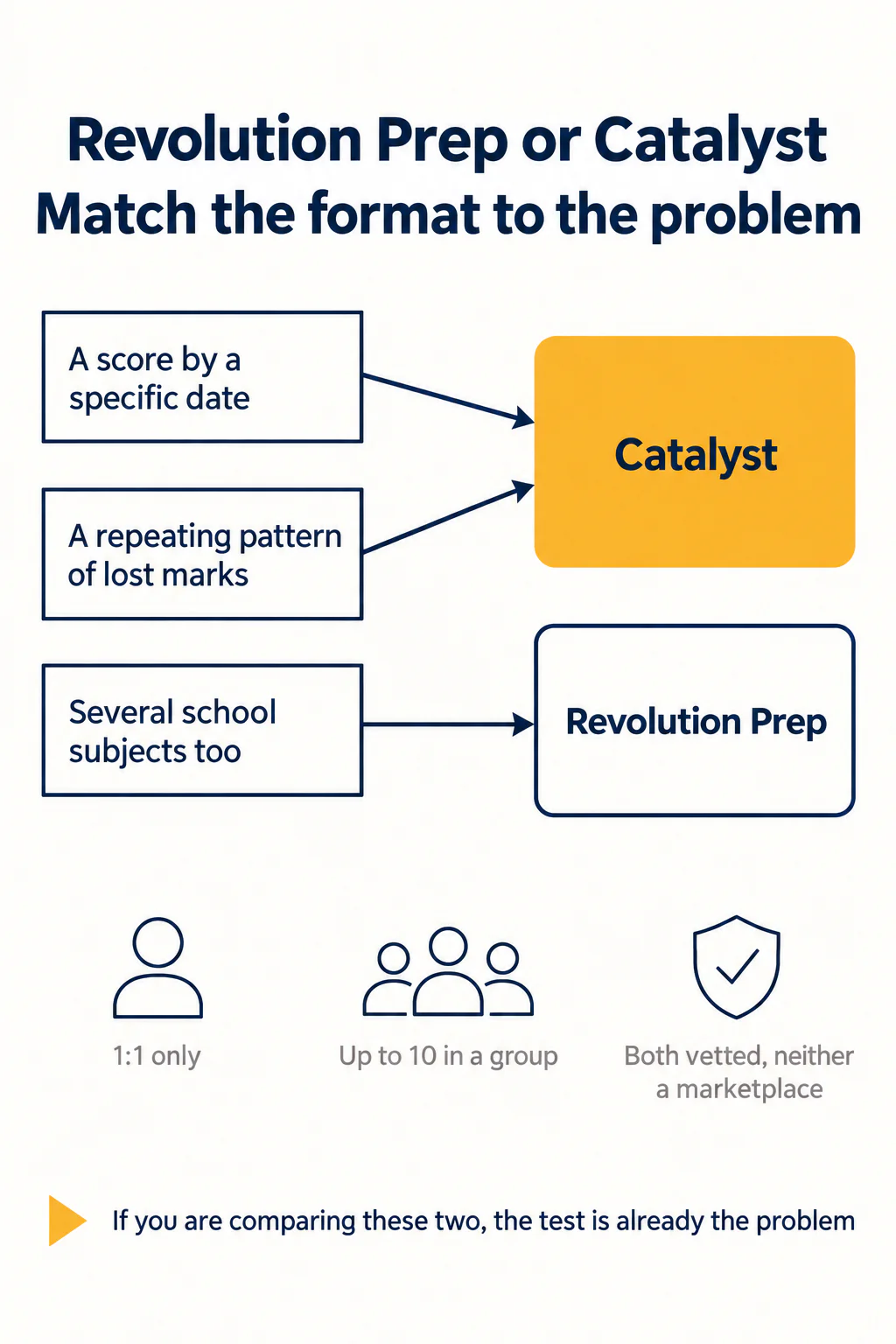
- You want a specific score by a specific date. This is Catalyst. A diagnostic sets the plan before any teaching starts, so the hours go to the question types losing marks rather than through a syllabus in order. When the test is eight weeks out, the difference between those two approaches is the whole result.
- Your teen has a specific, repeating pattern of lost marks. Also Catalyst, and for the same reason. A group of up to ten cannot slow down for one student's recurring error no matter how good the tutor is, so the format decides this one before the brand does. Ask any provider you call who builds the study plan and what it is built from.
- The SAT is one item on a longer list of school subjects. Here Revolution Prep is the better fit and we are not going to pretend otherwise. Over 100 subjects from one provider with one scheduling relationship is a real operational advantage, and Catalyst does not offer it.
Most people comparing these two are in the first two cases, because searching for a test prep comparison means the test is already the problem. If you are earlier than that and still mapping the whole field, the best SAT prep options compared covers self-study, apps, group courses and 1:1 together.
The questions to ask either company
Five questions separate providers faster than any comparison article, including this one.
- What is the group size, exactly? "Small group" is not a number. Up to 10 is a published number, which is better.
- What did the tutor score on the test my teen is sitting? A reasonable company answers this.
- Who writes the study plan, and what is it built from? A diagnostic, a placement call, or a standard syllabus. These produce very different first months.
- What happens to a missed session? The answer tells you whether you are buying hours or a programme.
- What does the total come to, not the starting price? Starting prices are real but they are floors.
Where this leaves the decision
Revolution Prep is the better fit for breadth: many subjects, younger students, private school admissions tests, and a group option for a teenager who needs structure more than instruction. It is a serious company and that is a real offer.
Catalyst is the better fit for the thing this page is actually about. When the test is the problem and the marks are going somewhere specific, narrow scope and 1:1 stop being constraints and start being the reason it works: the plan comes from a diagnostic, the pacing adapts inside the session, and nothing is spent teaching your teen what they already know. That is a smaller promise than covering 100 subjects, and it is the one that moves a score by a deadline.
Ready to turn a prep plan into real score gains? Catalyst's 1:1 live online SAT programme starts with a free consultation to benchmark your teen's starting point and build a personalised path to their goal score.
Book a Free ConsultationCompetitor details taken from Revolution Prep's tutoring page and test prep page, both read on 6 October 2026. Pricing and programme details change, so confirm current figures with the provider before deciding.