The PSAT/NMSQT testing window opens on 1 October 2026 and closes on 30 October. If your teen is in tenth or eleventh grade, they are probably sitting it in the next few weeks, and you may not have been told much beyond the date.
The confusion is understandable. The PSAT is described as practice, as a scholarship qualifier, and as a predictor, and it is genuinely all three depending on which year your child is in. That ambiguity leads families to either ignore it entirely or over-prepare for it, and both are mistakes.
Here is what the test actually is, what the scores do and do not mean, and the sensible amount of preparation for the month you have left.
Key Takeaways
- The 2026 testing window is 1 to 30 October. There is no single national date; your teen's school chooses one inside that window.
- It runs 2 hours 14 minutes across 98 questions, identical in length to the digital SAT.
- Colleges never see PSAT scores. It does not affect admissions in any way.
- Only the eleventh-grade sitting counts for National Merit. Tenth graders get practice and data, not eligibility.
- For most students the real value is diagnostic: it tells you where SAT preparation should start.
What the PSAT actually is
The PSAT/NMSQT is a digital test taken in the Bluebook app, the same software used for the digital SAT. It assesses the same skills as the SAT in a grade-appropriate way, which is why it works as a preview.
The structure, straight from College Board:
| Section | Time | Questions |
|---|---|---|
| Reading and Writing | 64 minutes | 54 |
| Math | 70 minutes | 44 |
| Total | 134 minutes | 98 |
That is worth pausing on. The PSAT is exactly as long as the digital SAT and has exactly as many questions. Families often assume it is a shortened practice version. It is not. It is a full-length rehearsal of the real thing, which is precisely what makes the resulting data worth having.
Scoring differs slightly. The PSAT runs 320 to 1520, with each section scored 160 to 760, against the SAT's 400 to 1600. The ceiling is lower, so a PSAT score and an SAT score are not directly comparable at the top end.
The two things it is actually for
One: National Merit qualification. This applies to eleventh graders only. The National Merit Scholarship Corporation uses the PSAT/NMSQT to identify students for its scholarship programme, and the mechanics are genuinely misunderstood, so we have covered them separately in how the National Merit Selection Index actually works.
Two: diagnosis. This applies to everyone, and for most families it is the more useful of the two.
A full-length test taken under real conditions produces something no practice session at home can: an honest picture of how a student performs when it counts, including how their pacing holds up in the final ten minutes of a module. That is the raw material for a sensible SAT plan.
What it is emphatically not is an admissions factor. Colleges do not receive PSAT scores. A disappointing result costs your teen nothing except information, which is a genuinely freeing thing for an anxious student to hear.
Not sure where your teen stands? A free consultation with Catalyst Test Prep maps exactly which SAT topics need the most work, so you're never guessing about study time.
Book a Free Consultation →Which year is your teen in?
The answer changes what the test means, and families get this wrong often enough to be worth stating plainly.
| Year | What the PSAT does | How much to prepare |
|---|---|---|
| Grade 9 or 10 | Practice and baseline data. No National Merit eligibility. | Almost none. Familiarity with the format only. |
| Grade 11, not chasing National Merit | The most accurate SAT predictor you will get free | Light. Protect the honesty of the baseline. |
| Grade 11, National Merit is realistic | A scholarship qualifier with a hard, one-time deadline | Seriously. This is the only sitting that counts. |
That last row is the only situation where heavy PSAT-specific preparation makes sense. There is no retake for National Merit purposes, which makes it unusually high-stakes for a test nobody in admissions will ever see.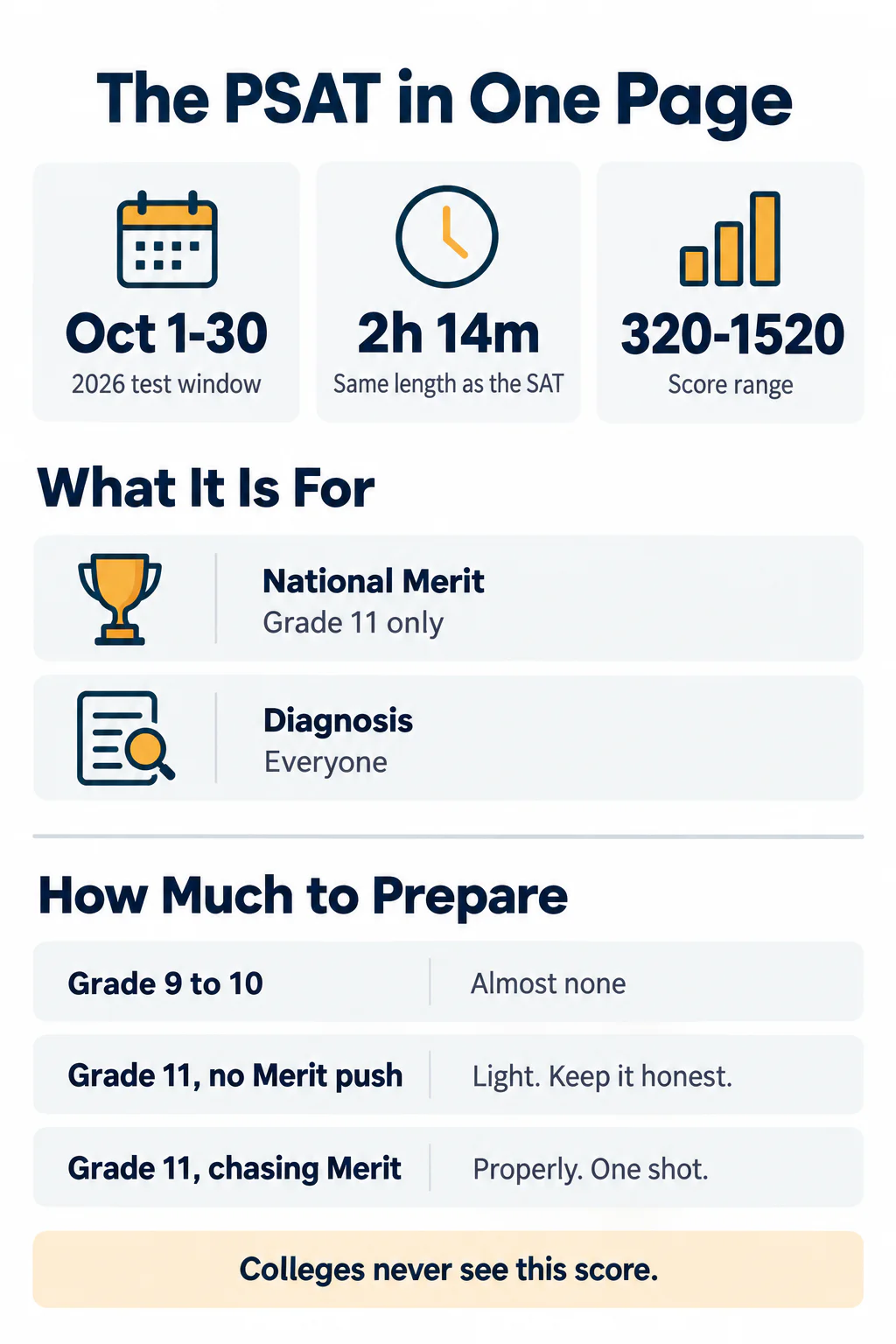
Should you prepare, and how much?
Here is the argument most test-prep companies will not make: for the majority of students, preparing hard for the PSAT is counterproductive.
The reason is that its main value is as an honest baseline. A student who crams for three weeks produces a score that reflects the cramming rather than their actual standing, and then builds an SAT plan on a number that overstates where they are. You have paid for accuracy and thrown it away.
What is genuinely worth doing in the month beforehand takes about two hours in total.
- Download Bluebook and open it. Work through the practice content until the interface is boring. Unfamiliar software costs real minutes on test day.
- Try the on-screen Desmos calculator. Students who meet it for the first time under time pressure either avoid it entirely or waste minutes fighting it.
- Sit one timed module. Not a full test. One 32-minute Reading and Writing module is enough to calibrate what that pace feels like.
- Agree what the score is for. Tell your teen explicitly that colleges will never see it. Anxiety costs more points than any content gap at this stage.
If National Merit is realistically in play, ignore the above and prepare properly. For everyone else, resist the urge.
What to do when the scores arrive
Scores typically land a few weeks after the test, and this is the part families underuse.
Do not stop at the total. The useful information is in the detail: which question types were missed, and whether errors cluster in the last quarter of each module. A student losing points at the end of modules has a pacing problem, which is a completely different fix from a content gap and considerably faster to solve.
That distinction is the whole basis of a sensible plan. We work through it in detail in how to go from 1200 to 1400 on the SAT, which uses the same error-sorting method on practice test results.
From there, the timeline question becomes concrete. Our guides to when to start SAT prep and how long score improvement actually takes map what is realistic from a given starting point.
Frequently Asked Questions
When is the PSAT/NMSQT in 2026?
College Board sets a testing window of 1 to 30 October 2026. There is no single national test day. Each school picks its own date inside that window, so the only reliable answer for your teen is the one their school counsellor gives you. Ask now rather than in October.
How long is the PSAT and how many questions does it have?
2 hours and 14 minutes, 98 questions. Reading and Writing is 64 minutes with 54 questions, Math is 70 minutes with 44 questions. That is the same length and question count as the digital SAT, so it is a genuinely realistic rehearsal rather than a shortened practice version.
What is a good PSAT score?
The PSAT is scored 320 to 1520, with each section running 160 to 760. Because the ceiling is 1520 rather than 1600, PSAT and SAT scores are not directly comparable at the top. A score that would be strong on the SAT reads slightly differently here, so judge against PSAT percentiles.
Does the PSAT count for college admissions?
No. Colleges do not see PSAT scores and it plays no part in an admissions decision. Its two real functions are qualifying eleventh graders for National Merit consideration and giving you an early, accurate read on where SAT preparation should start.
Which year of the PSAT counts for National Merit?
Only the one taken in eleventh grade. A tenth grader sitting the PSAT/NMSQT gets useful practice and diagnostic information but cannot qualify for National Merit from that result. This catches families out regularly, so check which year your teen is actually in.
Should my teen prepare for the PSAT?
Lightly, unless National Merit is a realistic target. For most students the PSAT is most valuable as an honest baseline, and preparing heavily makes that baseline less honest. Familiarity with Bluebook and the timing is worth an hour or two. Weeks of cramming usually is not.
Is the PSAT easier than the SAT?
Slightly, and mostly at the top end. It tests the same skills in a grade-appropriate way and has the same length and structure, but the ceiling is lower. The practical difference for a student sitting it is small enough that it feels like the SAT.
Do I need the Bluebook app for the PSAT?
Yes. The PSAT/NMSQT is a digital test taken in the Bluebook app, the same software used for the digital SAT. Downloading it and completing the practice content beforehand removes a layer of unfamiliarity on test day for no real effort.
What should we do with the PSAT score when it arrives?
Treat it as a diagnostic rather than a verdict. Look past the total at which question types were missed and whether errors cluster at the end of modules. That pattern tells you what SAT preparation should target, which is far more useful than the headline number.
How does Catalyst help with PSAT and SAT preparation?
Catalyst runs 1:1 live online preparation for the PSAT, SAT and ACT, with a study plan built from a student's actual error patterns rather than a fixed syllabus. For most families the highest-value moment is after PSAT scores arrive, when there is real data to build a plan around.
The short version
The PSAT sits in an awkward spot. It is a full-length, realistic test that no college will ever see, which makes it simultaneously low-stakes and genuinely valuable.
For a tenth grader it is free practice. For an eleventh grader not chasing National Merit it is the most accurate SAT predictor available, and worth protecting from over-preparation. For an eleventh grader with National Merit in reach it is a one-shot scholarship qualifier and deserves real work.
Whichever applies, the scores matter more in December than in October. What you do with the error pattern is where the value is.
Ready to turn a prep plan into real score gains? Catalyst's 1:1 live online SAT programme starts with a free consultation to benchmark your teen's starting point and build a personalised path to their goal score.
Book a Free ConsultationSources: College Board PSAT/NMSQT test dates and College Board on PSAT/NMSQT structure.