
The PSAT 10 and the PSAT/NMSQT are the same test. Same content, same difficulty, same 320 to 1520 scale. What separates them is the month they are given and one consequence that most families only discover too late: only the PSAT/NMSQT, taken in 11th grade, can lead to National Merit.
The PSAT/NMSQT testing window opens on 1 October, which makes this the fortnight when the distinction stops being academic. This guide sets out exactly what changes between the two, what the PSAT 10 does qualify for, and what a sophomore should actually do about it.
Key Takeaways
- Identical test, identical scale. The only real differences are timing, fee waivers and scholarship eligibility.
- National Merit comes only from the 11th grade PSAT/NMSQT. A PSAT 10 score can never qualify, no matter how high.
- The PSAT 10 does count toward College Board's National Recognition Programs, which need the top 10 percent plus a 3.3 GPA.
- PSAT/NMSQT runs 1 to 30 October 2026; PSAT 10 runs 1 March to 30 April 2027. Schools pick their own date inside the window.
- Fee waivers exist for the PSAT/NMSQT and not for the PSAT 10.
What is actually different between the two tests?
Almost nothing about the test itself. College Board states directly that the PSAT/NMSQT and PSAT 10 are the same test, offered at different times of year, with identical subject matter, score range and difficulty. Every difference is administrative.
| PSAT/NMSQT | PSAT 10 | |
|---|---|---|
| Who takes it | 11th graders, and 10th graders where schools offer it | 10th graders |
| When | Autumn: 1 to 30 October 2026 | Spring: 1 March to 30 April 2027 |
| Content and scale | Identical, 320 to 1520 | Identical, 320 to 1520 |
| National Merit | Yes, 11th graders only | No |
| Other scholarship programmes | Yes | Yes |
| Fee waivers | Yes | No |
The windows come from College Board's PSAT 10 test dates page and the corresponding PSAT/NMSQT schedule. Inside each window the school chooses the date, which is why two neighbouring high schools can test three weeks apart.
Why can't a sophomore qualify for National Merit?
Because the National Merit Scholarship Program uses the PSAT/NMSQT taken in the third year of high school as its entry test, and the 10th grade attempt, whichever test it was, does not enter a student into the competition.
This produces the single most common misunderstanding in the whole PSAT conversation. A sophomore sits the PSAT/NMSQT in October, scores extremely well, and the family reasonably assumes something has been banked. Nothing has. The score is a useful practice result and nothing more, because National Merit only reads the junior-year sitting.
Two consequences follow, and they point in opposite directions:
- A strong sophomore score is not safe. It has to be repeated a year later on the sitting that counts.
- A weak sophomore score costs nothing. It does not follow the student anywhere. There is no downside to taking it.
The mechanics of how the qualifying score is actually computed, including the Selection Index that decides cutoffs rather than the headline total, are covered in our breakdown of how the National Merit Selection Index works.
Not sure where your teen stands? A free consultation with Catalyst Test Prep maps exactly which SAT topics need the most work, so you're never guessing about study time.
Book a Free Consultation →What does the PSAT 10 qualify for?
College Board's National Recognition Programs, which is a genuine scholarship-adjacent route that almost nobody mentions when dismissing the PSAT 10 as "just practice".
The criteria are specific. A student needs to be in the top 10 percent of test takers in their high school, among first-generation college students in their state, or among rural and small-town students in their state. Alternatively they can earn a 3 or higher on two or more distinct AP exams in 8th, 9th or 10th grade. Either route also requires a cumulative GPA of B+ or higher, at least 3.3 or 87 to 89 percent, at the time of submission.
Crucially, College Board confirms that scores are considered from the PSAT/NMSQT or PSAT 10 in 10th grade, or the PSAT/NMSQT in 11th grade. The PSAT 10 counts. It is the one national recognition the spring test can produce, and it arrives a year earlier than anything National Merit can offer, which matters because recognition on an application is only useful if it exists before the application is written.
Notice also that the threshold is a percentile, not a fixed number. A student in a school where few people test well can reach the top 10 percent with a score that would not be remarkable elsewhere.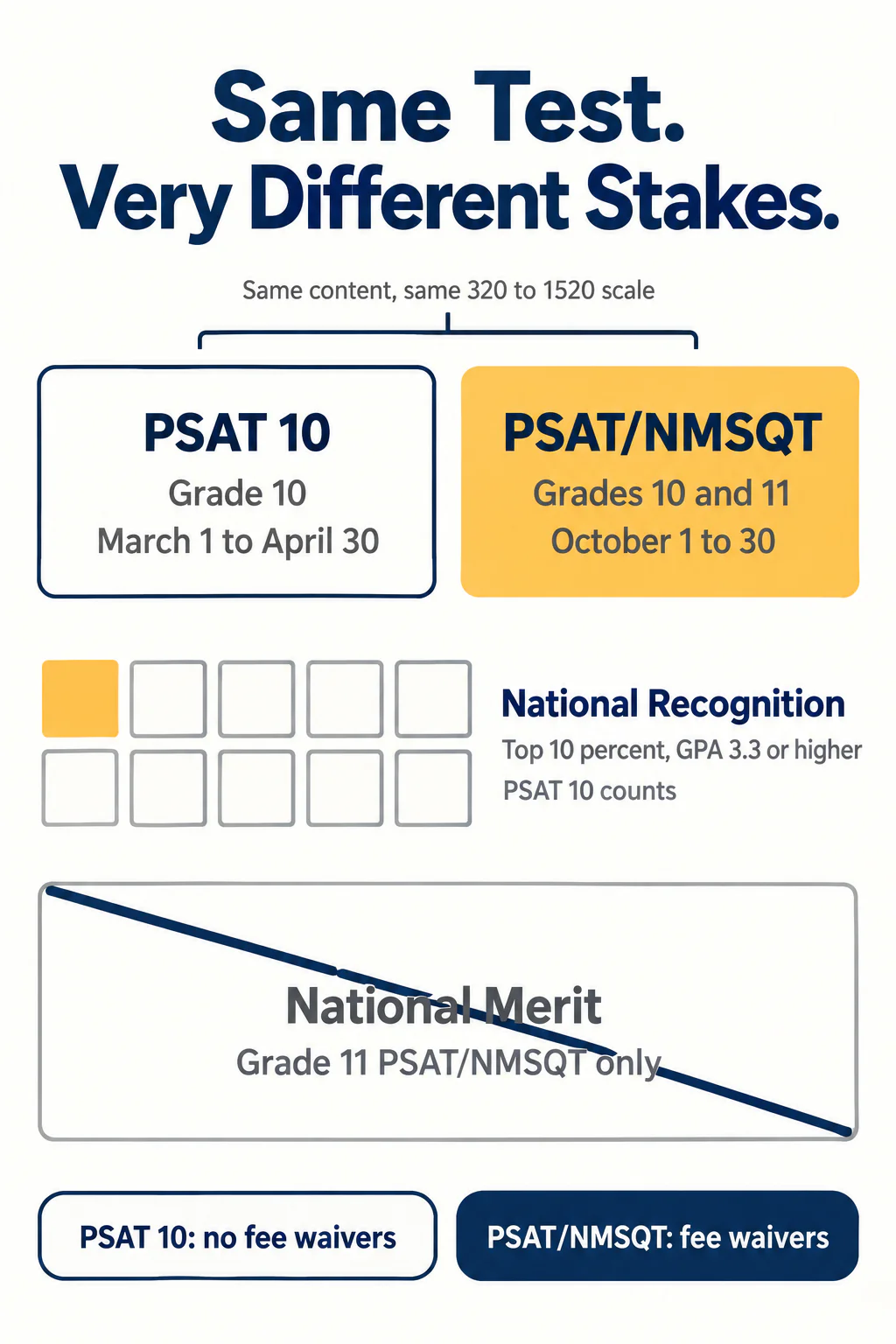
Which should a 10th grader take?
If the school offers the October PSAT/NMSQT to sophomores, take that one. It is the better rehearsal, for a reason that has nothing to do with content.
The junior-year qualifying attempt happens in October. A sophomore who sits the PSAT/NMSQT in October has rehearsed the exact calendar position, the exact time of year, the same point in the school term, with the same pre-test fortnight. A sophomore who sits the PSAT 10 in March has taken the same test in a completely different part of the academic year, after another six months of coursework.
The content is identical either way. The rehearsal value is not.
Where the school only offers one, take what is offered. Both produce a full score report against the same syllabus as the Digital SAT, and that report is worth considerably more than the label on the front of it. Our primer on what the PSAT/NMSQT is and why it matters covers the autumn test in full.
The case against sitting either one
There is a reasonable objection, so here it is fairly. A sophomore with no intention of chasing National Merit, no interest in the National Recognition route, and a full autumn of other commitments is giving up a morning for a diagnostic they could get from a free practice test at home. That is a defensible position.
The counter is that a school-administered sitting is the only realistic way most students experience proctored test conditions before the SAT itself, and the gap between a practice test at the kitchen table and a real administration is larger than students expect. Timing pressure behaves differently when the room is silent and nobody can pause.
What to do with the score report
Read the section scores, not the total. The total tells you roughly where your teen sits. The section breakdown tells you what to do next, and that is the part with a year of runway attached to it.
Because the PSAT and the Digital SAT share a content framework, a PSAT report is an unusually direct map to SAT preparation. If the report shows the marks going on information and ideas questions in Reading and Writing, that is the same skill area the SAT will test. If they go on algebra, likewise. The gaps transfer intact, which is not true of most practice tests a student might take instead.
The practical sequence for a sophomore who has just sat either test:
- Wait for the report, then read the skill-level detail rather than reacting to the headline number.
- Pick the two weakest areas and work those specifically over the following months, rather than revising everything.
- Decide by spring of 10th grade whether National Merit is a realistic target, because chasing it changes the junior-year timetable.
- Book the junior October PSAT/NMSQT deliberately, not by default, and prepare for it as a real test.
Students aiming at a National Merit-level Selection Index generally need to be operating near the top of the scale, and getting there from a mid-range sophomore score is a year of targeted work rather than a term of revision. Our guide to when to start SAT prep sets out the timeline that makes that feasible.
Where that leaves a sophomore
The PSAT 10 and PSAT/NMSQT are one test wearing two labels. The label decides three things: when it happens, whether a fee waiver exists, and whether National Merit is on the table. Everything the student experiences on the day is the same.
For a 10th grader, the October PSAT/NMSQT is the better sitting where it is offered, because it rehearses the junior-year attempt in the right part of the calendar. The PSAT 10 is not a consolation prize either: it feeds the National Recognition Programs that the spring test can genuinely produce. Take whichever the school gives, then spend the year working the two weakest skill areas the report names.
Ready to turn a prep plan into real score gains? Catalyst's 1:1 live online SAT programme starts with a free consultation to benchmark your teen's starting point and build a personalised path to their goal score.
Book a Free Consultation