
Most articles answer this with one percentile and move on. There are two, they differ by four points, and the one almost everybody quotes is the one that flatters you. A 1400 SAT score is the 97th percentile against a nationally representative sample and the 93rd percentile against students who actually sat the test.
That is not a rounding quibble. The first number says 3 students in 100 beat you. The second says 7 do. In an admissions pile made entirely of people who took the SAT, the second is the only one describing your competition. So yes, 1400 is a good SAT score by any ordinary standard. Whether it is a good score for you depends on three things nobody puts in the headline: which percentile you use, how the 1400 is built, and what the colleges on your list actually publish.
Key Takeaways
- 1400 is the 97th percentile nationally and the 93rd among test takers. Use the 93rd when comparing yourself to applicants.
- Two 1400s are not equivalent. 750 Math reads as the 95th percentile; 750 Reading and Writing reads as the 98th.
- Math percentiles run lower than Reading and Writing at the same score, because high Math scores are more common.
- Published college score ranges describe students who chose to submit, so they sit above the true range of everyone admitted.
- Retake decisions belong to a college list, not to a round number. 1400 is above the midpoint at most universities in the United States.
What percentile is a 1400 SAT score?
College Board publishes two percentiles for every score, and they answer different questions.
| Total score | Nationally Representative percentile | User Group percentile |
|---|---|---|
| 1300 | 91 | 85 |
| 1350 | 94 | 89 |
| 1400 | 97 | 93 |
| 1450 | 99 | 95 |
| 1500 | 99 | 97 |
| 1600 | 99+ | 99+ |
Source: College Board SAT Understanding Scores percentile tables, checked 13 October 2026.
Why the two numbers differ, and which one to use
The Nationally Representative percentile comes from a research study of all US 11th and 12th graders, including the large number who never take the SAT at all. The User Group percentile is built from the actual scores of students who graduated in the past three school years and sat the test.
An admissions reader is not comparing you to teenagers who never registered. They are comparing you to a pile of applications from people who did. So the User Group figure, 93, is the honest one, and the four point gap at 1400 is the difference between beating 97 percent of a population and beating 93 percent of your actual competition.
Notice what happens further up the table. At 1450 and 1500 the national percentile has already saturated at 99, while the user percentile is still moving from 95 to 97. Above roughly 1430 the national number stops carrying information entirely, which is another reason to stop using it.
Are all 1400s the same score?
No, and this is the part that changes what a student should actually do next. The SAT reports two section scores from 200 to 800, and the same total can be built very differently.
| Section score | Reading and Writing, user percentile | Math, user percentile |
|---|---|---|
| 650 | 84 | 84 |
| 700 | 92 | 91 |
| 750 | 98 | 95 |
| 800 | 99+ | 99+ |
Source: College Board SAT section score percentile tables, checked 13 October 2026.
The 750 that is worth less than the other 750
At 650 the two sections are identical: 84th percentile either way. By 750 they have pulled apart by three percentile points, and the direction surprises people. A 750 in Math is the 95th percentile. A 750 in Reading and Writing is the 98th.
The reason is distribution, not difficulty. More students cluster at the top of the Math scale, so a high Math score separates you from fewer people. Build a 1400 as 750 Math and 650 Reading and Writing and you are at the 95th and 84th. Build it as 750 Reading and Writing and 650 Math and you are at the 98th and 84th. Same 1400 on the envelope, a visibly different profile inside it.
This matters most where the programme reads one half closely. Engineering, computer science, business and economics departments look hard at the Math score, and a 650 there reads as a genuine weakness regardless of what the total says. For a humanities or social science applicant the same 650 Math is close to irrelevant.
Not sure where your teen stands? A free consultation with Catalyst Test Prep maps exactly which SAT topics need the most work, so you're never guessing about study time.
Book a Free Consultation →Is 1400 good enough for the colleges on your list?
This is the only version of the question that has a real answer, and it is answered college by college. Every university publishes a middle 50 percent range for admitted students: the 25th and 75th percentile of enrolled scores. Three positions are possible and each implies a different decision.
- 1400 is above the 75th percentile. The score is an asset. Submit it, stop preparing, and spend the time on the application itself.
- 1400 sits inside the middle 50 percent. The score is neutral. It will not sink the application and it will not carry it. Submitting is usually still correct if you are at or above the midpoint.
- 1400 is below the 25th percentile. The score is doing nothing for you. Either retake with a specific target or, at a test-optional college, consider withholding.
The bias in every published range
Here is the correction almost no article makes. Those published ranges describe admitted students who chose to submit a score. Since most colleges went test-optional, students with scores below a college's typical band simply do not send them. The scores that remain in the published range are the stronger ones, which pushes the reported 25th and 75th percentiles upward.
The practical consequence is that a published range reads harder than the real distribution of admitted students. A 1400 that looks slightly below band at a selective college is less far below than the table suggests, because the students admitted without submitting a score are invisible in it. That is an argument for reading the range as a submission guide rather than as an admission bar.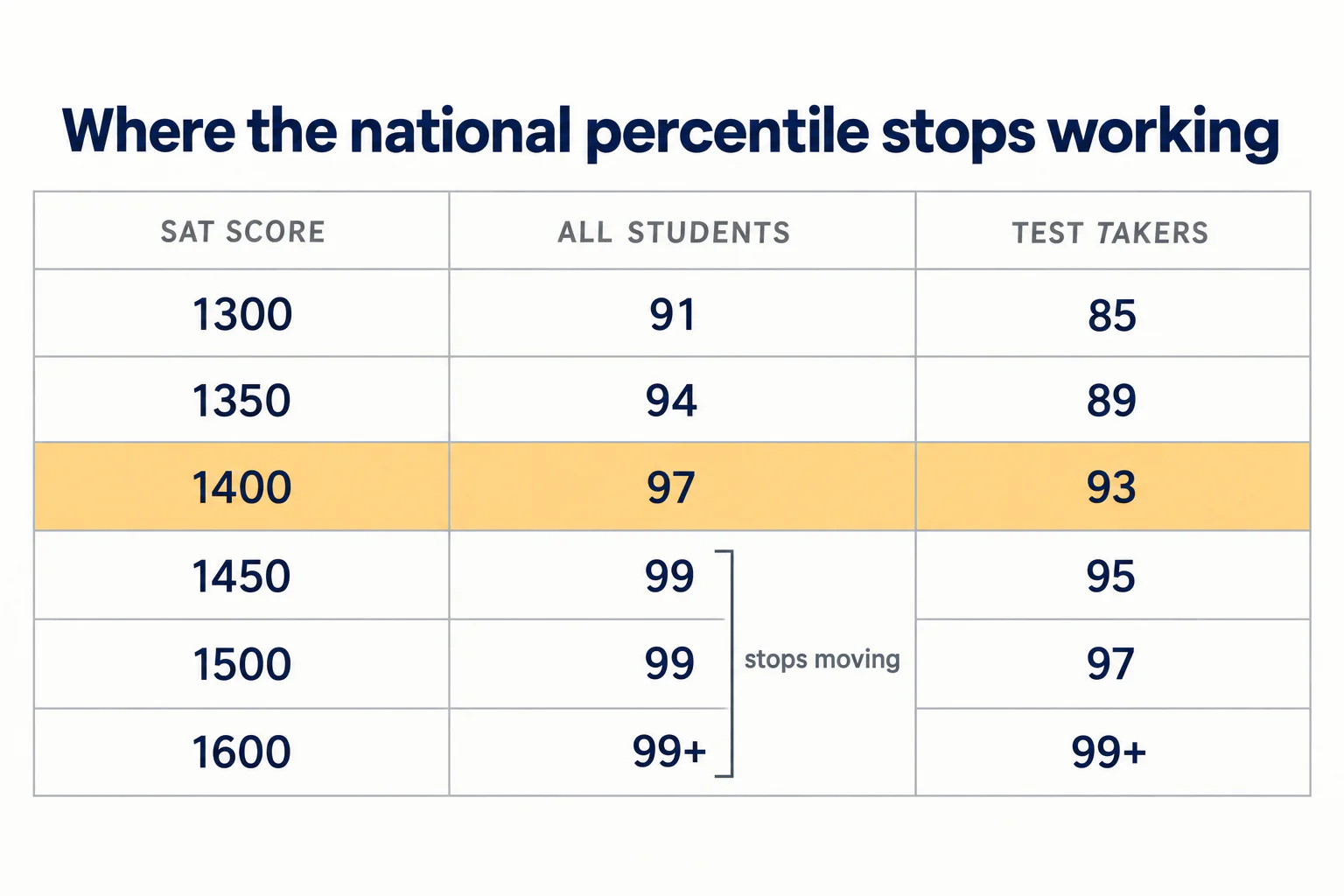
Should you retake a 1400?
Retake if there is a specific thing a higher score buys. Do not retake because 1400 is not 1500.
- Check your section percentiles, not your section scores. A student at 720 Reading and Writing and 680 Math has a weaker Math half than the 40 point gap implies, because Math percentiles run lower at the same score.
- Compare against your actual list. If 1400 is above the midpoint everywhere you are applying, a retake buys you nothing you can spend.
- Count the questions, not the points. At 1400 you are missing a small number of items, and they are concentrated in a few question types. The work is narrow and specific.
- Check the calendar before the ambition. A retake needs a test date that returns scores before your deadlines, and a plan with enough weeks in it to change anything.
Our walkthrough of how to retake the SAT strategically covers the sequencing, and how superscore and Score Choice work matters here because a retake that improves only one section can still raise a superscored total.
What moving from 1400 to 1500 actually involves
The gap is a hundred points on paper and a change of method in practice. Below 1300, score gains come from covering content that was genuinely not known. At 1400, the content is mostly known and the losses come from a thin set of recurring failure modes: misreading the question stem, running out of time in the second module, algebra slips under pressure, and two or three question types that were never properly learned.
Broad review does almost nothing at that point, because you spend most of the time re-practising what you already get right. Our guide to breaking the 1400 to 1500 barrier goes through those failure modes in detail. The short version is that the preparation has to get narrower as the score gets higher, which is the opposite of what most students do.
Where 1400 sits in the real world
Against the full population of American universities, 1400 is a strong score that clears the published range at the large majority of them, including most state flagships. It is competitive for merit aid at many institutions, where thresholds sit well below selective admission bands. For a student who wants a good university and a scholarship, 1400 is frequently the finish line rather than a staging post.
Against the twenty or so most selective colleges in the country, 1400 is typically below the published middle 50 percent band. That is a statement about those twenty colleges, not about the score. It is also why the honest answer to "is 1400 good" is a question back: good for what?
If you are still deciding what target to set, what counts as a good SAT score works through the general framing, and how to go from 1200 to 1400 covers the tier below if you are not there yet.
What to do with the number this week
Write down your two section scores and convert each to its user percentile rather than comparing the raw numbers. Pull the published middle 50 percent range for every college on your list and mark where 1400 falls. If it is above the midpoint everywhere, the score is finished and your time belongs to the essays. If it is below at two or more of your genuine targets, pick a test date and work on the specific question types that lost the points, not on everything.
A 1400 is a good SAT score. The useful question is whether it is a finished one, and that is answered by a college list rather than by a percentile table.
Ready to turn a prep plan into real score gains? Catalyst's 1:1 live online SAT programme starts with a free consultation to benchmark your teen's starting point and build a personalised path to their goal score.
Book a Free ConsultationSource checked 13 October 2026: College Board SAT Understanding Scores percentile tables.