
You get four free SAT score reports. They expire nine days after test day. Your score is released thirteen days after test day. Read those three sentences together and a problem appears that almost no guide to sending SAT scores mentions: the free reports run out four days before you are allowed to see what you are sending.
That is not a quirk of one test date. Checked against College Board's own registration and score-release pages on 19 October 2026, it holds at every single administration in the 2026-27 year, eight for eight. The two pieces of standard advice you will read everywhere, "use your four free score reports" and "wait until you see your score before deciding where to send it", cannot both be followed. They are mutually exclusive by design.
Here is how sending actually works, what the real choice is, and the dates that bind this cycle.
Key Takeaways
- Four free reports, nine days. College Board gives four score sends free if ordered within nine days of the test date.
- Scores arrive on day thirteen. Every 2026-27 date releases scores four days after the free window shuts, and seven days after it for the June test.
- So the free sends are always blind. You choose colleges before you know the number, or you pay per college afterwards.
- A fee waiver removes the problem entirely, because waiver recipients send unlimited reports free with no nine-day cliff.
- A sent report cannot be recalled. Cancelling a score deletes it from your record, which is a different and larger decision.
How do you send SAT scores to colleges?
Score reports are ordered through your College Board account, and there are three moments when you can do it. You can add recipients during registration, before you have sat the test. You can add them at the test centre on test day. Or you can order them afterwards from the scores section of your account, at any point in the future.
Colleges are selected by name or by a four-digit code, and delivery is electronic. The report that arrives is a full record for the administration you choose, not a transcript you assemble yourself.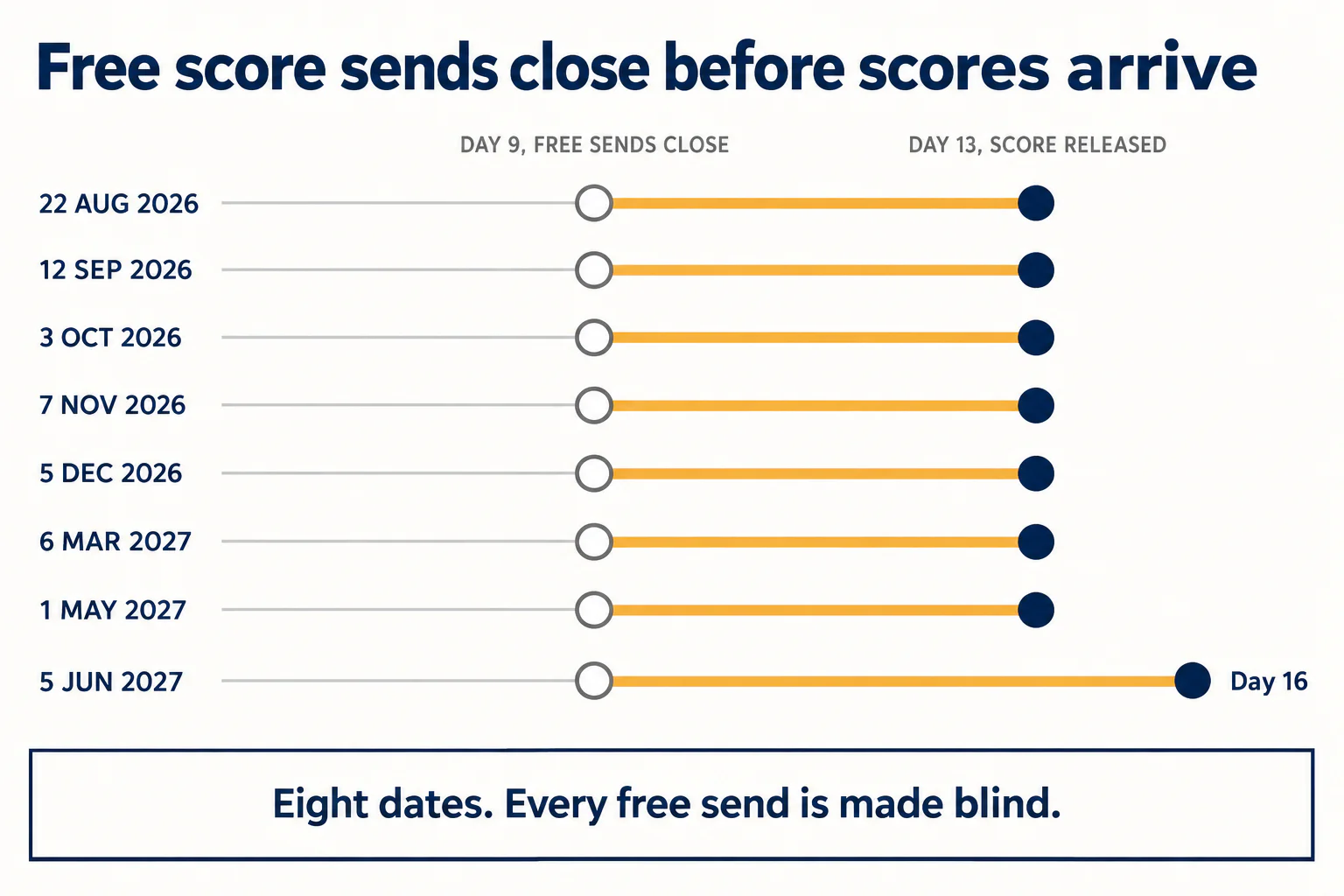
The four free reports expire before your score arrives
College Board's test-fees page states the rule in one line: "Your first 4 score reports are free if you order them by 9 days after the test date." The score-release schedule is published separately, and reading the two together produces the table below. Both were checked on 19 October 2026.
| Test date | Free sends expire | Scores released | Blind by |
|---|---|---|---|
| 22 August 2026 | 31 August | 4 September | 4 days |
| 12 September 2026 | 21 September | 25 September | 4 days |
| 3 October 2026 | 12 October | 16 October | 4 days |
| 7 November 2026 | 16 November | 20 November | 4 days |
| 5 December 2026 | 14 December | 18 December | 4 days |
| 6 March 2027 | 15 March | 19 March | 4 days |
| 1 May 2027 | 10 May | 14 May | 4 days |
| 5 June 2027 | 14 June | 21 June | 7 days |
Eight administrations, eight gaps. The June date is the worst of them at a full week. There is no administration in the 2026-27 year at which a student can see a score and still use a free report, and nothing on College Board's site presents this as a trade-off, because the two facts live on two different pages.
What it costs once the free window shuts
Past day nine, or past four recipients, score reports are charged per college. From College Board's published fee table, verified 19 October 2026: each additional score report is 15 dollars, and a rush report adds 31 dollars. For context, SAT registration itself is 68 dollars.
One group is exempt from all of this. Fee waiver recipients send unlimited score reports free, with no nine-day cliff at all. If you qualify for a waiver, the entire dilemma in this article does not apply to you, and it is worth checking eligibility properly rather than assuming. Our guide to who qualifies for SAT fee waivers covers the criteria.
Not sure where your teen stands? A free consultation with Catalyst Test Prep maps exactly which SAT topics need the most work, so you're never guessing about study time.
Book a Free Consultation →Should you send blind or wait and pay?
This is the only real decision in score sending, and it comes down to what the test is for. Three situations cover almost everyone.
Send blind when the score is a formality
If you have already tested once, you are retaking to improve a score that was acceptable, and the colleges on your list are ones you will apply to whatever happens, use the free sends. The downside case is a report arriving that is slightly worse than your existing one, which superscoring and Score Choice largely absorb. The saving is real and the risk is small.
Wait and pay when you are testing to find out
If this is a first sitting, or you are hoping for a jump you have not yet demonstrated on a practice test, do not spend the free sends. Paying per college is the cost of making an informed decision, and it is a modest amount set against an application. A student who sends blind and then scores well below their range has bought nothing and given away information.
Send nothing when the colleges will not read it
If your list is entirely test free, the question dissolves. The University of California and Cal State systems do not show submitted scores to admissions readers at all, so a free send there achieves nothing. Sort your list by policy before you decide anything about sending. Our guide to which colleges require SAT scores sets out the four policy tiers and which schools sit in each.
When a rush report is worth paying for
A rush report is an expedited order, dispatched within one to four business days rather than on the standard timeline. It is worth buying in exactly one situation: a college deadline falls inside the window between your normal delivery and that deadline.
What a rush report cannot do is beat the scoring calendar. It accelerates dispatch, not marking. If your score releases on 18 December, no rush order gets it to a college on 15 December, because the number does not exist yet. Students reach for rush orders expecting them to solve a scoring delay, and they only ever solve a posting delay.
How Score Choice changes the calculation
Score Choice lets you decide which test dates to send rather than sending everything. It is what makes a blind free send tolerable, because a disappointing sitting can simply not be sent later. It is also what the nine-day window quietly undermines: a report you already sent blind cannot be unsent, so Score Choice only protects the sittings you have not yet released.
That asymmetry is the practical reason to be conservative with the free sends on a first test. Our explainer on SAT superscore and Score Choice covers how colleges treat multiple sittings, and it is worth reading before your first test rather than after it. Note also that a handful of colleges ask for all scores, which removes Score Choice from the table entirely for those applications.
Cancelling a score is a separate and much larger action. It removes the sitting from your record rather than from one college's view, it has its own short deadline, and it cannot be reversed once the window passes. The SAT score cancellation deadline is worth knowing before test day, not after a bad morning.
What are the dates you actually need?
From College Board's registration and score-release pages, checked 19 October 2026. Registration deadlines expire at 11:59 p.m. ET.
- 7 November 2026 SAT: registration closes 23 October 2026, changes and cancellations close 27 October, scores released 20 November, free sends expire 16 November.
- 5 December 2026 SAT: registration closes 20 November 2026, changes close 24 November, scores released 18 December, free sends expire 14 December. This is the final SAT of the calendar year.
- 6 March 2027 SAT: registration closes 19 February 2027, scores released 19 March.
- Students borrowing a testing device must register at least 30 days before test day.
If a deadline has already caught you out, changing or cancelling an SAT registration covers the fees and cut-offs, and when SAT scores come out tracks release timing across the year.
Conclusion
Sending SAT scores is a nine-day decision disguised as an administrative task. The four free reports are genuinely useful, and they are only ever usable blind, so decide before test day whether you intend to spend them or let them lapse. Write the two dates on the same page as your application deadlines: test day plus nine for the free window, test day plus thirteen for the score itself.
Then sort your college list by testing policy before you order anything, because a free report sent to a test-free university is a report nobody will read.
Ready to turn a prep plan into real score gains? Catalyst's 1:1 live online SAT programme starts with a free consultation to benchmark your teen's starting point and build a personalised path to their goal score.
Book a Free ConsultationSources checked 19 October 2026:College Board SAT test fees · College Board SAT dates and deadlines · College Board SAT score release dates