

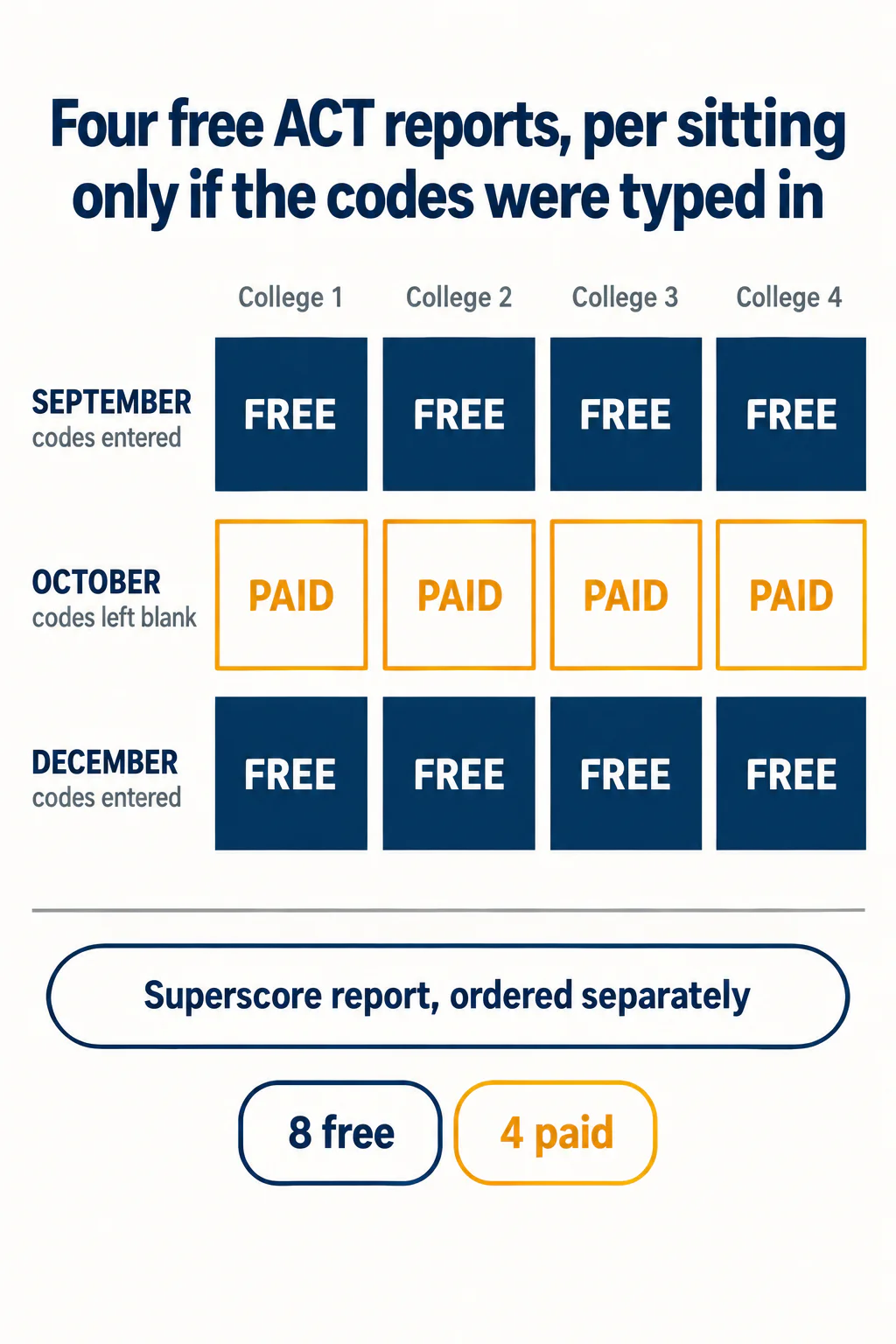
The four free score reports that come with your ACT registration are not four credits you spend after you see how you did. They are four boxes on the registration form. ACT's own fee page says the price includes reports for you, your high school and up to four colleges "if codes are provided when you register", and that parenthesis is the entire policy. Leave the boxes empty and nothing is held for you.
That makes sending ACT scores a decision you take before the test rather than after it, which is the reverse of how almost every guide describes it. Below is the procedure, the fee schedule as ACT publishes it today, and the arithmetic on all seven national test dates in 2026-27 that shows why waiting to see your score almost always costs 20 dollars a college.
Key Takeaways
- Enter college codes during registration. Up to four reports are included per test date only if the codes are there when you register.
- You can still change them until noon Central on the Thursday after the Saturday test, free, in MyACT.
- On five of seven 2026-27 dates that deadline falls on the same day online scores start appearing, and on the other two it falls twelve days earlier.
- Paper testers never see a score in time. Paper results land five to twelve days after the free window has shut.
- Adding the writing test delays what colleges receive, because ACT holds the whole report until every section is ready.
How do you send ACT scores to colleges?
There are two routes, and they cost very different amounts.
Route one, at registration. When you register, you are asked for college codes. ACT's registration page states plainly that "prices include score reports for you, your school, and up to four colleges." Fill in up to four and those reports are part of the fee you have already paid.
Route two, afterwards. Sign in to MyACT and order. ACT's instruction is to "create or sign in to your MyACT account, request score reports from your dashboard, and pay by credit card." The fee is 20 dollars per test date, per report. Requests are "processed after your test is scored and all results for your test option are available", and once ready, reports are "usually sent the same day."
Between those two sits a free grace period that is the most useful thing on this page, and the least advertised.
Your four free reports are chosen at registration, not after the test
The grace period is specific and it is short. ACT's support guidance for national testing reads: "you have until Thursday noon, central time, immediately following the regularly scheduled Saturday test date to correct your high school code and/or add/change/cancel college codes."
So the free list is editable for five days after you sit the test. You can add a college, swap one out, or cancel a choice you no longer want, at no charge, in MyACT. The path is Edit Score Recipients, then checkout, then submit, and the submit step matters because an unsubmitted basket is not a change.
After Thursday noon, the free route is gone for good
ACT is unambiguous about what happens next: "once your test has been scored, you are no longer able to update the non-test questions and will be charged a fee for any scores sent to colleges." There is no partial credit, no rollover to your next sitting, and no refund of the unused slots. A student who registered without codes and did nothing by Thursday has bought four reports and sent none of them.
One related option is worth knowing because it behaves differently from everything else in the fee table. A fifth and sixth college choice can be bought in advance at 20 dollars each, and ACT describes them as "request online before the test date" and "refundable on written request if you do not test." They are the only score-reporting fee on the schedule that comes back if you skip the test. Every other fee, including the registration fee itself, does not, and ACT confirms the consequence: "if you do not test, no score reports will be sent."
Does the free window ever stay open long enough to see your score?
This is the question the deadline actually turns on, and it can be answered exactly, because ACT publishes both halves. The free-choice deadline is fixed to the test date. Score release is published separately, with different dates for online and paper testing. Put the two tables side by side and the pattern is the same on every single date.
Taking the Saturday dates and the Thursday-noon rule together with ACT's initial release table:
| Test date | Free codes editable until | Online scores start | Paper scores start |
|---|---|---|---|
| 19 September 2026 | Thu 24 September, noon | 6 October | 6 October |
| 17 October 2026 | Thu 22 October, noon | 22 October | 27 October |
| 12 December 2026 | Thu 17 December, noon | 17 December | 22 December |
| 27 February 2027 | Thu 4 March, noon | 16 March | 16 March |
| 10 April 2027 | Thu 15 April, noon | 15 April | 20 April |
| 12 June 2027 | Thu 17 June, noon | 17 June | 23 June |
| 10 July 2027 | Thu 15 July, noon | 15 July | 20 July |
Online testers get hours; paper testers get nothing
On five of the seven dates, the online release date and the deadline date are the same calendar day. That is not a comfortable overlap. The deadline is a hard noon; release is a start, not a guarantee, and ACT says scores "continue to be processed during business hours" and that "over 97% of ACT scores are available online within 1-4 weeks after your test date." A score that appears at two in the afternoon appeared two hours too late to change a free code.
For paper testers there is no overlap at all. Five or six days separate the closed deadline from the first results, and on the September and February dates both formats release a full twelve days after the window shut. So the honest answer to "should I wait and see my score first" is that on the ACT you generally cannot, and the useful question becomes which four colleges are worth a report regardless of the number.
Not sure where your teen stands? A free consultation with Catalyst Test Prep maps exactly which ACT sections need the most work, so you are choosing those four college codes from a realistic score range instead of a guess.
Book a Free Consultation →What does it cost once the free window shuts?
Here is the current schedule as ACT publishes it, so you can see where score reporting sits against everything else you might pay for.
| Item | Fee | Note |
|---|---|---|
| The ACT Test (English, maths, reading) | $70.00 | Includes reports for you, your school and up to four colleges |
| Science add-on | $5.00 | Can be added or removed through the late deadline |
| Writing add-on | $25.00 | Delays what colleges receive, see below |
| Additional score report | $20.00 | Per test date, per report |
| 5th and 6th college choices | $20.00 each | Request before test day; refundable if you do not test |
| Archive fee | $32.00 | Added for scores three or more years old |
| Late registration | $42.00 | During the late period |
| Change fee | $49.00 | Test form, test day or test centre change |
Two things in that table are easy to misread. The archive fee is in addition to the 20 dollars, so an old score sent to one college is 52 dollars, which is why graduates reapplying often pay more to send a score than they paid to sit the test. And the change fee has a side effect on score reports that ACT spells out: if you make a test change, fees for fifth and sixth college choices, additional score reports and My Answer Key "will be updated to reflect the current price. You will be automatically refunded the original fee paid and charged the current price." Moving your test date re-prices anything you have already bought.
If money is the constraint, check eligibility before you pay rather than after. Our guide to who qualifies for an ACT fee waiver covers the thresholds, and waiver benefits are set annually, so confirm the current terms with your counsellor.
Colleges get your scores later than you do, and the writing test is why
This is the finding that catches the most families, and it is stated outright on ACT's own scores page. Writing takes longer to process: "processing writing scores may take longer than the multiple-choice section due to additional processing steps in the score verification process." Then comes the part nobody quotes:
"You'll see your multiple-choice scores, including your Composite score, as soon as they become available. Your scores will not be reported to score recipients until all scores from the event are available, so they have a complete record of your test."

So if your teen sat the ACT with writing, logs in, sees a 31 Composite and tells you the colleges have it, that is very likely untrue. The student view updates section by section. The recipient view waits for a complete record. Nothing is broken and nothing needs chasing; it just means the only reliable confirmation is in MyACT's order history, not in the score display.
There is a planning consequence too. If an application deadline is tight and the writing score is not required by that college, the writing add-on is buying you a delay you did not want. Decide on writing at registration on the merits, not as a default.
What "per test date, per report" means if you are retaking
ACT prices reports per sitting, not per student, and that is better news than it sounds. Because each report covers one test date, you choose which sittings a college sees. Reports can be ordered for "test events September 2011 to current, plus your Superscore."
That last item is a separate thing you can send. ACT "automatically calculates a Superscore for students who have tested more than once since September 2016", combining your highest section scores across dates, and superscoring will even "combine writing scores from one test date with multiple-choice scores from another test date." If you have tested twice, the Superscore is usually the report worth sending, and our explainer on how ACT superscoring actually works covers which colleges accept it. Read your target college's policy first, because a few still want every sitting.
Two practical rules follow. If you plan to retake, enter codes at every registration, because each sitting carries its own four. And if you are not sure a sitting is worth sending, do not buy a report for it; buy the one for the sitting you are proud of, or the Superscore.
The December ACT, in the order the dates fall
The 12 December 2026 ACT is the one most seniors are looking at now, and its dates do not fall in the order people assume.
- 6 November 2026 is the registration deadline, and the moment the four free codes are decided. A late fee applies after this date.
- 29 November 2026 is the late deadline.
- 7 December 2026 is the photo upload and standby deadline.
- 12 December 2026 is test day.
- 17 December 2026 at noon Central is the last moment to change a free college code, and the same day online scores begin appearing.
- 22 December 2026 is when paper scores begin appearing, five days after the free window closed.
Note what sits first in that list. The decision with real money attached is the one on 6 November, eleven days from now, and it is the one that looks like admin. If you need to move the date or the centre after registering, changing or cancelling an ACT registration covers the fees and the standby route. If you also sat the SAT, note that College Board runs the opposite system, where the four free reports stay orderable until nine days after the test; we worked through that gap in how to send SAT scores.
What to do this week
Four jobs, in order, and none of them takes long.
- Write down four colleges before you register. Not a shortlist of nine. The four that would read an ACT score and act on it.
- Register by 6 November with those codes in the form. Blank boxes are the single most expensive keystroke on the ACT.
- Put Thursday 17 December at noon Central in a calendar with a reminder the evening before. That is your free edit window.
- Decide on the writing add-on deliberately. Check whether any of your four actually require it, and remember it delays every report from that date.
If you want to know what score to expect before committing the codes, run your latest practice test through our ACT score calculator, and read how to read an ACT score report so the numbers mean something when they arrive.
Where this leaves you
Sending ACT scores is cheap if you treat it as part of registering and expensive if you treat it as part of getting your results. The four reports are tied to the codes you type on the form, the free edit window shuts at noon on the Thursday after the test, and on no 2026-27 date does a score reliably arrive before then. Paper testers can stop wondering entirely. And if the writing test is on your registration, expect your own score first and your colleges' copies later.
Pick the four colleges on evidence, not on optimism. That is a question about where a student realistically lands, which is a prep question before it is an admin one.
Ready to turn a prep plan into real score gains? Catalyst's 1:1 live online ACT and SAT programme starts with a free consultation to benchmark your teen's starting point and build a personalised path to their goal score.
Book a Free ConsultationSources checked 26 October 2026: ACT test fees, ACT score release dates and policies, ACT's sending-your-scores and registration pages, and ACT's support guidance on changing college codes.