
Most students take a practice test, look at the score, feel something about it, and move on. That is the whole reason practice scores plateau. Learning how to review an SAT practice test properly is the part of preparation that actually moves a number, and it takes roughly 90 minutes of unglamorous work per test.
The test itself gives you 98 questions of information about your own weaknesses, in 2 hours and 14 minutes. Throwing that away and booking another test is like weighing yourself twice instead of changing what you eat.
Key Takeaways
- Budget 90 minutes of review per full-length test, in four passes. Review time, not test volume, is what converts practice into points.
- Classify every error by cause before you read the explanation. Ten mistakes from four different causes are four separate problems with four different fixes.
- Review the questions you got right but were unsure about. They are the unstable ones, and the score report files them as wins.
- Errors in the first module cost more than errors in the second, because module 1 decides how hard module 2 will be.
- Finish by writing next fortnight's drill list. A review that does not change what you practise next week was entertainment.
Why does reviewing beat taking another test?
Because a practice test measures, and review teaches. Those are different activities and only one of them is optional.
A full-length Bluebook practice test is timed and mirrors real conditions, though it lets you move to the next section before time runs out. It produces a score if you were signed in with a College Board account while testing. That score tells you where you are. It tells you almost nothing about why, and "why" is the only actionable thing in the whole exercise.
There is a second reason, specific to the digital format. The SAT is adaptive by module: the first module in each section carries a broad mix of easy, medium and hard questions, and your performance on it decides whether the second module is harder or easier. So the questions you never saw are a consequence of the errors you made early. A student who reviews their whole test equally is spending the same attention on both, when the first module deserves more.
What Bluebook and My Practice actually give you
Before the method, know what tools you already have, because most students use one tenth of them.
- Score details in My Practice. Signed in to My Practice, you see every question on your practice test, the correct answer, the answer you selected, and a Review button with a breakdown of each answer choice. Not just a key. A reason for every option.
- A downloadable score report showing your performance across the content domains on the test, which is what turns "I am bad at maths" into "I am bad at two of the four maths domains".
- Tailored Practice, which builds question sets from the Student Question Bank based on how you performed, at the difficulty level you need.
- Test previews, which are untimed, unscored question sets whose only job is to let you try the tools. Use one before your first real practice test so you are not learning the interface and the content at once.
Two free supports sit alongside these. Khan Academy runs a matching review course for every official SAT practice test, and Schoolhouse.world offers live four-week small-group sessions led by trained peer tutors who scored well themselves. Our honest assessment of how far the free route gets you is in is Khan Academy enough for the SAT.
The 90-minute review method
Do this the day after the test, not the same evening. You need enough distance to read your own work without defending it.
- Ten minutes: read the report, not the score. Write down the two section scores, then the domain breakdown. Find the single weakest domain in each section. Those two are your fortnight's project.
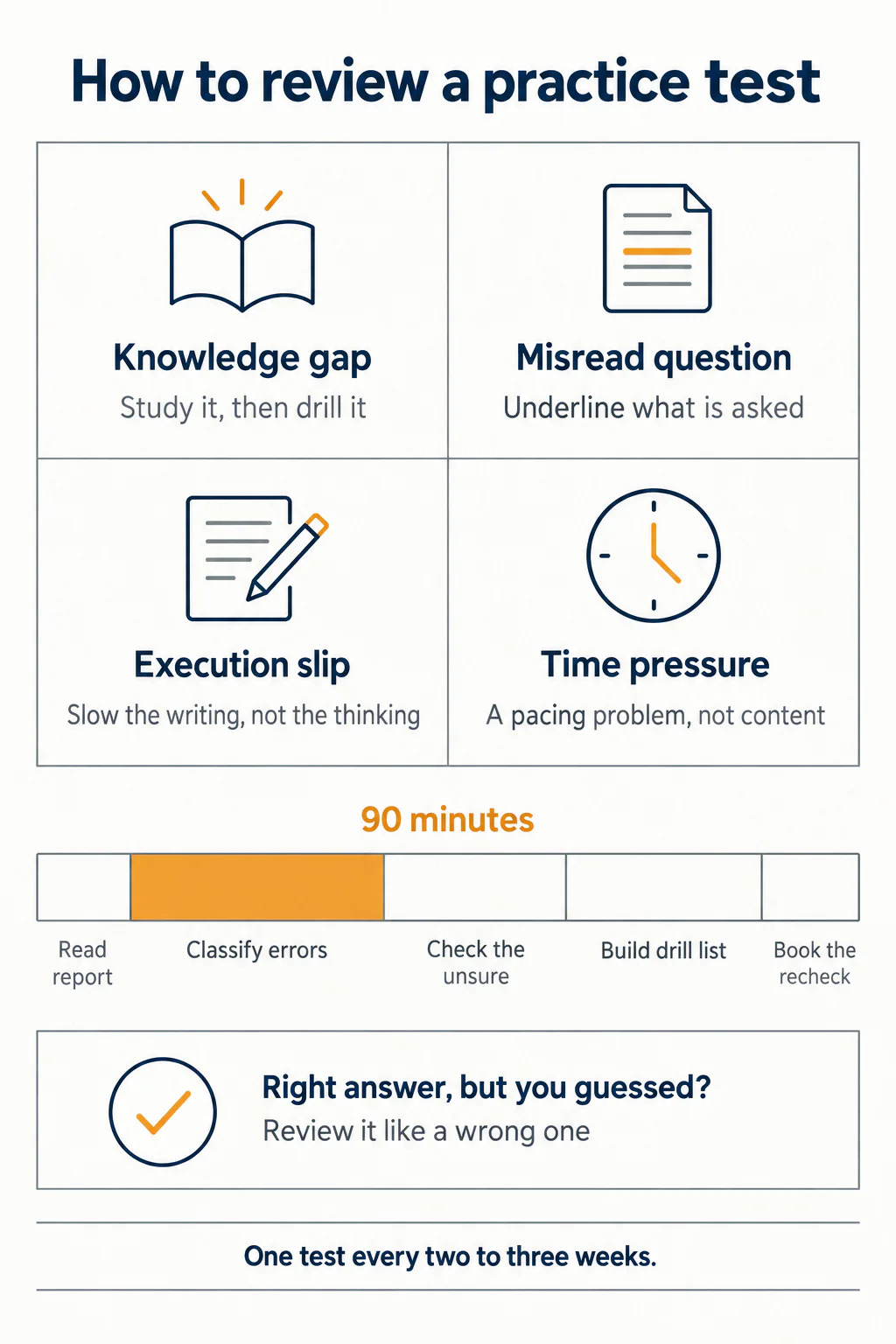
- Thirty minutes: classify every error before reading any explanation. For each wrong answer, write one of four causes (below). Resist opening the explanation first, because once you have read it every mistake looks careless.
- Twenty minutes: audit the shaky rights. Go through the questions you answered correctly but flagged, guessed, or spent too long on. Read those explanations properly.
- Twenty minutes: build the drill list. Convert the two weakest domains and your most common error cause into specific practice for the next fortnight, using Tailored Practice for volume.
- Ten minutes: schedule the recheck. Diary a redo of ten of today's wrong answers for two weeks from now, from scratch.
Not sure where your teen stands? A free consultation with Catalyst Test Prep maps exactly which SAT topics need the most work, so you're never guessing about study time.
Book a Free Consultation →Sort every error into one of four causes
This table is the whole method in miniature. The cause determines the fix, and treating every error as "I need to revise more" is why some students revise for months without improving.
| Cause | How you recognise it | The fix |
|---|---|---|
| Knowledge gap | You read the explanation and learn something new. You could not have got it. | Study the topic, then drill it. This is the only cause that more content revision solves. |
| Misread question | You solved a real problem correctly. It was not the problem on the screen. | Underline what is actually being asked before working. On maths, write the target quantity down first. |
| Execution slip | Right method, wrong arithmetic, sign, or transcription into the answer box. | Slow the mechanical step, not the thinking step. Most slips happen in copying, not reasoning. |
| Time pressure | You would have got it with another 40 seconds, and you know it. | A pacing problem, not a content problem. See our guide to digital SAT pacing. |
Count the four categories at the end. The shape of that count is your real diagnosis. A student with eleven knowledge gaps and one slip needs revision. A student with two gaps and nine slips does not need to learn anything, and telling them to study harder will make them worse.
Why the questions you got right matter too
Here is the part almost no guide includes, and the part experienced tutors go to first.
Every practice test contains a category the score report cannot see: questions you got right without really knowing why. You guessed between two options. You half-remembered a rule. You ran the arithmetic twice and picked the version that felt better. Those are marked correct, so they vanish from review, and then they reappear as errors on test day when the pressure is higher and the guess goes the other way.
The fix is mechanical. Use Mark for Review while you test, on anything you are not confident about, then treat every flagged-but-correct question as though it were wrong. Students who do this typically find five to ten of them per test. That is a meaningful slice of a score sitting in plain sight, filed under success.
How to turn a review into next week's practice
A review ends in a written list or it did not happen. The list has three lines.
- Two content domains, taken from the score report, to drill with Tailored Practice question sets.
- One error habit, taken from your cause count, with a specific countermeasure. "Write the target quantity before solving" is a countermeasure. "Be more careful" is not.
- Ten questions to redo in a fortnight, from scratch, to check the fix held.
For tracking those numbers across several tests rather than one, our guide to tracking practice scores covers what to log and what to ignore, and how the adaptive modules work explains why module 1 errors are weighted more heavily than their raw count suggests.
How often should you take a full practice test?
One every two to three weeks is plenty for most students, and the gap between them is not idle time. It is when the drills happen. A test every Saturday with no review produces a student who is very good at sitting the SAT and no better at answering it.
The exception is the final fortnight before a real test date, where a full sitting one week out is worth taking purely for stamina and timing, with a lighter review focused on pacing rather than content.
Conclusion
Knowing how to review an SAT practice test is the difference between collecting scores and improving one. Read the domain report before the score. Classify every error by cause, and let the shape of that count tell you what kind of problem you actually have. Audit the answers you got right while unsure, because those are the ones that move under pressure. Then write the drill list, because a review that changes nothing about next week was just a long look at a number.
Ready to turn a prep plan into real score gains? Catalyst's 1:1 live online SAT programme starts with a free consultation to benchmark your teen's starting point and build a personalised path to their goal score.
Book a Free ConsultationSource: College Board's own guidance on practising in Bluebook.