A 1200 is a good score. That is worth saying first, because most articles on this subject open by implying it is a problem. It is roughly the 74th to 83rd percentile, and it is competitive at a wide range of universities.
It is also, for a lot of students, the point at which progress stops. The prep that carried them from 1000 to 1200 stops working, the score sits still across three practice tests, and nobody can explain why.
Here is the useful reframe. Going from 1200 to 1400 on the SAT is about 20 more correct answers across a 98-question exam. Roughly ten in each section. Two or three per module. The difficulty is not volume, it is knowing which twenty questions to chase.
Key Takeaways
- A 200-point jump is roughly 20 more correct answers, about two or three per module. The exact figure varies by test form.
- 1400 sits near the 94th percentile against roughly the 74th to 83rd for 1200, so the jump moves you into the top 6 percent.
- Below 1200 most lost points are content gaps. Between 1200 and 1400 the mix shifts to pacing and careless errors, which need different work.
- First-module accuracy matters disproportionately, because it decides whether your second module carries the higher score ceiling.
- Plan on three to five months and 60 to 100 focused hours, with review time treated as seriously as practice time.
What 200 points actually costs you
The Digital SAT is 98 questions in 2 hours and 14 minutes: 54 in Reading and Writing across two 32-minute modules, and 44 in Math across two 35-minute modules.
Raw-to-scaled conversion varies between test forms, so no one can give you an exact number that holds every time. As a working figure, a 200-point gain from 1200 is in the region of 20 additional correct answers, split roughly evenly between the sections.
Ten more in Reading and Writing. Ten more in Math. Across four modules, that is two or three questions each.
Students find this genuinely encouraging, and they should. It also sharpens the real question. You are not trying to get better at the SAT in general. You are trying to find twenty specific questions you are currently losing and work out why.
Why the 1200 plateau happens
The prep that got you to 1200 was probably broad: work through content, do practice sets, take a test. That works early because when gaps are wide, almost any practice hits something.
By 1200, the wide gaps are closed. What remains is specific, and broad practice mostly rehearses what you can already do.
The errors in this band tend to fall into four groups.
Pacing collapse at the end of modules. Look at where your wrong answers sit. If they cluster in the final quarter of each module, the problem is time management, not knowledge. You would get those questions right with two more minutes.
Careless errors on questions you can do. The ones that produce a groan on review. Typically four to eight points per test, and they are the cheapest points on the board because no learning is required, only a process change.
Two or three recurring question types. Almost every student in this band has a small set of specific formats they reliably lose: rhetorical synthesis, or systems of equations in word form, or inference questions with two plausible answers.
Genuine content gaps, but narrow ones. Usually a small number of topics, often in advanced Math.
The proportions differ by student, which is exactly why generic advice stops working here. Our guide to the most common SAT prep mistakes covers the habits behind several of these.
Not sure where your teen stands? A free consultation with Catalyst Test Prep maps exactly which SAT topics need the most work, so you're never guessing about study time.
Book a Free Consultation →Build the error log first
Before any study plan, spend one session doing this. It is the highest-value hour in the whole process.
Take your most recent full-length practice test and go through every wrong answer. For each one, write a single line recording the question type, and the reason you missed it, chosen from four categories:
- Did not know it. A real content gap.
- Knew it, misread the question. A comprehension slip.
- Knew it, made an arithmetic or transcription error. Carelessness.
- Ran out of time. Pacing.
Then count the categories. That distribution is your study plan, and it usually surprises people. Students convinced they need more content work routinely find half their errors in categories 2 through 4, where more content teaching would change nothing.
| Your biggest category | What actually fixes it | Realistic gain |
|---|---|---|
| Did not know it | Targeted content work on the specific topics, not the whole syllabus | 40 to 80 points |
| Misread the question | Annotating what is being asked before looking at options | 20 to 50 points |
| Careless errors | A fixed checking routine and slowing down on easy questions | 20 to 60 points |
| Ran out of time | Pacing drills and a skip-and-return rule | 30 to 70 points |
Those ranges are typical rather than guaranteed, and they overlap because most students have a mix.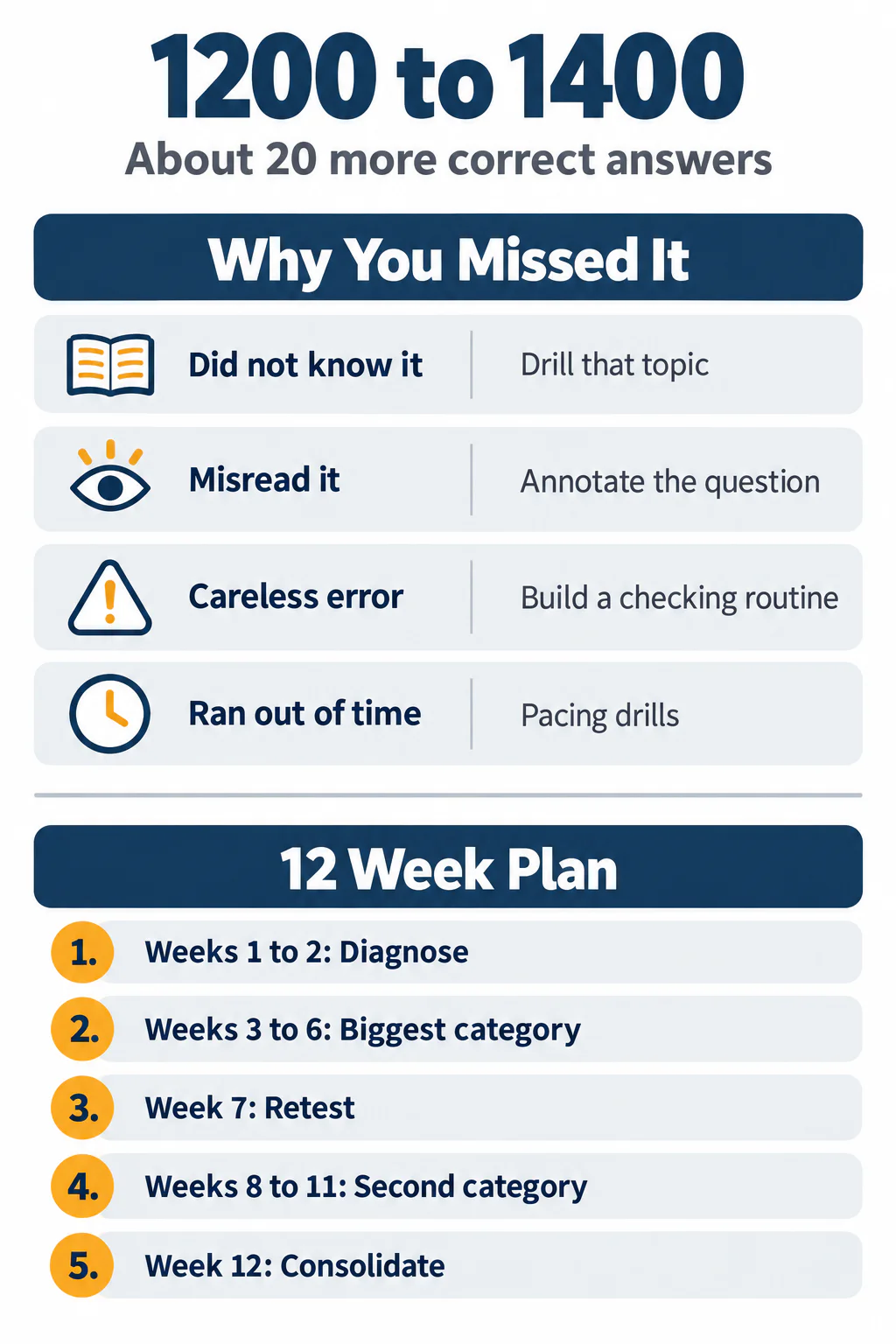
A twelve-week plan that works
This assumes five to eight hours a week. Adjust the length rather than the structure if you have more or less time.
Weeks 1 to 2: diagnose. Full-length official practice test under real conditions. Build the error log. Identify your two or three recurring question types by name. Do not start studying content yet.
Weeks 3 to 6: attack the largest category. Whatever your error log says is biggest. If it is content, drill those specific topics. If it is pacing, do timed module drills rather than untimed sets. Resist the urge to work on everything at once; this is where most plans dilute themselves into nothing.
Week 7: retest and re-diagnose. A second full-length test. Rebuild the error log from scratch. The distribution will have shifted, and your second half targets the new largest category.
Weeks 8 to 11: second category, plus maintenance. Attack the new biggest group while doing a short weekly set on the first one so it does not regress.
Week 12: consolidate. One final full-length test early in the week, light review of your personal error patterns, then taper. Cramming in the last week reliably costs more in fatigue than it gains in content.
For how this maps onto different total timelines, see how long it takes to improve your SAT score.
The adaptive detail that changes your strategy
This is worth understanding because it is specific to the Digital SAT and many students do not know it.
Each section has two modules, and your performance on the first decides whether the second is harder or easier. The harder second module carries the higher score ceiling.
The practical consequence: accuracy in module one is worth more than accuracy in module two. A careless error early does not just cost that question, it can route you to a version of module two that caps where you can finish.
So if you are rationing attention, ration it toward the first module of each section. Slow down slightly at the start, check work on questions you find easy, and do not guess quickly on something you could solve with another thirty seconds. Our guide to pacing on the Digital SAT goes into the timing detail.
What to do about Math specifically
Math is usually the faster half of a 1200 to 1400 jump, because the errors are more clearly defined. A student either knows how to handle a quadratic in vertex form or does not, and the fix is unambiguous.
At this level the recurring culprits are narrow: systems of equations presented as word problems, functions and notation, ratios and rates under time pressure, and a handful of geometry and trigonometry relationships. Our SAT Math syllabus breakdown maps the topics by weight, which tells you where drilling pays.
One habit worth building: use the built-in Desmos calculator deliberately rather than reflexively. Students at 1200 often either avoid it entirely or reach for it on every question. Both waste time. It is decisive on graphing and systems questions and slower than paper on simple arithmetic.
You can check where a raw score lands using our SAT score calculator.
Frequently Asked Questions
How long does it take to go from 1200 to 1400?
Most students need three to five months of consistent work, which usually means 60 to 100 focused hours. Students who review mistakes properly move faster than students who simply do more questions. A 200-point gain in under eight weeks is possible but uncommon, and usually happens when pacing rather than content was the real problem.
How many more questions do I need to get right?
Roughly 20 across the whole test, though the exact number varies by test form because scaling differs. That is about 10 more in Reading and Writing and 10 more in Math. Framed that way the jump is far less intimidating: it is two or three questions per module.
Is 1200 to 1400 harder than 1000 to 1200?
Yes, meaningfully. Below 1200 most lost points are content gaps, and learning the content recovers them. Between 1200 and 1400 the mix shifts toward pacing, careless errors and a handful of hard question types, which need different work. Same point gain, different problem.
What percentile is a 1400 SAT score?
Around the 94th percentile, against roughly the 74th to 83rd for a 1200. So the jump moves a student from the top quarter of test takers into roughly the top 6 percent. That shift is what changes which colleges treat the score as a strength rather than a neutral.
Should I focus on Math or Reading and Writing?
Whichever section has more recoverable points, which is not always the weaker one. Look at your error log, not your section scores. Math gains are usually faster to win because the errors are more clearly defined, but a Reading and Writing section full of transition and evidence errors is often equally fixable.
How many practice tests should I take?
One every two to three weeks, with a full review session after each. Taking tests more often than that leaves no time to act on what they show, and the official adaptive test pool is limited. Review time matters more than test count: budget at least an hour of review per test.
Can I get from 1200 to 1400 with self-study?
Some students can, particularly those who genuinely analyse their mistakes rather than repeating practice. The common failure is not knowing why a question was missed, which self-study rarely fixes because it is the hardest thing to see in your own work. That is where outside diagnosis earns its cost.
Why has my score stopped moving?
Usually because the practice you are doing no longer targets what you are getting wrong. Early prep improves scores almost regardless of method, because the gaps are broad. A plateau means the remaining errors are specific, and they will not move until you identify them precisely.
Does the adaptive format change my strategy?
Yes. Performance in the first module decides whether the second is harder or easier, and the harder path carries the higher score ceiling. That makes first-module accuracy disproportionately valuable. It also means guessing carelessly early costs more than the same mistake made later.
How does Catalyst help with a 200-point jump?
Catalyst starts with a free consultation, then a diagnostic that identifies which specific question types and habits are costing points, and builds a 1:1 study plan around them rather than a fixed syllabus. For a student stuck at 1200, the value is usually in the diagnosis: knowing which 20 questions to chase.
The short version
Twenty questions. That is the whole gap. Two or three per module, and a meaningful share of them are questions you can already answer but are losing to time pressure or carelessness.
The work is not more practice. It is one honest hour with your last practice test, sorting every mistake into why it happened, then spending the next month on whichever pile is largest.
Students who do that reach 1400. Students who keep doing untargeted practice sets usually sit at 1230 for six months and conclude they have hit their ceiling. They have not. They just have not found the twenty questions yet.
Once you get there, breaking the 1400 to 1500 barrier is a different problem again, and worth reading before you start it.
Ready to turn a prep plan into real score gains? Catalyst's 1:1 live online SAT programme starts with a free consultation to benchmark your teen's starting point and build a personalised path to their goal score.
Book a Free Consultation