
Nobody runs out of willingness to sit practice tests. They run out of official ones. The real limit on how many SAT practice tests you can take is the supply of adaptive forms College Board has published, and that supply is finite, unnumbered in public, and quietly changing as old forms retire. Which is why the honest answer to the question is not a number at all.
Four or five, spent deliberately across a three-month plan, with full review between each one. That is the working answer for most students, and the reasoning behind it matters more than the figure. This post explains what the supply actually consists of, why three different things all get called a practice test when only one of them gives you a score, and how to space the ones you have so you are not measuring the same student over and over.
Key takeaways
- College Board publishes no fixed count of Bluebook practice tests. Count what your own account offers.
- A test preview is not a practice test. It returns no score and no feedback on your answers.
- Practice tests are only scored if you are signed in to a College Board student account.
- Paper practice forms are nonadaptive and are meant for paper-accommodation candidates, not for predicting a digital score.
- The number that predicts a score rise is how many you review, not how many you sit.
Why will nobody tell you the exact number?
Because College Board does not state one. Its Bluebook practice page says only that "full-length practice tests are available in Bluebook for the SAT and PSAT assessments", and its practice tests page likewise points to "official full-length practice tests on the Bluebook app" without a total.
That is not an oversight. Forms get retired when they have been in circulation long enough, and new ones get added. Any article that tells you there are exactly six, or exactly ten, is quoting a snapshot that may already be stale, and the number is the one thing in such an article that is easiest to check and most likely to be wrong.
So the first step is mechanical: open Bluebook, sign in, and count. Then plan against that number rather than against somebody else's.
Three different things called a practice test
They are not interchangeable, and students routinely burn a week on the one that gives them nothing back.
| What it is | What you get back | Use it for |
|---|---|---|
| Full-length practice test in Bluebook | A score, on My Practice, if signed in | Measuring where you stand |
| Section-length practice | Partial, one section only | Pacing a single section |
| Test preview | No score, no feedback on your answers | Seeing the format once |
College Board is explicit about the last one: with a test preview "you won't receive scores or any feedback on your answers." It exists so that a student who has never opened Bluebook can see what a question screen, a timer and the built-in tools look like. It is twenty minutes well spent, once. It is not a data point and it should never appear in a count of practice tests taken.
The scoring condition on the real thing is worth repeating because it catches people out. "Full-length practice tests are scored if you're signed in to a College Board student account. After you complete a practice test in Bluebook, your scores will be available on My Practice." A student who works through a full form while signed out has spent more than two hours and has no record of it.
Why the paper practice tests will not predict your score
They are linear, and the digital SAT is not. College Board describes the paper forms as nonadaptive and recommends them "for students who will test with paper-based accommodations on test day", which tells you exactly who they are for.
The reason this matters is structural. On the digital test, your performance in the first module decides which second module you get, and the difficulty of that second module sets the range your section score can reach. A linear paper form has no routing to reproduce, so it cannot model the single mechanism that most affects the final number. A student can score well on paper and lower digitally without having got worse at anything.
If your teen genuinely tests on paper under approved accommodations, the paper forms are the right practice and this objection does not apply. For everybody else, use them as question banks, not as mock exams.
Not sure where your teen stands? A free consultation with Catalyst Test Prep maps exactly which SAT topics need the most work, so you're never guessing about study time.
Book a Free Consultation →How precise is one practice score?
Less precise than a three-digit number implies, and knowing why stops a lot of panic. Every SAT form, practice or real, carries questions that do not count. Reading and Writing presents 54 questions of which 50 are scored and 4 are unscored pretest items. Math presents 44 of which 40 are scored and 4 are pretest. Those items are, in College Board's own description, otherwise indistinguishable from the operational questions.
Add ordinary measurement error on top, which is the reason score reports show ranges at all, and a 30 or 40 point movement between two practice tests is not necessarily movement. It can be the same ability measured twice. Students who sit a test every weekend end up reading noise as progress or as collapse, and adjusting their plan to both.
This is the strongest argument against volume. A test you sit in order to feel busy adds a data point you cannot interpret.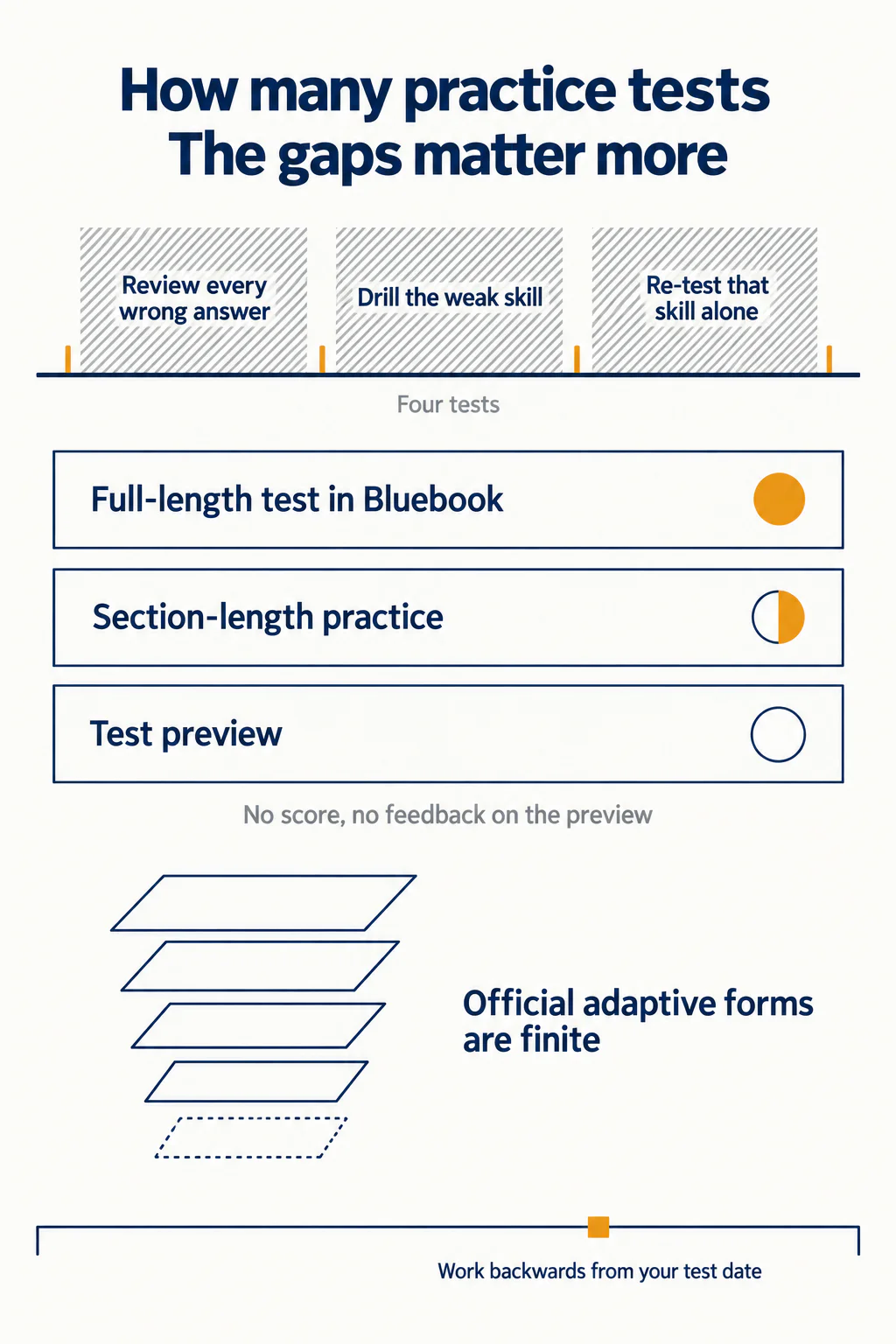
What should go in the gap between two practice tests?
More hours than the test itself took. A full SAT is 64 minutes of Reading and Writing and 70 minutes of Math, so a shade over two hours of testing. Reviewing it properly and then drilling what it exposed is a multiple of that, not a fraction.
The sequence that works, in the two to three weeks between forms:
- Review every wrong answer the same week, while you still remember what you were thinking. Our guide to reviewing an SAT practice test in ninety minutes sets out the method question by question.
- Sort the errors by cause, not by topic. A question missed on timing and a question missed on knowledge need opposite responses.
- Drill the single weakest skill for a week, in short sessions, away from full-length conditions.
- Re-test that skill alone using section-length practice or a module from a form you have already used. You remember the questions, which ruins it as a measurement and leaves it perfectly good as a drill.
- Only then spend a fresh form.
The reason to protect fresh forms this carefully is that there are not many of them and they are the only honest measurements you will get. A student who sits four forms in the first fortnight has converted the whole supply into one week of information.
What does the cadence look like across a real timeline?
Work backwards from the test date rather than forwards from today. The shape barely changes with the length of the plan; only the spacing does.
| When | What to sit | Why |
|---|---|---|
| Week 1 | Full form, timed, signed in | Baseline. Everything else is planned from it |
| Weeks 2 to 4 | Review and drill, no full form | Convert the baseline into a plan |
| Week 5 or 6 | Full form | First honest check on whether the drilling worked |
| Weeks 7 to 9 | Review and drill | Second round on the remaining weakness |
| Week 10 | Full form | Confirmation, and pacing under fatigue |
| Final 10 to 14 days | One last full form, then stop | Rehearsal, not diagnosis |
Note the last row. A practice test inside the final week tells you almost nothing you can still act on, and a disappointing one can cost more in confidence than it gains in information. Sit the last full form about a fortnight out, then taper to short sessions and test-day logistics.
Two other details worth settling before the first form. Take it inside Bluebook rather than on paper if you will test digitally, so the tools, timer and navigation are familiar rather than novel. And take it in one sitting, at roughly the time of day the real test starts, because the pacing problem on the SAT is a stamina problem as much as a clock problem. Average time per question is 1.19 minutes in Reading and Writing and 1.59 in Math, and nobody holds that rate for the second module if they have never tried.
So what is the number?
Four or five full-length official forms across a three-month plan, one every two to three weeks, each one fully reviewed before the next. Over a six-month plan, six or seven, with the extra space going into drilling rather than into more tests. Under a one-month plan, two: a baseline and a rehearsal, because there is no time to act on more than one round of findings.
If you have more official forms than your schedule has slots, that is a good position to be in. Keep them. If you have fewer, use section-length practice and re-sat modules for the drilling and save every fresh form for a real measurement. You can turn a raw count into a section score with the SAT score calculator while you plan.
The students whose scores move are not the ones who sat the most tests. They are the ones who could still tell you, a month later, exactly what the last test showed them.
Ready to turn a prep plan into real score gains? Catalyst's 1:1 live online SAT programme starts with a free consultation to benchmark your teen's starting point and build a personalised path to their goal score.
Book a Free Consultation