

Ask the internet how many AP classes you should take and you will get a number, usually somewhere between eight and twelve. Ask a college, and you will not get a number at all. Stanford's admission site says it directly: there is no minimum GPA and no specific number of AP or honors courses you must have on your transcript. That is not evasion. It is the actual policy, and once you understand why colleges refuse to name a figure, the question changes from "how many" into something you can answer about your own school and your own schedule. The national data makes the gap even starker: the real average is nowhere near eight.
Key takeaways
- No selective college publishes a required number of APs. Stanford says so in as many words.
- The real national average is about 3.7 AP exams per AP student across an entire high school career, not eight to twelve.
- Roughly one in three AP students never scores a 3 or higher on any exam. More exams do not mean more credit.
- Your count is read as a fraction of what your school offers. Four of five is not the same as four of twenty-two.
- Grades still edge rigour: 76.8% of colleges call grades considerably important against 63.8% for curriculum strength.
What do colleges actually say about the number?
They say there is not one. The clearest published statement comes from Stanford, which tells applicants outright that it has no minimum GPA requirement, "nor is there a specific number of AP or honors courses you must have on your transcript".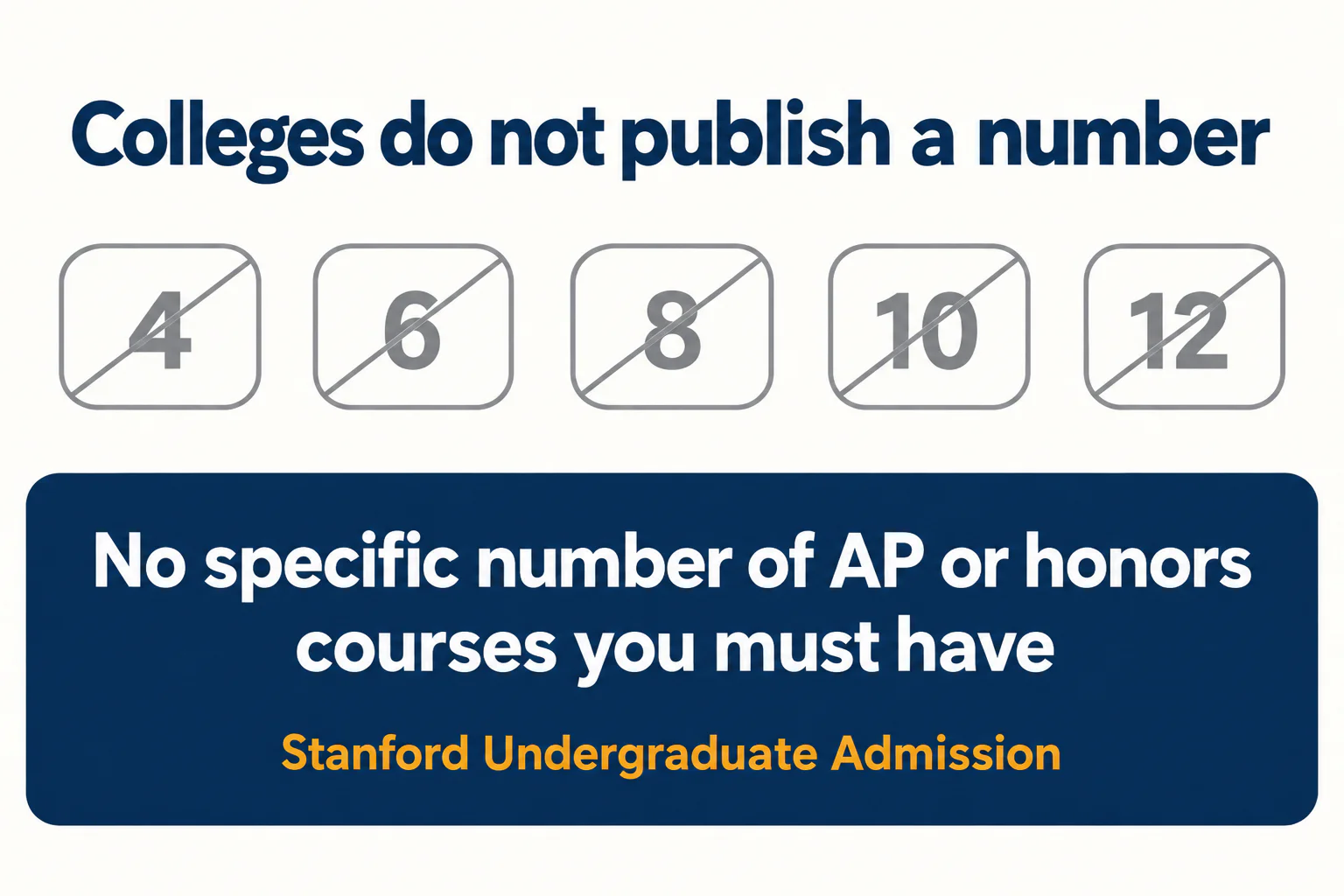
Stanford describes what it does instead: it looks at "how you have excelled in your school environment and how you have taken advantage of what is available to you in your school and community". Read that sentence carefully, because it contains the mechanism. The comparison is not against a national standard. It is against your own school.
That is why no number can exist. A fixed figure would reward students at well-resourced schools and punish students whose schools offer three AP courses in total, which is the opposite of what an admissions office is trying to measure.
How many AP exams do students actually take?
Far fewer than the advice suggests. College Board's own class of 2025 results report that 1,307,781 students, 37.0% of US public high school graduates, took at least one AP exam, and that those students sat more than 4.8 million exams between them.
Divide one figure by the other and the average AP student sits roughly 3.7 exams across their entire high school career. Not per year. In total. A student taking four APs is not lagging behind some national norm; they are slightly above it.
This matters because the "eight to twelve" advice circulating online is not describing typical applicants. It is describing a small, self-selected group at schools with deep AP catalogues, and presenting it as a standard.
Why does one in three AP students get no credit?
Because sitting an exam and scoring on it are different things, and the gap is larger than most families expect. Of the 1,307,781 students who took at least one AP exam, 875,778 scored a 3 or higher on at least one.
That is the contrarian number in this post, and it is computed directly from College Board's two published figures: about 33% of AP students, one in three, never score a 3 or higher on anything. Not on one exam. On any of them.
The planning consequence is blunt. Adding a sixth AP to a schedule that is already straining does not add credit, it adds the risk of a score that earns nothing. If credit is the goal, read our breakdown of what a 3, 4 and 5 are actually worth first, because the answer varies enormously by institution and by subject.
Not sure where your teen stands? A free consultation with Catalyst Test Prep maps exactly which AP subjects are realistic this year, so you're never guessing about workload.
Book a Free Consultation →Why your school's catalogue decides your number
Because the same count means different things in different buildings. Consider two students who each take four AP courses.
At a school offering five AP courses, taking four is close to exhausting the catalogue, and a counselor's school profile will say so. At a school offering twenty-two, the same four is under a fifth of what was available. Neither student is better. They are simply being read against different denominators, and only one of them has room to be asked "why not more".
So the question to answer is not "how many is enough". It is "what does my school offer, and how much of it can I take while keeping my grades up". Your counselor's profile already tells colleges the first half. You control the second.
Does a B in an AP beat an A in a regular class?
The honest answer is that it depends on the college, but the published survey data gives a usable steer rather than a shrug. NACAC's figures for the Fall 2023 admission cycle show how many colleges rate each factor as of considerable importance:
| Factor | Colleges rating it of considerable importance |
|---|---|
| Grades in college prep courses | 76.8% |
| Total high school grades, all courses | 74.1% |
| Strength of high school curriculum | 63.8% |
| Positive character attributes | 28.3% |
| Essay or writing sample | 18.9% |
Grades sit above curriculum strength by roughly thirteen points. Both are near the top and the two are not in opposition, which is exactly why the sensible load is the most demanding one you can carry without the grades slipping. A schedule that converts three As into three Bs has traded the higher-rated factor for the lower-rated one.
If you are weighing APs against college courses taken at a local institution, that is a different comparison with different mechanics, and we cover it in AP versus dual enrollment. On whether test scores still belong in this picture at all, see do SAT scores still matter.
A method for picking your own number
Four steps, and they take an evening.
- Get your school's actual AP list from the counselor, not from memory. The number of courses offered is the denominator everything else is read against.
- Subtract the ones you cannot take, because of prerequisites, timetable clashes or a year group restriction. The real menu is usually shorter than the catalogue.
- Count your current weekly hours honestly, including sport, work and travel, then add what one more AP costs. If the honest answer is that something has to go, you have found your ceiling.
- Decide per subject whether you will sit the exam. The course appears on your transcript either way, and the exam is the part that has to clear a 3 to be worth credit.
Step four is the one families skip, and it is where the one-in-three figure bites. Once you know which exams you are committing to, the next question is when to start preparing for them, which we work through in when to start studying for AP exams. The short version is that the 2027 exams run 3 to 14 May and your subject's date, not the month, sets your deadline.
Where students get this wrong
Three patterns, all of them common.
The first is counting instead of choosing. A student picks a target number, usually from a forum, then works backwards to fill it with whatever fits the timetable. That produces a transcript with an AP the student had no reason to take and a grade that shows it.
The second is loading the junior year. Junior year already carries the heaviest workload for most students, and stacking four new APs onto it is where grades slip. Spreading the same courses across two years usually produces the same count and better grades.
The third is treating the exam as automatic. Sitting an exam you are not ready for costs a fee and produces a score you may then want to withhold. Our guide to sending, withholding and cancelling AP scores covers what your options are afterwards, but the cheaper fix is deciding earlier.
Conclusion
How many AP classes you should take has no national answer because colleges deliberately do not set one. What they do is read your transcript against your own school's catalogue, which makes the useful question "how much of what was available did I take, and did my grades hold". The national average is about 3.7 exams per AP student, one in three AP students never scores a 3 or higher on anything, and grades are rated above curriculum strength by three quarters of colleges. Take the most demanding load you can carry well. That sentence is not a dodge; given the evidence, it is the only defensible answer.
Ready to turn a prep plan into real score gains? Catalyst's 1:1 live online AP programme starts with a free consultation to benchmark your teen's starting point and build a personalised path to their goal score.
Book a Free ConsultationFigures checked against College Board's AP Program Results for the class of 2025, NACAC's factors in the admission decision and Stanford's published selection criteria, all checked 31 October 2026. The per-student average and the one-in-three figure are computed here from College Board's two published totals.