
The short answer: 125 minutes of testing for the three sections that produce a Composite score, or 165 minutes if you add the optional science section. The optional essay adds another 40.
The longer answer is more useful, because those numbers hide two things that change how you should prepare. The time per question is now wildly uneven between sections, and 23 of the questions you answer do not count toward your score at all. Both facts come straight out of ACT's own published specifications, and neither tends to appear in a list of test times.
Key Takeaways
- 125 minutes of testing for the Composite, 165 with science, plus 40 more for the optional essay.
- 23 of the 131 questions do not count. ACT embeds field-test items that are "not counted in students' scores".
- Unscored questions are not spread evenly: a quarter of the reading section is field-test material, against fewer than one in ten in mathematics.
- Reading changed most. It went from roughly 53 seconds per question to roughly 67, about a quarter more time.
- The whole test day is 30 minutes shorter for national testing but only 10 minutes shorter for state and district testing.
ACT section times and question counts
This is the current structure, consistent across ACT's test-structure page and its February 2026 research report on the enhancements.
| Section | Questions | Scored | Minutes | Approx. seconds per question |
|---|---|---|---|---|
| English | 50 | 40 | 35 | 42 |
| Mathematics | 45 | 41 | 50 | 67 |
| Reading | 36 | 27 | 40 | 67 |
| Composite total | 131 | 108 | 125 | 57 |
| Science (optional) | 40 | 34 | 40 | 60 |
| Total with science | 171 | 142 | 165 | 58 |
| Writing (optional) | 1 essay | n/a | 40 | n/a |
Science and writing are both optional and both reported separately. The Composite is built from English, mathematics and reading only.
None of these figures include arrival, check-in, identity verification, instructions or breaks. Plan on a test morning considerably longer than the testing time, and work out your actual finish time from your admission ticket rather than from this table.
Why are 23 questions not counted?
This is the part most students have never been told, and it is stated plainly in ACT's documentation: the enhanced test "includes embedded field-test items, which are not counted in students' scores."
Field-testing is how any serious exam gets built. Before a question can be scored it has to be tried on real students to see whether it behaves properly. The legacy ACT did this with a separate section at the end of national test days, often called the fifth test. The enhanced ACT does it invisibly, by mixing trial questions into the real sections.
The counts are specific:
- English: 40 scored, 10 field-test, 50 total
- Mathematics: 41 scored, 4 field-test, 45 total
- Reading: 27 scored, 9 field-test, 36 total
- Science: 34 scored, 6 field-test, 40 total
So across the three required sections, 23 of 131 questions are unscored, which is about one question in six.
Notice how unevenly that lands. In mathematics fewer than one question in ten is a trial item. In reading it is exactly a quarter. A student who answers 27 reading questions well and runs out of time on the last nine has not necessarily lost nine scored questions, and a student who nails nine of them may have earned nothing at all.
What should you actually do about it?
Nothing clever, and this matters. You cannot identify a field-test question, they are not flagged, and guessing at which ones to skip would be a way to throw away scored questions.
The useful conclusions are quieter:
- Treat every question as scored. It is the only safe policy.
- Stop over-reading a single hard question. If one question feels oddly worded or unusually difficult, there is a real chance it is a trial item that will never count. Give it your best guess and move.
- Be careful comparing raw counts to scaled scores on unofficial practice material, because the ratio of scored to total questions in a commercial practice test will not match the real thing.
Not sure where your teen stands? A free consultation with Catalyst Test Prep maps exactly which SAT topics need the most work, so you're never guessing about study time.
Book a Free Consultation →How much shorter is the enhanced ACT, really?
Here is the comparison, using ACT's own figures for the legacy test.
| Section | Legacy questions | Legacy minutes | Enhanced questions | Enhanced minutes |
|---|---|---|---|---|
| English | 75 | 45 | 50 | 35 |
| Mathematics | 60 | 60 | 45 | 50 |
| Reading | 40 | 35 | 36 | 40 |
| Science | 40 | 35 | 40 | 40 |
| All four | 215 | 175 | 171 | 165 |
ACT's summary is that "Total testing time is reduced, with Composite scores requiring 125 minutes of testing for the enhanced ACT rather than the 175 minutes required for the legacy ACT", and that "Most of this reduction is because of the science test being optional and not included in the Composite score."
That sentence is worth reading twice. The headline saving of 50 minutes is mostly not a shortening of the test. It is the removal of a section from the Composite. A student who still takes science sees 171 questions in 165 minutes against 215 in 175, which is a real but much smaller change.
And the saving on the day depends on where you sit the test. ACT states that because legacy national testing included a stand-alone 20-minute field-test section, "for students taking all four section tests through national testing, the entire testing experience for the enhanced ACT is 30 minutes shorter", while "for students taking all four section tests through state and district testing, the entire testing experience for the enhanced ACT is 10 minutes shorter."
Thirty minutes against ten, for the same test, decided by which administration you are in. Few comparisons online make that distinction.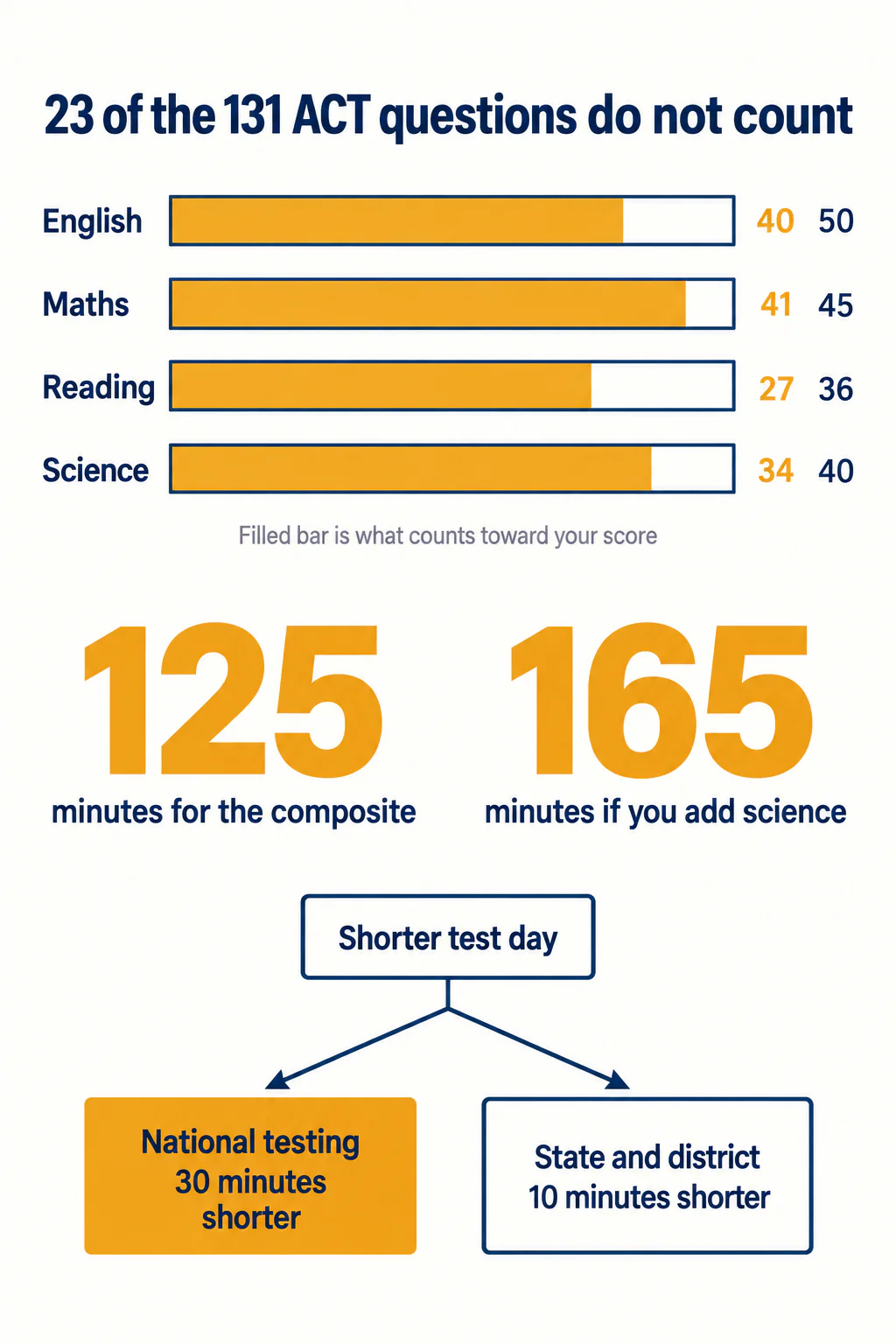
The pacing change nobody mentions
ACT reports that the enhanced test "offers an average of nine seconds more per item", and adds that "this difference varies across test sections." It varies a great deal.
- English: about 36 seconds per question to about 42. Six seconds more.
- Mathematics: about 60 to about 67. Seven seconds more.
- Science: about 53 to about 60. Seven seconds more.
- Reading: about 53 to about 67. Fourteen seconds more.
Reading received double what any other section received, because it is the one place where the question count fell while the time went up. Four fewer questions and five more minutes is a substantially different test to sit.
If you prepared from older material, or from advice written for the legacy format, the reading guidance you absorbed was built for a quarter less time per question. The old strategies were shaped by that scarcity: skim first, answer line-reference questions only, abandon the hardest passage. With 67 seconds a question those trade-offs are no longer obviously correct.
English went the other way in character. It is still the fastest section by a wide margin, at around 42 seconds, and it is now 50 questions rather than 75. Short and brisk.
Planning your test day around the real numbers
- Decide about science early. It is 40 questions and 40 minutes, it sits outside the Composite, and that decision changes your preparation more than anything else on this page. Our breakdown of the optional ACT science section covers who should still take it and why.
- Decide about writing separately. Forty minutes, one essay, reported separately, no effect on the Composite. Take it if a college asks and not otherwise.
- Practise with the current timings. Not 35 minutes for reading. Forty.
- Set a per-question budget per section rather than one for the whole test. Fifty-seven seconds is an average that applies to no section.
- Check your admission ticket for the real schedule, including breaks, and work out your finish time from that.
Once you have real scores, two follow-ups are worth knowing. ACT superscoring determines what a college actually reads across multiple sittings, and the My Answer Key service is the only way to see your own questions and answers after the fact, which is where genuine diagnosis happens. If you are still weighing the ACT against the SAT, our comparison of which test suits which student is the place to start, and the ACT score calculator will turn a practice raw score into a scaled estimate.
The ACT is shorter than it was, and most of the saving came from making a section optional rather than from making the test faster to sit. The part that genuinely changed is the pace of the reading section, and that is the part worth rebuilding your preparation around.
Ready to turn a prep plan into real score gains? Catalyst's 1:1 live online SAT programme starts with a free consultation to benchmark your teen's starting point and build a personalised path to their goal score.
Book a Free ConsultationQuestion counts, timings and the field-test figures come from ACT's Design Framework for the ACT Enhancements (February 2026) and its test sections and structure page.