
Four of the 44 questions in the Digital SAT math section are never scored. College Board's own test specifications put 20 operational questions and 2 pretest questions in each of the two modules, so the item you spend four minutes on may be a trial question that counts for nothing. That single fact reframes the whole hunt for the hardest SAT math questions. The goal is not to collect rare problems. It is to recognise the handful of structures that show up on every form, in every module, and to know which solve path is shorter.
There are six of those structures. Below is each one, the phrase in the question stem that gives it away, a worked example, and the specific mistake that costs the point. Every number cited here was checked against College Board on 15 October 2026.
Key takeaways
- Only 40 of the 44 math questions are scored. Each module holds 20 operational items and 2 pretest items, and you cannot tell them apart.
- Algebra and Advanced Math are roughly 35% of the section each, so about 70% of your math score comes from two domains.
- Stems like "exactly one solution" and "no real solutions" are instructions to use the discriminant, not invitations to solve for x.
- Difficulty is part of the scoring model: College Board says the same number of correct answers can produce different section scores.
- Seventy minutes for 44 questions is about 95 seconds each, which is why the Desmos path matters on the problems where it saves three steps.
What makes the hardest SAT math questions hard?
Structure, not content. The maths in the hardest items on the Digital SAT rarely goes past Algebra 2, and most of it is on the syllabus of a typical tenth-grade course. What changes is how many translation steps sit between the sentence you read and the equation you can solve.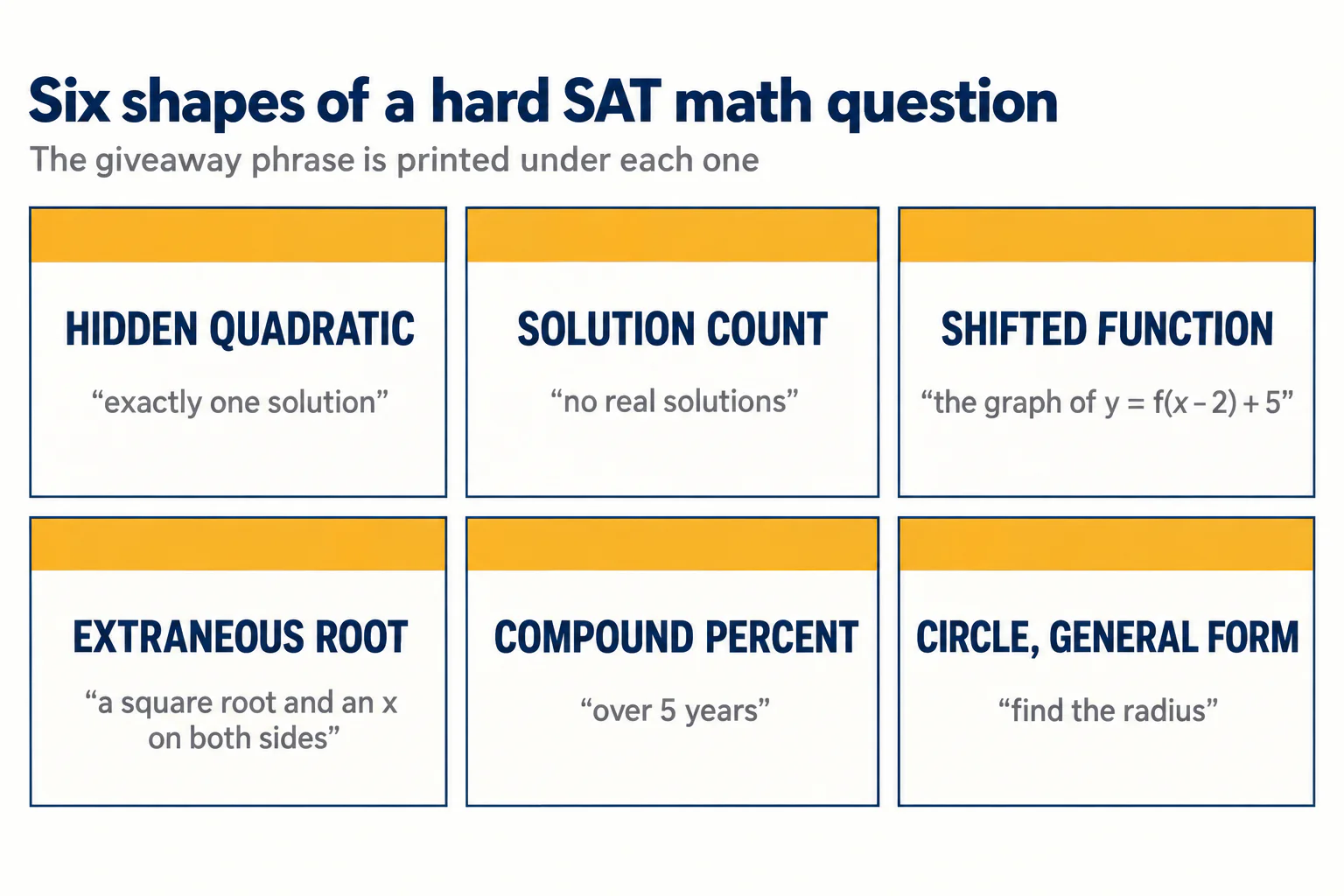
About 30% of math questions are set in a context, which means a scenario you have to strip back to a relationship between quantities. A hard question usually stacks two of those translation steps on top of each other, then asks for something adjacent to the thing you solved for. You find x and the question wants 2x + 1. You find the vertex and the question wants the value of a constant that puts a line below it.
Name the failure mode plainly: students lose these points by answering a question the test did not ask. The maths was right. The target was wrong.
The six shapes that keep coming back
1. The hidden quadratic
Giveaway phrase: exactly one solution, or exactly one real zero.
Worked example: the function f(x) = x2 + bx + 9 has exactly one real zero. What is a possible value of b?
A single real zero means the discriminant equals zero, so b2 - 4(1)(9) = 0, giving b2 = 36 and b = 6 or b = -6. The trap is reflexive factoring. Nothing here factors until you know b, and students burn 90 seconds trying before they read the condition as an instruction. If you need a refresher on the standard forms, our guide to the SAT math formulas worth memorising covers the discriminant alongside the rest.
2. The condition on the number of solutions
Giveaway phrase: no real solutions, infinitely many solutions, or exactly two solutions.
Worked example: the system y = x2 - 4x + 7 and y = k has no real solutions. What is the greatest possible integer value of k?
Set them equal: x2 - 4x + (7 - k) = 0. No real solutions means the discriminant is negative, so 16 - 4(7 - k) < 0, which simplifies to k < 3. The greatest integer value is 2. The trap is answering 3, because 3 is the value at which the line touches the curve, and touching is one solution rather than none.
3. The shifted or composed function
Giveaway phrase: the graph of y = f(x - 2) + 5, or any f(g(x)).
Worked example: g(x) = f(x - 2) + 5. If f has a minimum value of -3 at x = 1, at what point does g reach its minimum?
The minus two inside the function shifts the graph right by 2, and the plus five lifts it by 5, so the minimum moves to x = 1 + 2 = 3 and the value becomes -3 + 5 = 2. The answer is the point (3, 2). The trap is the sign: a minus inside moves the graph in the positive direction, which contradicts what the symbol looks like it should do. This is the single most common careless error in the Advanced Math domain.
4. The equation that manufactures a wrong answer
Giveaway phrase: a square root with an x on both sides of the equals sign.
Worked example: solve the square root of (2x + 7) = x + 2.
Square both sides: 2x + 7 = x2 + 4x + 4, so x2 + 2x - 3 = 0, which factors to (x + 3)(x - 1) = 0 and gives x = -3 or x = 1. Now check both in the original. At x = -3 the left side is 1 and the right side is -1, so it fails. Only x = 1 works. Squaring an equation can create a solution the original never had, and the checking step is the entire point of the question. Skip it and you have done the algebra perfectly and still lost the mark.
5. Compounded percent change
Giveaway phrase: a growth factor plus a time span, such as over 5 years.
Worked example: a population is modelled by P(t) = 1,200(1.04)t, where t is years. By what percentage does the population grow over 5 years?
Raise the factor, do not multiply the rate: 1.045 = 1.2167, so the growth is about 21.7%. The trap is 20%, from multiplying 4% by five years, and it is a plausible-looking distractor on a Problem-Solving and Data Analysis item. Percent change on the SAT is almost always compounded, almost never linear.
6. The circle hiding in general form
Giveaway phrase: an equation with x2, y2 and single x and y terms, then a question about radius or centre.
Worked example: x2 + y2 - 6x + 8y = 0. What is the radius of the circle?
Complete the square twice: (x - 3)2 + (y + 4)2 = 9 + 16 = 25, so the radius is 5. The trap is the zero on the right, which looks like a radius of zero. Nothing in the equation is in a usable form until you have moved the constants, and Geometry and Trigonometry is only about 15% of the section, so most students have practised this shape far less than they have practised linear algebra.
Not sure where your teen stands? A free consultation with Catalyst Test Prep maps exactly which SAT topics need the most work, so you're never guessing about study time.
Book a Free Consultation →Where the hardest SAT math questions sit on the test
They are concentrated, and the concentration is published. College Board's math specifications weight the four content domains at approximately 35% Algebra, 35% Advanced Math, 15% Problem-Solving and Data Analysis, and 15% Geometry and Trigonometry, which works out to 13 to 15 questions each for the two big domains and 5 to 7 each for the two small ones.
Five of the six shapes above live in Algebra or Advanced Math. That is where your practice time belongs, and it is why a reading-heavy study plan quietly underperforms. The section itself runs 44 questions across two 35-minute modules, with roughly three quarters multiple choice and the remaining quarter student-produced response questions where you type the answer and no distractor can rescue a misread.
And then the detail almost nobody mentions. Each module carries two pretest questions that do not count toward your score, so 4 of the 44 are being trialled on you. You cannot identify them and you should not try. The practical consequence is about how you handle a question that feels impossible: it may be impossible because it is unscored. Mark it, move, come back.
Why the hardest question is rarely what costs you the score
This is the contrarian part, and it comes straight from College Board rather than from a tutor's intuition. On how scores are calculated, College Board states that "Two students who answer the same number of questions correctly in a test section may earn differing section scores based on the characteristics, including difficulty level, of the particular questions they answered correctly." Difficulty is inside the scoring model, through Item Response Theory, not bolted on afterwards.
That is usually quoted as evidence that hard questions matter more. Read the next part and the argument inverts. College Board also states that a student's "section score is based on how they did on all of the questions in both modules" and that "a range of section scores" is "possible no matter which second module a student sees".
So the second module is not a verdict. A student routed into the harder module can still score below a student routed into the easier one, because accuracy across every item is what is being measured. The lever is not the three hardest questions on the form. It is the fifteen mid-difficulty questions in module one, where the routing decision is made, and where a careless sign error does the same damage as failing to solve something genuinely difficult.
Students sitting in the 1400s know this intuitively. They look at their practice reports and see no cluster of exotic failures, just four or five preventable slips. Our guide on breaking through the 1400 to 1500 barrier makes the same case from score data, and a hardest-questions list is the wrong tool for that job.
The two-way solve, and when Desmos wins
Every question in this article can be answered twice: once with algebra, once by graphing. Bluebook contains an embedded Desmos calculator with graphing and scientific modes, and a calculator is permitted for the whole math section, so the choice is live on every item.
Take shape 2 again. The algebra path is five steps: set the expressions equal, collect terms, recall that no real solutions means a negative discriminant, solve the inequality 16 - 4(7 - k) < 0, then take the greatest integer below 3. The Desmos path is two: graph y = x2 - 4x + 7, read the vertex at (2, 3), and note that any horizontal line below 3 misses the curve entirely.
Where graphing wins: solution counts, intersections, systems with one non-linear equation, anything asking for a maximum or minimum, and anything you can state as "where do these two things meet". Where algebra wins: exact values with radicals or fractions, questions about a general constant rather than a number, and any case where typing the expression takes longer than solving it. Our walkthrough of the Desmos calculator on the Digital SAT covers the keyboard shortcuts that decide which of those two is actually faster.
The real skill is choosing in under five seconds. That is a drill, and almost nobody practises it.
What should you practise instead of a hardest-questions list?
Three things, in this order.
- Classification without solving. Take 20 official questions, and for each one write only the shape name and the giveaway phrase. No working. Ten minutes total. You are training the recognition step that the six shapes above all depend on.
- The adjacent-target check. Before you commit an answer, reread the final sentence of the question and ask what quantity it wants. This catches the single most expensive error pattern in SAT math, and it costs four seconds.
- Error review by cause, not by topic. Sort your wrong answers into misread, arithmetic slip, method gap, and ran out of time. Only the third one calls for more content study. Our method for reviewing an SAT practice test properly sets out the sorting step in full.
Once those three are running, a hard-question set is genuinely useful, because by then you are using it to test recognition speed rather than to meet an unfamiliar structure for the first time under timed conditions. Checking your projected score as you go is worth doing with the Digital SAT score calculator rather than by feel.
The hardest SAT math questions, in short
Six structures account for most of what students call impossible, and five of the six sit in Algebra or Advanced Math. The giveaway is always a phrase in the stem rather than a topic, so recognition beats content revision. Four of the 44 questions are not even scored, which is reason enough to stop treating any single item as decisive. And College Board's own scoring documentation says a range of section scores is possible whichever second module you see, so accuracy across the whole test is the lever, not a list of rare problems.
Practise classifying before solving, check the target quantity before you commit, and sort your errors by cause. That is a fortnight of work and it is worth more than a hundred hard questions.
Ready to turn a prep plan into real score gains? Catalyst's 1:1 live online SAT programme starts with a free consultation to benchmark your teen's starting point and build a personalised path to their goal score.
Book a Free ConsultationSources, all checked 15 October 2026: College Board, how the SAT is structured for question counts, module timing and adaptive routing; College Board, how scores are calculated for the Item Response Theory quotations; College Board's math specifications for the domain weights and the 20 operational plus 2 pretest split; and College Board's calculator policy for the embedded Desmos tool in Bluebook.