

On ACT's own 2025–26 practice test, the matrix question is number 6. The complex-number question is number 18. The radians conversion is number 24. Those are the topics most "hardest ACT math questions" lists lead with, and on the official form they all sit in the first half of the section. ACT's February 2026 design framework describes the enhanced math blueprint as "ordered in increasing difficulty", so position on the form is a rough measure of how hard ACT thinks an item is.
So what is actually at the hard end? Ordinary skills, stacked. A function table read three times over. Probability where the coin is not fair. Two right triangles that share a side. This post works through seven of the hardest official items from ACT's current practice test, shows the wrong answer each one is built to catch, and explains what makes the hardest ACT math questions hard on the enhanced test: 45 questions, 50 minutes and four answer choices.
Key Takeaways
- ACT orders enhanced math items by increasing difficulty, and on its official practice form the rare topics (matrices, complex numbers, radians) appear early.
- In the last 15 questions of that form, 8 of the 14 scored items are Integrating Essential Skills: rates, averages, proportions and multi-step reasoning.
- ACT cut advanced-topic items from about six per form to three, so drilling obscure topics buys less than it used to.
- In ACT's own study, students using a wrong method picked the right answer 19% of the time on four-choice items, worse than a blind guess.
- Four of the 45 questions are unscored field-test items, and you cannot tell which, so no single hard question deserves three minutes.
What actually makes an ACT math question hard?
The number of steps, not the rarity of the topic. On the enhanced ACT, a hard item usually asks you to do two or three routine things in sequence, and the wrong answers are the numbers you get if you stop one step early or run one step the wrong way.
The evidence is on ACT's own scoring key. On the 2025–26 "Preparing for the ACT" practice form, every math item is tagged with a reporting category. Split the 45 items into thirds and count:
| Items | Integrating Essential Skills | Preparing for Higher Math | Unscored |
|---|---|---|---|
| 1 to 15 | 6 | 8 | 1 |
| 16 to 30 | 2 | 11 | 2 |
| 31 to 45 | 8 | 6 | 1 |
Integrating Essential Skills (IES) is ACT's name for problems built from rates, percentages, proportions, averages and measurement. ACT describes it as measuring how well you "synthesize and apply your understandings and skills to solve more complex problems". It sounds like the easy category. On this form it dominates the hardest third.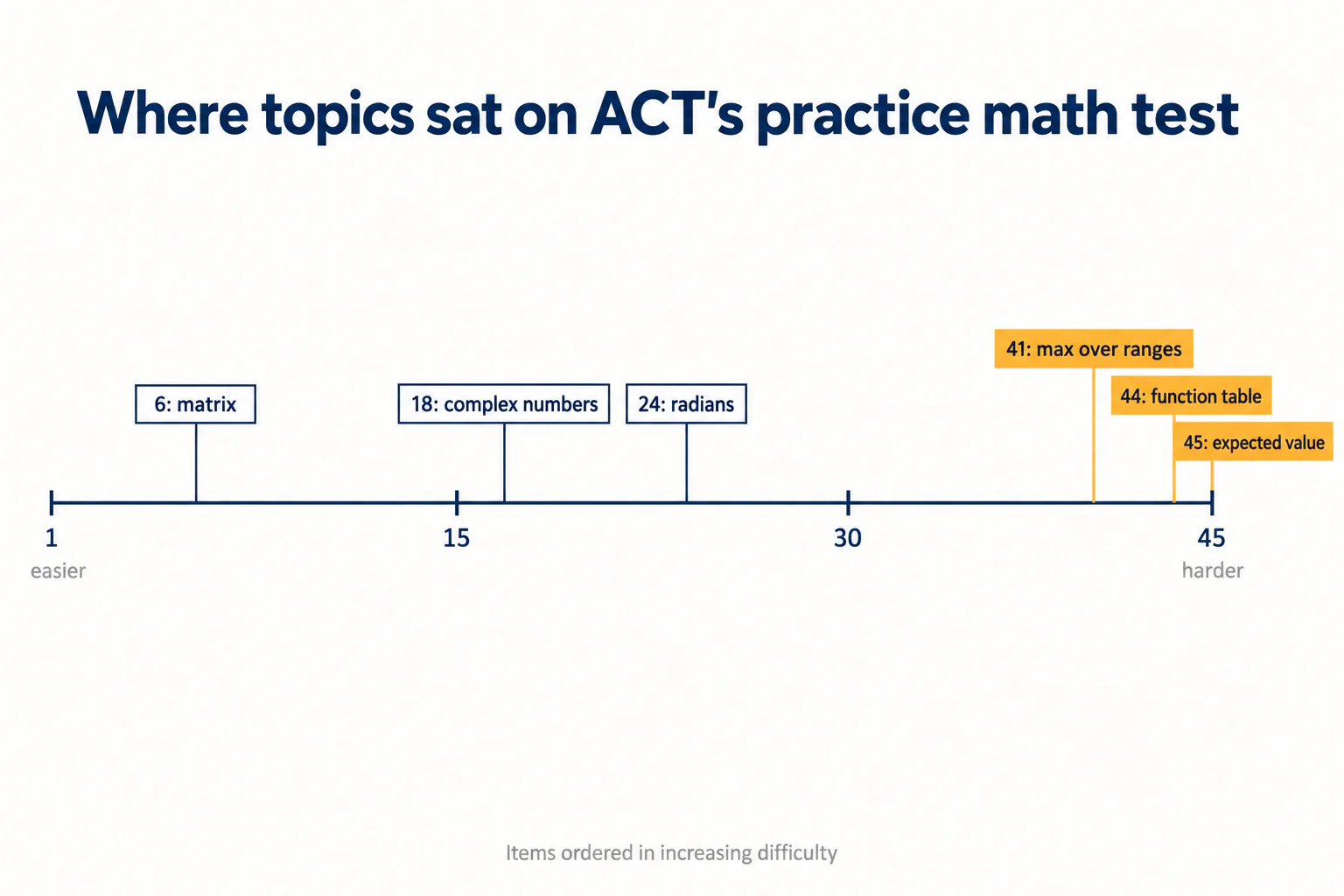
ACT made this shift deliberately. Its design framework says legacy forms averaged six advanced-topic items (10%) and enhanced forms reduce that to three (7%), partly because many students showed "nonsolution behavior" on them, meaning they gave up or guessed at random. Three questions out of 41 scored is not where a score is won or lost.
How is the enhanced ACT math section built?
Forty-five questions in 50 minutes, four answer choices each, a calculator allowed throughout, and no formula sheet. Of the 45, only 41 count. ACT's own table puts the pace at 67 seconds per item, up from 60 on the legacy test.
| Legacy ACT math | Enhanced ACT math | |
|---|---|---|
| Questions | 60, all scored | 45, of which 41 scored |
| Time | 60 minutes | 50 minutes |
| Seconds per item | 60 | 67 |
| Answer choices | 5 | 4 |
| Advanced-topic items | about 6 (10%) | about 3 (7%) |
| Formula sheet | No | No |
Four details matter for the hard questions specifically.
- The field-test items are hidden. ACT places them "strategically throughout the section tests" so students treat them like real items. On the practice form they were numbers 7, 16, 29 and 40, and ACT notes the slots change from form to form.
- Word problems are harder by design. ACT says items in a real-world context "take more time to read and are generally more difficult" than the same topic without context, and plans for 24% to 29% of enhanced items to have one.
- Complex formulas are given to you. The framework states that "for many items that require a complex or unfamiliar formula, the needed formula is included in the item." Our list of ACT math formulas you must memorize covers the common ones that are not.
- The calculator is allowed but not always useful. ACT's directions note that "some of the problems may best be done without using a calculator". Check which models are permitted in our ACT calculator policy guide.
The new versions are still easy to miss. PrepScholar's well-known list of the 21 hardest ACT math problems, last updated in August 2024, uses five-choice questions and describes 60 questions in 60 minutes. Practise on four-choice items from ACT's current materials.
Not sure which ACT math questions are costing your teen points? A free consultation with Catalyst Test Prep reads a practice score by reporting category and by position in the section, so you know whether the problem is content or pacing.
Book a Free Consultation →Seven of the hardest ACT math questions, worked
All seven come from the math section of ACT's free 2025–26 Preparing for the ACT booklet, and all seven are scored items. The setups are paraphrased here; try each one from the official PDF before reading the solution.
1. Question 21: two right triangles that share a side
The setup. Rectangle ABCD has a point E on side AD. Segments BE and CE cut it into three triangles. DE = 7 cm, BE = 26 cm and CE = 25 cm. Find BC.
The solve. Triangle CDE has its right angle at D, so DC = √(25² − 7²) = √576 = 24. Opposite sides of a rectangle are equal, so AB = 24 too. Triangle ABE has its right angle at A, so AE = √(26² − 24²) = √100 = 10. BC equals AD, which is AE + ED = 10 + 7 = 17 (C).
The trap. The answer choices are 10, 15, 17 and 24. Two of them, 24 and 10, are the intermediate lengths you find on the way. A student who stops after the first triangle picks 24. Students who know the 7-24-25 and 10-24-26 triples skip the square roots entirely.
2. Question 30: how many points satisfy both conditions?
The setup. How many points in the coordinate plane are 5 units from the origin and also 2 units from the line y = 0?
The solve. Points 5 units from the origin form a circle of radius 5. Points 2 units from the x-axis form two lines, y = 2 and y = −2. Each line is closer to the centre than the radius, so each crosses the circle twice. That gives 4 points (J), at x = ±√21 on each line.
The trap. Drawing only y = 2 gives 2 (H). "Distance from a line" works on both sides of the line, and the question is testing whether you remember that.
3. Question 37: "all and only" the zeros
The setup. p(x) = x³ + x² − 8x − 12, and (x − 3) is a factor. Which choice gives all and only the zeros of p?
The solve. Divide by (x − 3) with synthetic division: the coefficients 1, 1, −8, −12 become 1, 4, 4 with remainder 0. The quotient is x² + 4x + 4 = (x + 2)². The zeros are 3 and −2, and −2 is a repeated root. Answer: −2 and 3 (C).
The trap. Choice A, −3 and −2, flips the sign of the known factor. Choice D, 2 and 3, flips the sign of the repeated one. The phrase "all and only" is there because a cubic usually has three zeros, and students go looking for a third one that does not exist.
4. Question 41: pushing an expression to its maximum
The setup. 1 ≤ m ≤ 4, 4 ≤ n ≤ 6 and 8 ≤ p ≤ 10. What is the greatest possible value of (m/n)(1/p)?
The solve. The expression is m ÷ (n × p). Make the top as large as possible and the bottom as small as possible: m = 4, n = 4, p = 8. That gives 4 ÷ 32 = 1/8 (D).
The trap. Using the largest value of every variable gives 4 ÷ 60 = 1/15, which is choice B. Using the right m and n but the largest p gives 1/10, choice C. This is an Integrating Essential Skills item with no advanced content at all. It is hard because the instinct "greatest value means use the greatest numbers" is wrong for anything in a denominator.
5. Question 42: standard deviation without calculating
The setup. Which dataset has the largest standard deviation: 0, 0, 10, 10; 0, 1, 9, 10; 2, 3, 5, 7; or 5, 5, 5, 5?
The solve. Standard deviation measures typical distance from the mean. The first two sets both have a mean of 5. In 0, 0, 10, 10 every value is 5 away from the mean. In 0, 1, 9, 10 two values are only 4 away. So 0, 0, 10, 10 (F) is more spread out.
The trap. 0, 1, 9, 10 looks more varied because it has four different numbers and the same range. Typing all four sets into a calculator gets the right answer too, but costs a minute that the next question needs.
6. Question 44: a composite function read from a table
The setup. A table lists f(x), g(x) and h(x) for x = 1 to 5. Given h(f(g(a))) = 1, find a.
| x | f(x) | g(x) | h(x) |
|---|---|---|---|
| 1 | 2 | 4 | 3 |
| 2 | 1 | 5 | 1 |
| 3 | 4 | 2 | 5 |
| 4 | 5 | 3 | 4 |
| 5 | 3 | 1 | 2 |
The solve. Work from the outside in, reading the table backwards each time. h of something equals 1 only when that something is 2. f of something equals 2 only when that something is 1. g(a) = 1 only when a = 5. Answer: 5 (J).
The trap. Working inside out means testing all five values of a, which takes three lookups each. Stopping after the first reverse lookup gives 2, which is choice F.
7. Question 45: expected value with an uneven coin
The setup. A coin lands faceup three times as often as facedown. A player wins $1.00 for faceup and $2.00 for facedown. What is the expected value of one toss?
The solve. If facedown has probability q, faceup has 3q, and 3q + q = 1, so q = 1/4. Expected value = (3/4)(1.00) + (1/4)(2.00) = 0.75 + 0.50 = $1.25 (A).
The trap. Averaging the two prizes gives $1.50 (C), which treats the coin as fair. Reading "three times" as a split into thirds gives $1.33 (B) or $1.67 (D). Every wrong choice is a specific misreading of the first sentence.
Why does a wrong method score worse than a blind guess?
Because ACT builds the three wrong answers out of real mistakes. In the cognitive-lab study reported in its 2026 design framework, students who used targeted, correct approaches got four-choice items right 79.7% of the time. Students who used what ACT calls maladaptive approaches got them right 19.0% of the time, below the 25% a random guess would earn.
The worked items above show why. In question 21, a student who stops early lands on 24, which is printed as a choice. In question 45, a student who ignores the uneven coin lands on $1.50, also printed. A wrong method does not give you a random wrong answer. It leads you to the one ACT wrote for that mistake.
ACT's review panel made the same point when the change was proposed: going to four options did not make the test easier, "since the three wrong answer options could include many common misconceptions and errors for any given item." The practical lesson is that if your answer appears instantly on a hard late item, check which step you might have skipped before you bubble it.
How should you pace the last 15 questions?
Bank time early and set a hard ceiling late. ACT's research found that on the legacy test, where the standard was 60 seconds per item, more than half the students spent over 180 seconds on one unusual, difficult math item rather than answering and moving on. That single question cost them the time for two or three others.
- Move fast through 1 to 30. Aim to reach question 31 with at least 20 minutes left. The early items are where most students collect most of their raw score.
- Give each late item one honest attempt, about two minutes. If you have not found the path by then, eliminate what you can, guess, flag it and move on.
- Never leave a blank. ACT scores only correct answers, and its own booklet says "there is no penalty for guessing."
- Use the last minutes on flagged items, starting with the one you got furthest into.
ACT's own booklet gives the same advice in its test-taking tips: answer the easy questions first, then return to the difficult ones. The hidden field-test items are one more reason not to overinvest. Any one hard question could be among the four that do not count.
How are these different from the hardest SAT math questions?
The SAT's hard questions are concentrated by an adaptive engine; the ACT's are concentrated by position. On the digital SAT, a strong first module sends you to a harder second module, and Desmos is built into the test. Our guide to the hardest SAT math questions shows how often a graph solves them faster than algebra.
The ACT works differently. Everyone sees the same items in the same order, there is no built-in graphing tool and no reference sheet, and the hardest material sits at the end. That makes ACT difficulty partly a pacing problem. A student who reaches question 40 with eight minutes left will score differently from one who reaches it with two, even with the same knowledge. If you are still choosing between the tests, our comparison of which test suits which student covers the wider picture.
What should you practise instead of a hardest-questions list?
Full official forms, timed, then a review sorted by item position. A list of hard questions trains the topics; a timed form trains the decision about when to stop.
- Use ACT's current practice tests. They have four choices and 45 questions. Note that the forms are not identical in mix: the 2025–26 booklet form scores 16 items as Integrating Essential Skills, while ACT's 2026 Online Practice Test 2 key scores 8, which matches the published blueprint.
- Review by position. Mark which of your misses came in 1 to 30 and which in 31 to 45. Early misses are usually careless or content gaps. Late misses are usually skipped steps or time.
- Turn the raw score into a scale score with the form's own conversion table. On the booklet form, 35 of 41 scored items converts to 32 and 29 of 41 to 27. Our guide to estimating an ACT score from a practice test explains why the table changes between forms.
- Know your target. A student aiming for a 26 can miss several of the last 15 and still get there. Check what counts as a good ACT score for the colleges on your list before you spend weeks on the final five questions.
The hardest ACT math questions, in short
The hardest ACT math questions on the enhanced test are rarely about rare topics. ACT has cut advanced items to about three per form and orders the section by difficulty, so the hard end is filled with routine skills chained into several steps, each with a wrong answer waiting for the student who stops early. Learn to recognise the chain, cap your time at about two minutes per late item, guess rather than leave a blank, and practise on four-choice official forms. That combination is worth more than another list of obscure topics.
Ready to turn ACT practice into real score gains? Catalyst's 1:1 live online ACT prep starts with a free consultation to benchmark your teen's starting point and build a personalised plan around the questions that are actually costing points.
Book a Free ConsultationSources checked 18 November 2026: ACT, Preparing for the ACT Test 2025–2026 (math practice items 21, 30, 37, 41, 42, 44 and 45, mathematics scoring key, reporting categories, test-taking tips); ACT Research, Design Framework for the ACT Enhancements, R2519, February 2026 (test specifications, embedded field-test items, four answer options, advanced topics, items in context, formula sheet, speededness findings, Table 3.14); ACT National Online Practice Test 2 scoring key; ACT, Description of the Mathematics Test; PrepScholar, "21 Hardest ACT Math Problems" (updated 29 August 2024). Practice items are paraphrased; see ACT's booklet for the original wording and figures.