
Four or five weeks before the first deadlines, most families discover that applying early is not one choice but five, and that the differences between them are legally and financially significant. The early decision vs early action question is the one that matters most, because only one of the two can oblige you to attend a college you have not yet compared against any other.
About 450 colleges offer some form of early admission plan. Getting this right is largely a matter of reading the rules literally, which sounds obvious and is exactly what goes wrong.
Key Takeaways
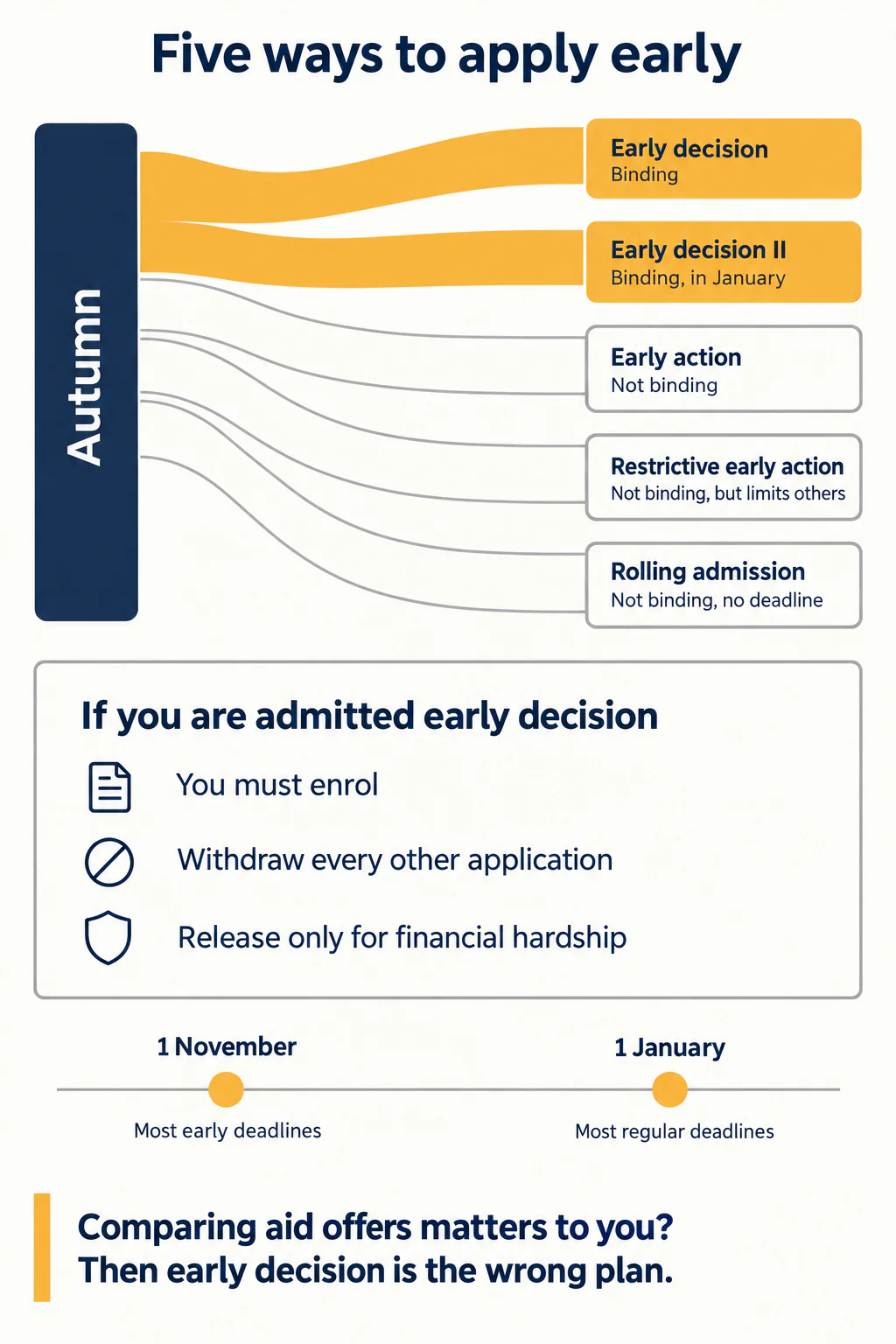
- Early decision binds you. If the college admits you and offers enough financial aid, you must enrol, withdraw every other application and start no new ones.
- Early action does not bind you. You can hold the offer until the spring reply date and keep every other application alive.
- Restrictive early action is narrower than its reputation. Yale's version permits non-binding early applications to public universities and to any programme notifying after 1 January.
- The real cost of early decision is not the commitment. It is losing the ability to compare financial aid offers side by side.
- Rolling admission rewards being early without asking for anything in return, which makes it the lowest-risk way to hold an acceptance by December.
What are the five plans, in one table?
| Plan | Binding? | Typical deadline | What it costs you |
|---|---|---|---|
| Early decision (ED) | Yes | 1 or 15 November | One college only, and no aid comparison |
| Early decision II | Yes | Early January | Same commitment, later |
| Early action (EA) | No | 1 or 15 November | Nothing. An earlier answer, no strings |
| Restrictive or single-choice EA | No | 1 November | Limits which other early applications you may file |
| Rolling admission | No | No single deadline | Nothing, but places fill as the cycle runs |
Regular decision sits behind all of them, usually with a 1 January deadline. Harvard, for example, sets 1 November for restrictive early action and 1 January for regular decision, with school counsellors given an extra week to file supporting documents.
What does binding actually mean?
It means what it says, and families routinely underestimate it. Under early decision you are making a commitment to a first-choice college: if admitted, you will enrol. You may not apply to other colleges under their binding plans at the same time. If you are accepted, you must withdraw all other applications and initiate no new ones.
There is one release valve. Students admitted under early decision may be released from the commitment in cases of documented financial hardship. College Board's own wording for the commitment is worth reading closely: if the college accepts you and offers enough financial aid, you must go to that college.
That phrase, "enough financial aid", is where the whole question lives. It is not a loophole for changing your mind. It is a recognition that a binding agreement cannot compel a family to pay what it does not have. Treat it as a genuine protection and not as a plan.
How restrictive is restrictive early action?
Here is the most common piece of self-inflicted damage in the autumn of senior year: students read "single-choice early action", assume it means one application until December, and file nothing else.
Yale's rules are more precise than that. A student applying single-choice early action to Yale may not also apply early action or early decision to other colleges or universities. But the restrictions do not apply to non-binding early programmes at public institutions, and they do not apply to early decision or early action programmes that notify applicants after 1 January. And if you are admitted early, you may keep active applications at other colleges.
Read what that permits. A student can apply single-choice early action to a highly selective private university and still file non-binding early applications to state flagships in the same autumn. Many do not, purely because they never read past the word "single".
Every restrictive plan words its carve-outs slightly differently, so check the specific college. The point is that checking is worth an evening.
Not sure where your teen stands? A free consultation with Catalyst Test Prep maps exactly which SAT topics need the most work, so you're never guessing about study time.
Book a Free Consultation →When does early decision cost you money?
Not through the aid formula. A college calculates need the same way in November as in April. The cost is structural: with one binding acceptance and every other application withdrawn, you have exactly one offer and nothing to weigh it against.
College Board is direct about this, advising students not to apply early if they want to compare admission and financial aid offers from several colleges. For a family who will pay full price, or a family whose first choice is clearly the most generous, that trade is often worth making. For a family relying on merit money, it rarely is, because merit awards vary far more between colleges than need-based packages do. Our guide to SAT scores and merit scholarships covers how those thresholds usually work.
A reasonable rule: if the difference between two likely aid packages would change your family's decision, do not apply early decision.
What is early decision II, and who is it for?
Early decision II is a second binding deadline, normally in early January. It carries exactly the same commitment as early decision I, and exists to give students more time to decide to apply early.
It suits three situations well. A student whose first choice only became obvious after visiting in the autumn. A student who was deferred or rejected from an early decision I college and still wants the advantage of applying under a binding plan somewhere. And a student whose autumn testing did not land in time for a November deadline, since a December sitting can still reach a January one, provided score release timing works out.
How does rolling admission change the calculation?
Rolling admission reviews applications as they arrive and issues decisions continuously until the class fills. There is no single deadline and no commitment attached.
Its usefulness is psychological as much as strategic. A rolling acceptance in October or November changes the temperature of the entire application season: the student has somewhere to go, and every subsequent application is made from a position of choice rather than anxiety. That is worth a great deal in a household where the SAT is also being retaken.
The only real discipline rolling demands is not to treat "no deadline" as "no hurry". Places and, at many universities, scholarship funds are finite and awarded as the cycle progresses.
Where do test scores fit into an early timeline?
They fit earlier than families expect, and this is where an autumn plan usually breaks. If a college requires or will consider a score and your deadline is 1 November, the useful sittings are the ones whose results arrive before it. That normally means testing has to be finished by the autumn sitting, not started then.
Two practical consequences. First, a student planning to retake should look at retaking strategically rather than simply booking the next available date. Second, know what you are allowed to send: superscoring and Score Choice often make one more sitting worthwhile, because only your best section scores need travel.
Conclusion
The early decision vs early action choice comes down to one question asked honestly: is this college so clearly your first choice that you would accept its offer without seeing another one, including the money? If yes, early decision converts that certainty into a genuine advantage. If there is any hesitation, early action gives you almost all of the benefit and none of the obligation, restrictive plans permit more than their names suggest, and rolling admission lets you hold an acceptance while you think. Read each college's actual wording before 1 November, and let the calendar rather than the folklore decide.
Ready to turn a prep plan into real score gains? Catalyst's 1:1 live online SAT programme starts with a free consultation to benchmark your teen's starting point and build a personalised path to their goal score.
Book a Free ConsultationSources: College Board BigFuture on early decision and early action, and Harvard College application requirements.