
Ask that question in a room of ten families and you will get ten answers, most of them out of date. So here is the version that survives contact with the actual admission pages: do SAT scores still matter depends on two things, and neither of them is a national trend. It depends on which colleges are on your list, and it depends on the year you graduate from high school.
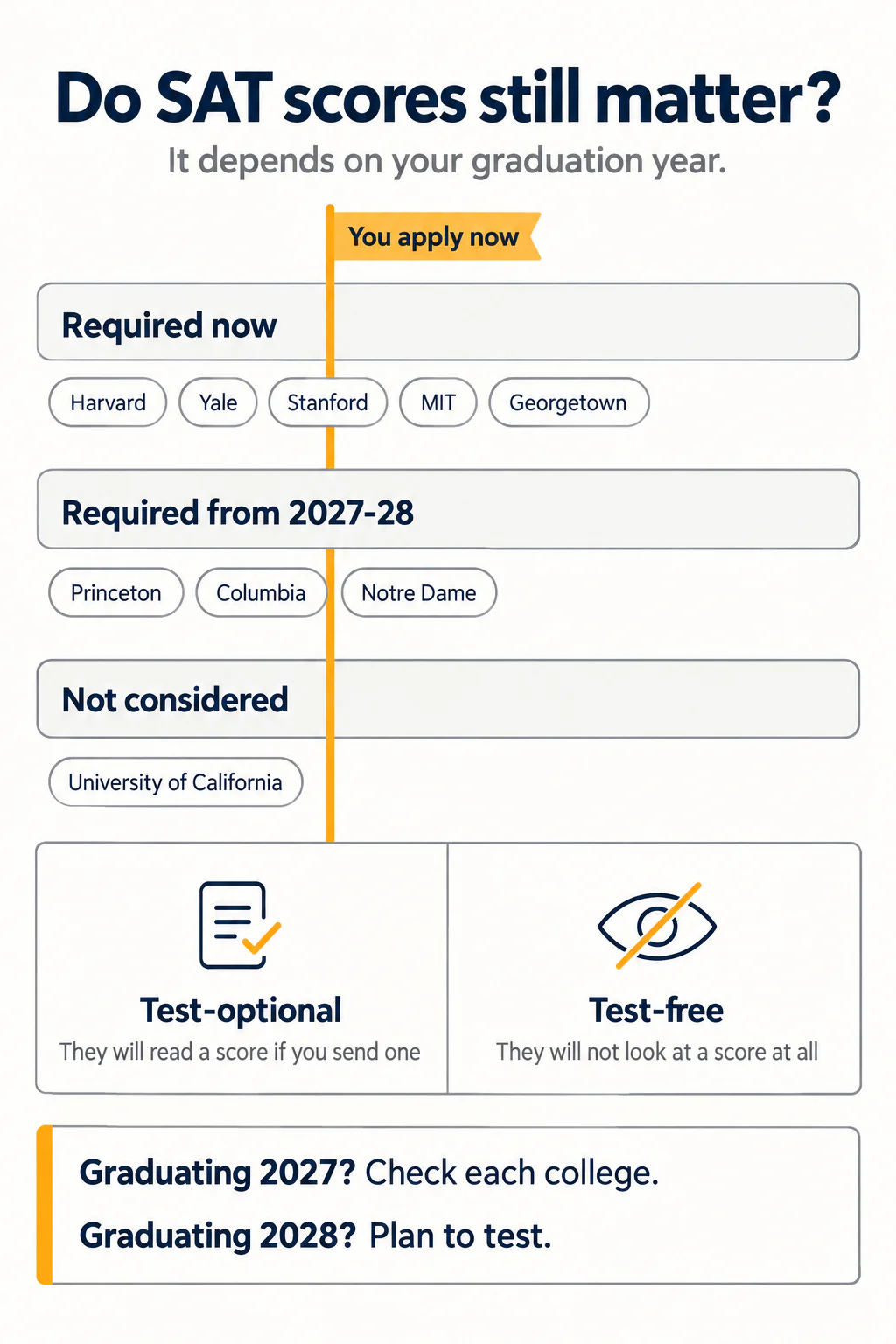
Harvard, Yale, Stanford, MIT and Caltech all require a score from the students applying this autumn. Princeton does not. Princeton will, but not until the students currently in eleventh grade apply. The University of California will not look at a score whatever you do. All four of those statements are true at the same time, which is why a single headline about the SAT "coming back" is useless to anyone actually filling in an application.
Key Takeaways
- The reversal is real but narrow. It is concentrated among the most selective private universities and a few flagship publics, not across all of American higher education.
- Your graduation year is decisive. Princeton, Columbia and Notre Dame begin requiring scores with the 2027-28 application cycle, so a current senior and a current junior face different rules at the same school.
- Test-optional is not test-blind. The University of California will not consider a score for admission or scholarships. Most test-optional colleges will read one gladly.
- Princeton reviewed five years of its own data and found that students who submitted scores went on to perform better academically than those who did not. That is the argument that changed minds.
- Merit money is the quiet reason to test. Award thresholds at many public universities are tied to scores even where admission is not.
Which colleges require the SAT or ACT right now?
A score is compulsory at a specific, growing and still fairly short list of institutions. These are the ones whose own admission pages state a requirement for current applicants.
| College | Status for current applicants | Detail worth knowing |
|---|---|---|
| Harvard | Required | Required since autumn 2025 entry. Accepts AP, IB, GCSE, A-level or national leaving exam results in exceptional cases where the SAT and ACT are genuinely out of reach. |
| Yale | Required | SAT or ACT, with no preference between them. Yale will take your highest section scores across several sittings. |
| Stanford | Required | Self-report your highest scores in the application. Official scores only follow if you enrol. |
| Princeton | Optional for autumn 2027 entry | Required from the 2027-28 cycle onward. Princeton states explicitly that applicants without a score this cycle "will not be at a disadvantage". |
| Columbia, Notre Dame | Optional now, required from the 2027-28 cycle | Same timing as Princeton, so today's juniors should plan to test. |
| University of California | Not considered | Test-free for admission and for scholarships, with a policy review reporting in early 2027. |
Note what the table does not say. It does not say the SAT is back everywhere, because it is not. The large majority of American colleges have not reinstated a requirement, and plenty never had one to reinstate. What has changed is that the most competitive end of the market has moved, and that end drives the conversation.
What does test-optional actually mean in practice?
Test-optional means the college will read a score if you send one, and will not hold its absence against you. That is the official position and it is broadly honest. What it does not mean is that a score is irrelevant, because an application is a pile of evidence and a strong score is evidence.
The practical effect is that test-optional shifts the decision from the college to you, once per school. A 1380 is a compelling submission at a university whose admitted students cluster around 1300 and a weak one at a university whose admitted students cluster around 1520. Same number, opposite decision. This is the single most common mistake families make: treating "should I submit" as one choice for the whole list rather than a separate judgement for each college on it.
If you are working out whether your current score clears that bar, our guide on moving from 1200 to 1400 sets out what the gap usually consists of, and superscoring and Score Choice covers what you are allowed to send and withhold.
Why did Princeton change its mind?
Because it read its own transcripts. Princeton reviewed five years of data from the test-optional period and reported that academic performance at Princeton was stronger for students who chose to submit test scores than for students who did not.
That finding deserves care, because it is easy to overstate. It is not a claim that the SAT measures merit, or that students admitted without scores were mistakes. It is narrower and more useful than that: among students already admitted to one of the most selective universities in the world, the ones who had submitted a score tended to do better in the classroom afterwards. Read as a preparation signal rather than a talent signal, it explains why an admissions office that dropped the requirement on principle would pick it back up on evidence.
It also reframes the question for you. If a score predicts something about how ready you are for the work, then the reason to prepare is not only to get in.
Not sure where your teen stands? A free consultation with Catalyst Test Prep maps exactly which SAT topics need the most work, so you're never guessing about study time.
Book a Free Consultation →Is any college genuinely score-free?
Yes, and the University of California is the one that matters most by volume. UC does not consider SAT or ACT scores when making admission decisions or awarding scholarships. Applications for autumn 2027 entry are due by 30 November 2026 and no score is required.
Here is the part almost nobody mentions. A submitted score can still be used at UC as an alternative route to satisfying minimum eligibility requirements, and for course placement after you matriculate. So at the largest test-free system in the country, a score cannot help you get in, and can still change which maths class you start in once you are there. "Test-free" is a statement about admission, not about the whole of your undergraduate life.
UC has also commissioned a review of the policy, with a report expected in early 2027. Nothing has changed yet. Plan for the rules as they are and watch that review if you have a younger child.
What if you cannot access a test?
This is where the strictest colleges turn out to be more flexible than their reputation. Harvard requires a score, and then sets out what to do when a student cannot reasonably get one: in exceptional cases, including difficulty paying for a test or securing a seat before the Regular Decision deadline, students may submit AP results, or predicted or final IB, GCSE, A-level or other national leaving exam results instead.
Two things follow. First, "required" is rarely absolute, so read the exceptions before you panic. Second, the exceptions are for genuine access problems, not for a disappointing score. Nobody is accepting an AP portfolio because the SAT went badly in March.
How should you decide whether to submit a score?
Work through it in this order, college by college.
- Check the requirement, not the reputation. Open each college's testing page and confirm the rule for your graduation year. Policies announced in one cycle frequently start in another.
- Find the admitted range. Compare your best score against the middle 50 per cent of admitted students at that specific school.
- Submit at or above the middle. A score in or above that band adds weight. A score well below it invites a question your transcript was not being asked.
- Check the money separately. Merit thresholds are often tied to scores even where admission is test-optional. Our guide to SAT scores and merit scholarships covers how those cut-offs usually work.
- Decide once you have a real score. Not before. A diagnostic taken in your bedroom in October is not the number this decision needs.
What this means for your timeline
If you are a senior applying now, your requirement is fixed and you should already know which of your colleges demand a score. If any do, the remaining test dates are the whole of your flexibility, and score release timing decides whether a late sitting arrives before a deadline or after it.
If you are a junior, assume you will need a score. Three of the most selective universities in the country have already said so for your cycle, others will follow, and the cost of preparing for a test you turn out not to need is far lower than the cost of needing one you did not prepare for. That asymmetry is the practical answer to the whole debate.
Conclusion
Do SAT scores still matter? At the colleges that have reinstated a requirement, they matter absolutely, because without one there is no application. At test-optional colleges they matter conditionally, and the condition is whether your score strengthens the case you are already making. At the University of California they do not matter for getting in, and may still matter for what you study first. And if you graduate in 2028 or later, the direction of travel is clear enough that planning to test is simply the lower-risk choice.
Ready to turn a prep plan into real score gains? Catalyst's 1:1 live online SAT programme starts with a free consultation to benchmark your teen's starting point and build a personalised path to their goal score.
Book a Free ConsultationSources used in this article: Princeton University standardized testing policy and Harvard College application requirements.