Most students walk out of the digital SAT having formed a theory about their score, and most of those theories are wrong. The theory usually rests on one thing: whether the second module felt hard. That instinct is not baseless, but it is a blunt read of a system that is more specific than it looks. The digital SAT adaptive modules route you once per section, on evidence you produce in the first module, and then score you in a way that has very little to do with how many questions you got right.
This post explains the mechanism the way a tutor explains it after a practice test: what the routing actually measures, where in the first module your points are most expensive, and why two students with identical raw scores can be 40 points apart. Everything here is from College Board's own documentation, linked in place.
Key takeaways
- Each SAT section has two separately timed modules, and the test adapts once per section, not question by question.
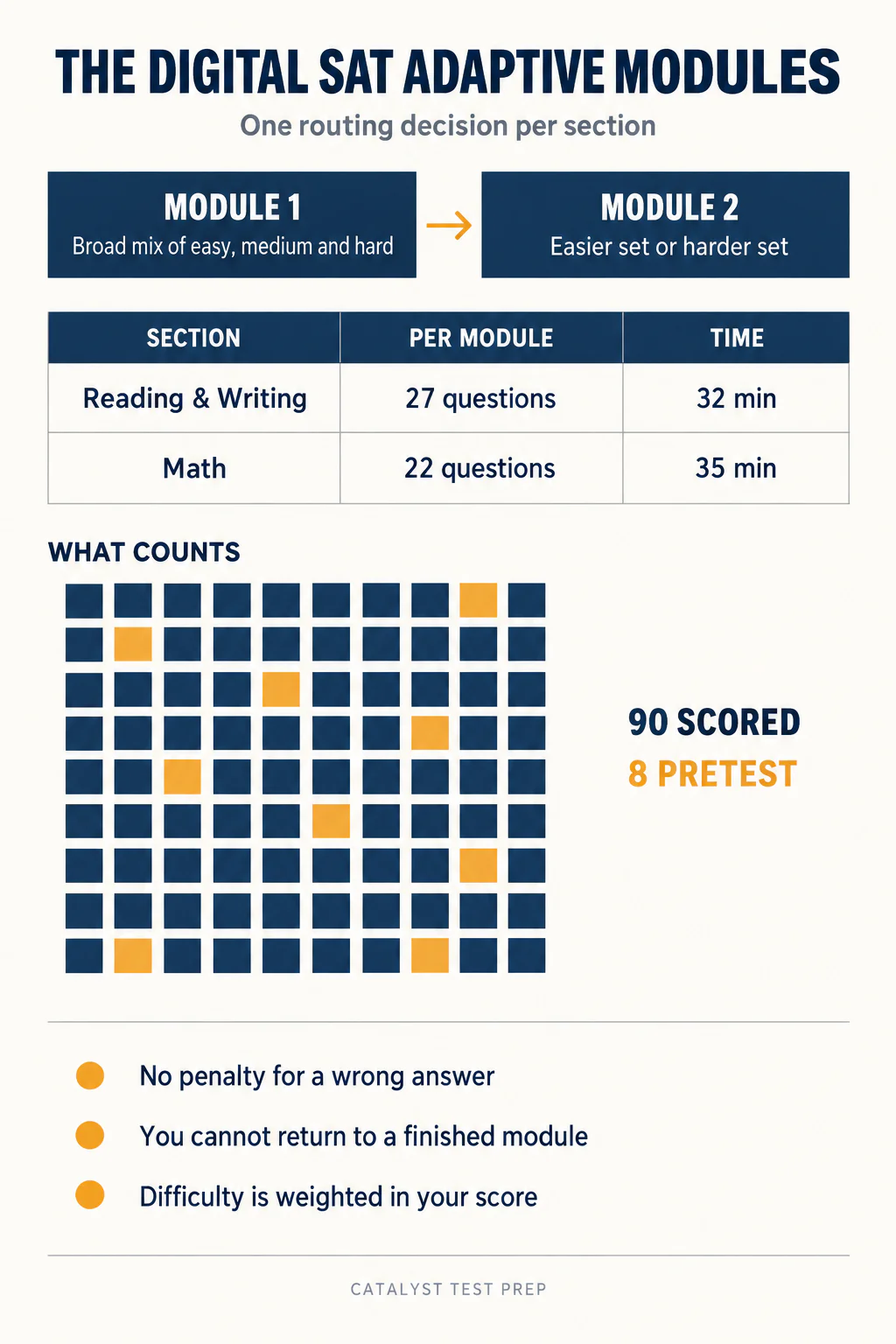
- Your first module is 27 Reading and Writing questions in 32 minutes, or 22 Math questions in 35 minutes. Two of each module's questions are unscored pretest items.
- Once a module's timer ends you are moved on automatically and cannot return, so flagging only works inside the module you are in.
- Scoring uses item response theory, so College Board confirms two students with the same number of correct answers can earn different section scores.
- The routing decision rests on roughly 25 scored Reading and Writing questions or 20 scored Math questions, which is why early careless errors are the costliest kind.
The two-module structure, in plain terms
Each section of the digital SAT is split into two equal-length, separately timed parts that College Board calls modules. You take the first, Bluebook decides which version of the second you get, and you take that. There is no negotiation and no visible signal telling you which version you received.
The arithmetic matters more than students expect:
| Section | Questions per module | Time per module | Seconds per question | Section total |
|---|---|---|---|---|
| Reading and Writing | 27 | 32 minutes | about 71 | 54 questions, 64 minutes |
| Math | 22 | 35 minutes | about 95 | 44 questions, 70 minutes |
That is 98 questions in 2 hours 14 minutes, with a 10-minute break between the two sections. If those numbers are new to you, start with our complete guide to the digital SAT and come back to this one.
Inside a module you have real freedom. College Board's own description is that you "can jump back and forth between questions in a module, previewing upcoming questions or marking earlier questions to return to if you have time." Between modules you have none. Once you move on from a module, you cannot go back to it, and when the timer hits zero Bluebook advances you whether you are ready or not.
How does the SAT decide which second module you get?
Your performance across the whole first module decides it. There are two versions of the second module waiting: one with a lower overall difficulty and fewer hard questions, one with a higher overall difficulty and fewer easy ones. Stronger first-module performance routes you to the harder version.
College Board describes it carefully: "The mix of questions in the second module is, on average, either of higher difficulty or of lower difficulty than that in the first module." Note the phrase "on average". The harder second module still contains easy questions. The easier one still contains hard ones. What changes is the proportion.
What College Board has never published is a threshold. There is no stated number of correct answers that guarantees the harder module, and anyone quoting you a precise cutoff is guessing. This is the single most over-claimed topic in SAT prep, and it is worth being blunt about: the useful question is not "what is the cutoff" but "which of my mistakes are cheap and which are not".
Why two students with the same raw score can land in different places
Because the SAT does not score raw counts. It uses item response theory, which weights the specific questions you answered correctly. College Board states this directly on its scoring page: "two students who answer the same number of questions correctly in a test section may earn differing section scores based on the characteristics, including difficulty level, of the particular questions they answered correctly."
Read that twice, because it quietly demolishes the most common way students track progress. Counting your right answers on a practice test and looking it up on a conversion chart gives you an estimate at best. Two students both getting 40 of 44 Math questions right can finish several dozen points apart, depending on which four they missed and which module they were in when they missed them.
The same logic explains a result that feels unfair: scoring lower on a test where you answered more questions correctly. If the extra correct answers came on low-difficulty items while you dropped harder ones, the pattern is weaker evidence of skill even though the count is higher. College Board's scoring explanation also notes that scores reflect "the probability that the pattern of answers suggests they were guessing."
One thing this format does not change: there is no penalty for a wrong answer. College Board's guidance is that for most students trying their best, guessing beats a blank, particularly after eliminating an option or two. A blank answer is the only guaranteed zero on the test.
Not sure where your teen stands? A free consultation with Catalyst Test Prep maps exactly which SAT topics need the most work, so you're never guessing about study time.
Book a Free Consultation →Does a hard second module mean you did well?
Usually, yes, and it is still a poor thing to dwell on. Difficulty is the visible side effect of the routing, so a second module that feels relentless is a reasonable sign the first one went well. Plenty of students have walked out convinced they failed and opened a 1480.
The caution is that perceived difficulty is unreliable. A module can feel brutal because the passages were on unfamiliar subjects, because you were 90 minutes into a test, or because two questions early on rattled you. Students misjudge this constantly. Treat it as weak evidence and nothing more, and resist re-running the test in your head on the drive home.
The practical version of this question is different and more useful: can you reach a 700+ section score from the easier second module? Realistically, no. A form built largely from easier items cannot produce evidence of high-level skill, because the scoring weights difficulty. If your target sits above 1400, the section is effectively decided in the first module. Our guide on breaking through the 1400 to 1500 barrier goes deeper into what that demands.
The most expensive questions are not the ones you think
Here is the part most prep content skips. Strip out the two pretest questions and the routing decision for Reading and Writing rests on about 25 scored questions. For Math it rests on about 20.
That is a small evidence base, and it changes where your attention belongs. Students instinctively protect the hard questions at the end of a module, on the theory that those are what separate strong scores. But an early careless error and a late genuine one cost you similarly in the routing, and the early one is entirely preventable. In a 20-question scored pool, one avoidable slip is five per cent of the evidence the test has about you.
There is a second consequence. Because Module 1 contains a broad mix of easy, medium and hard questions by design, rushing the opening third to buy time for the end is close to the worst available strategy. You are trading cheap, certain points for expensive, uncertain ones. Our post on digital SAT pacing strategies covers how to budget the 71 and 95 seconds properly.
Eight questions on your test do not count
Every module contains two pretest questions, which College Board includes to gather performance data for future tests. They do not affect your score. Across four modules, that is eight of the 98 questions on your test, leaving 90 scored.
You cannot identify them. They are written and presented exactly like scored questions, and that is deliberate. The practical implication is the opposite of what students hope for when they hear this: since a strange, unusually hard or oddly worded question is as likely to be scored as not, the only workable policy is to treat every question as though it counts and never to spend extra time interrogating one that feels off.
What should change in how you practise?
Four things, in order of how much they matter.
- Practise the first module under real time, every time. The routing rests on it. Doing a 27-question set with the clock paused trains a skill the test never assesses. Full-length Bluebook practice tests are free and route exactly as the real test does.
- Review by difficulty, not by count. After a practice test, sort your errors into careless, concept gap, and genuinely hard. Careless errors in the first module are the highest-value fix on the entire test, and most students have more of them than they believe.
- Stop tracking progress with raw-score conversion charts alone. They are a rough guide. Use the scaled score Bluebook reports, and if you want to model targets, our SAT score calculator is more honest than a hand count.
- Answer every question. No penalty, no exceptions. Build the habit of a 10-second sweep before each module ends.
What the adaptive format does not change
It is easy to over-think the mechanism and under-practise the content. The adaptive structure changes where errors cost the most; it does not change what is tested. Section scores still run 200 to 800 and totals still run 400 to 1600. College Board's college and career readiness benchmarks are still 480 for Reading and Writing and 530 for Math. Linear equations, rhetorical synthesis, punctuation and data interpretation still carry the same weight they did.
If your Math score is capped because quadratics are shaky, no amount of understanding the routing will move it. The mechanism tells you where to aim your effort. It does not substitute for the effort. For a structural view of what is actually tested, the Reading and Writing breakdown is the place to start.
Where this leaves you
Three things are worth carrying out of this. The digital SAT adaptive modules make one routing decision per section, on a scored pool of roughly 20 to 25 questions, which makes early careless errors the most expensive mistakes available to you. Scoring weights difficulty, so raw counts are a weak proxy for progress and a same-count practice test can move your score in either direction. And the module that feels hard is weak evidence of a good outcome, not a result.
Practise the first module under real conditions, sort your errors by type rather than counting them, and answer everything.
Ready to turn a prep plan into real score gains? Catalyst's 1:1 live online SAT programme starts with a free consultation to benchmark your teen's starting point and build a personalised path to their goal score.
Book a Free Consultation