

Most early decision and early action results land in mid-December. The last SAT whose score can reach a regular decision review is on 5 December, and its registration closes on 20 November. So the decision about whether a deferred student will have a new SAT score to send is made weeks before anyone knows they have been deferred.
That timing problem is the part deferral advice leaves out. It spends its words on the letter of continued interest and says almost nothing about test scores, which are the one update that can genuinely change how a file reads. Below is what six universities say on their own pages about new scores after a deferral, which sittings arrive in time, and how to decide whether the number is worth sending at all.
Key Takeaways
- Register before you know. The 5 December SAT closes registration on 20 November (late registration 24 November), and the 12 December ACT's late deadline is 29 November.
- There is no January test. After December, the next SAT is 6 March 2027 and the next ACT is 27 February 2027, both scored too late for most regular decision cut-offs.
- Policies split sharply. Michigan lets a deferred test-optional applicant add a score until 1 February 2027. UVA and USC say the testing choice is already fixed.
- Self-report where you can. MIT, Michigan and Georgia Tech take scores typed into a portal; Georgetown wants an official report and does not superscore.
- A low score is worse than none at a test-optional school. Compare it with the college's submitter range before you send anything.
What does a deferral actually mean?
A deferral moves your early application into the regular decision pool for a second read, with a final answer in the spring. It is neither an admission nor a rejection, and the file is already complete, so anything you add is an update rather than a fresh application.
UVA's wording is the clearest of the six we checked: a deferral means "we feel your application deserves another review", and in many cases the university wants to see how the student is doing in senior-year classes. Georgia Tech says roughly 20 percent of deferred students have been admitted in recent years. Georgetown puts its figure at about 15 percent of early action deferrals. MIT says it has admitted between 150 and 250 deferred students in regular action in recent years.
Those numbers are not consolation. They mean most deferred files are not admitted, so the question of what can still be added to the file is worth taking seriously. If you are still choosing between plans for another college, our guide to early decision versus early action sets out what each one commits you to.
Which colleges accept new SAT or ACT scores after a deferral?
Most selective colleges accept a new score from a deferred applicant, but the conditions differ in ways that decide whether it is read. The sharpest split is over test-optional applicants: some colleges let you switch to submitting scores, and others say the choice you made in October is final.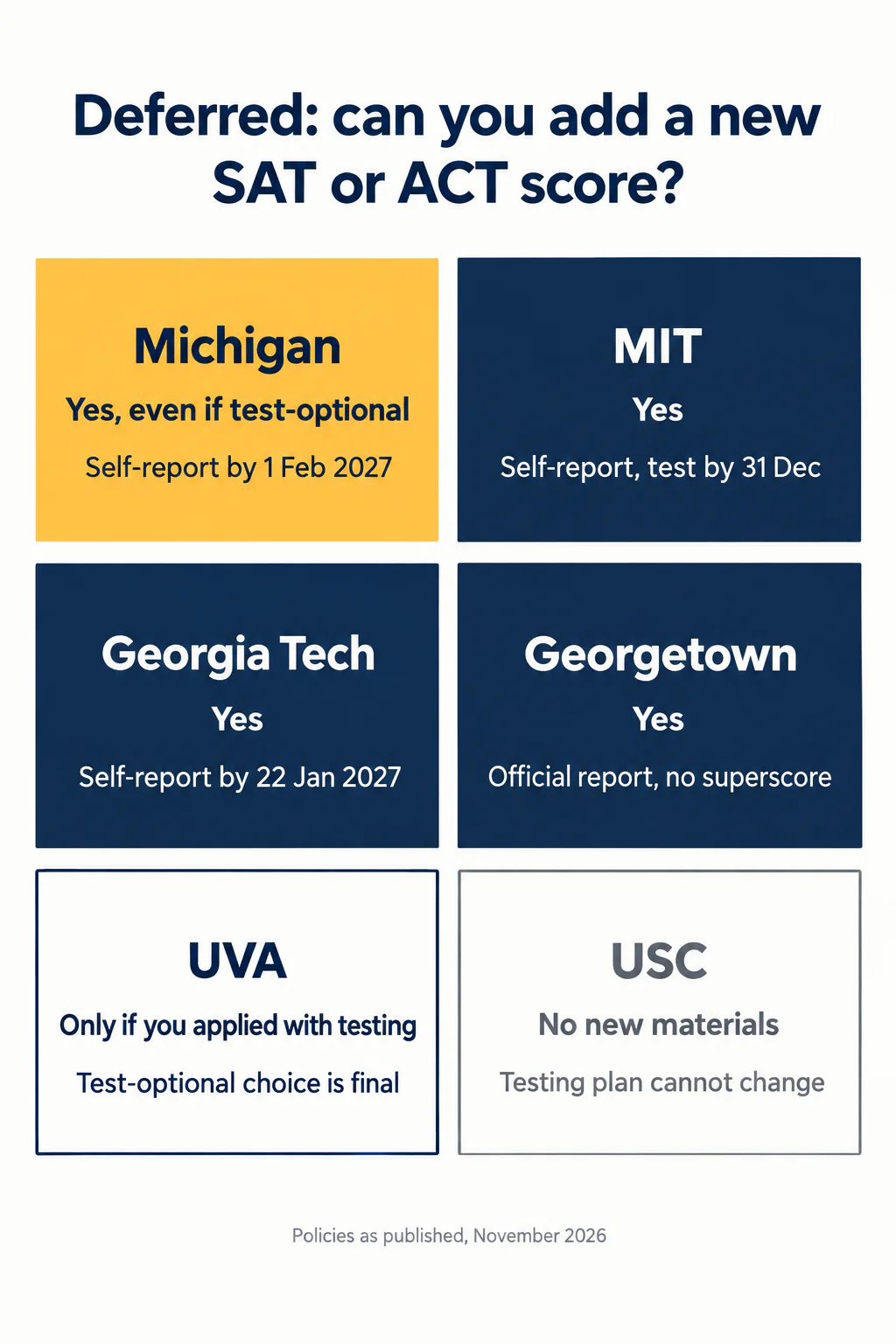
Here is each policy, taken from the university's own admissions pages on 12 November 2026.
| College | New score after deferral? | How it is sent | Cut-off to know |
|---|---|---|---|
| University of Michigan | Yes, including applicants who applied test-optional | Self-report through Enrollment Connect | 1 February 2027 |
| MIT | Yes | Self-report on the Application Status Page | Test taken before 31 December |
| Georgia Tech | Yes | Self-report through the portal | 22 January 2027 (regular decision score deadline) |
| Georgetown | Yes, "welcomes" them | Official report from the testing agency | Allow delivery time; no superscores |
| UVA | Only if you applied with testing | Score section in the applicant portal | Test-optional choice can no longer change |
| USC | No new materials; testing plan cannot change | Mid-year transcript only | Per USC's January 2026 deferral FAQ |
Michigan: the most permissive policy we found
Michigan calls a deferral being "postponed". Its application changes page for fall 2027 entry says any postponed early action applicant "may self-report a new ACT and/or SAT score for consideration as long as the score is reported prior to the Feb. 1 application deadline", and adds: "This includes applicants who initially asked to be evaluated without the consideration of an ACT/SAT score." Michigan also says it uses your highest superscore across test dates.
UVA and USC: the door is already shut for test-optional applicants
UVA will accept new results "if you applied with testing" and superscores them automatically. But for an applicant who chose test-optional at early decision or early action, its deferral page says the deadline to change that selection has passed. USC's deferral FAQ, posted in January 2026 for last cycle, says the mid-year transcript "is the only item we will accept" and that USC cannot change your testing plan at that stage. USC is test optional for fall 2027, so check its applicant portal for this cycle's wording before assuming anything.
MIT, Georgia Tech and Georgetown: test-required, so updates are expected
All three require the SAT or ACT. MIT says to add new scores through the Application Status Page and that you "do not need to send in official scores". Georgia Tech takes self-reported scores and will not use scores received by email or on a transcript. Georgetown is the strict one: new scores after the deadline "will still need to be sent to our office directly from the testing agency", and its testing page says it "does not accept superscores".
Not sure where your teen stands? A free consultation with Catalyst Test Prep maps exactly which SAT topics need the most work, so you're never guessing about study time.
Book a Free Consultation →Will December SAT and ACT scores arrive in time for regular decision?
December scores arrive in time at all four colleges with a published cut-off. February and March scores do not. That makes the two December sittings the last realistic chance to put a new number in front of a regular decision reader.
The release dates come from College Board's and ACT's own score calendars for 2026-27:
- SAT, 5 December 2026: scores to students on 18 December.
- ACT, 12 December 2026: initial scores on 17 December for online testers and 22 December for paper.
- ACT, 27 February 2027: initial scores on 16 March.
- SAT, 6 March 2027: scores to students on 19 March.

There is no January weekend SAT and no January national ACT this year. The SAT calendar goes straight from 5 December to 6 March, and the ACT from 12 December to 27 February. MIT is explicit that regular action applicants "must take required tests before December 31", which rules out both spring dates on its own terms.
The registration trap
Deferrals arrive after the December registration windows close. MIT releases early action decisions in mid-December. Georgetown notifies by 15 December. USC tells early decision applicants in mid-December 2026. The December SAT stops taking registrations on 20 November, with late registration to 24 November, and the December ACT's late deadline is 29 November.
So a student who might be deferred has to decide by late November whether to sit the December test, without knowing the early result. Our December SAT deadlines guide covers the cancellation date and fees if you register and then decide not to sit.
How do you send a new score once it arrives?
Use the college's self-report portal wherever it exists, and order an official report only where the college insists on one. Self-reporting is instant and free, while an official send has to travel through the testing agency's delivery schedule.
Self-reporting portals
Michigan takes scores through Enrollment Connect, MIT through the Application Status Page, Georgia Tech through its admission portal, and UVA through a score section in the MyUVA portal. The official report is checked later, on enrolment. Michigan says admitted students who self-reported must send official scores "that corroborate their highest self-reported scores". Copy the numbers from your score report rather than from memory; our guide to self-reported SAT scores explains why a mismatch is treated as a serious problem.
Official SAT reports and Score Choice
College Board says standard score sends typically go out within 5 to 10 business days of the order. Rush reports go within 1 to 4 business days, not counting weekends and holidays, and only for scores already released. A December score ordered on 18 December is therefore running into the holiday week before it moves.
Score Choice lets you choose which test dates to send, and an entire sitting travels together. Two catches. College Board says Score Choice "is not available to any of your free score sends" from weekend registration, and the four free sends expire nine days after the test, which for 5 December is 14 December, four days before the score exists. And some colleges require every score, so check before you choose. The mechanics are in our guide on how to send SAT scores.
ACT reports and superscoring
ACT processes a score request once the test is scored and all results for your test option are available, and says reports are then usually sent the same day. If you took the writing test, expect a delay, because writing scores take longer and are not reported until everything from the event is ready. ACT calculates a superscore automatically for students who have tested more than once since September 2016, and you can send either that superscore or a single test event.
Will a new score help or hurt at a test-optional college?
It helps only when it beats what the college is used to seeing. At a test-optional school, the reader compares your score with the scores other applicants chose to send, and that pool is self-selected and strong. A number below it is evidence against you that you volunteered.
Michigan's Common Data Set shows the scale. Of first-year students who enrolled in fall 2025, 55 percent submitted an SAT and 18 percent an ACT. The submitters' SAT range ran from 1370 at the 25th percentile through 1470 at the median to 1530 at the 75th. The ACT range was 32 to 34.
Read that range as a filter, not a target:
- At or above the median (1470 at Michigan): send it. This is the case where switching from test-optional earns its place.
- Between the 25th percentile and the median: a judgement call that turns on the rest of the file. A strong mid-year transcript may say more.
- Below the 25th percentile: hold it. Michigan states that an applicant "will not be disadvantaged" for not sending a score, so silence costs nothing.
At a test-required college the arithmetic changes, because a score is already in the file. A higher new sitting simply improves it, more so at colleges that superscore. Be careful at MIT, which says scores "cannot be deleted once they are submitted", and at Georgetown, which reads full sittings rather than a superscore.
Where does the letter of continued interest fit?
Lower down the list than most advice suggests. Several of these universities say in plain words that a letter will not change the review, and each one has its own form instead.
UVA says its defer form "takes the place of" a letter of continued interest and that an extra letter will not affect the review. USC answers "No" when asked whether to send one. MIT says you do not need to email to say you are still interested. Michigan offers an optional Expression of Continued Interest form, due 1 March, with one submission allowed. Georgia Tech wants its Deferred Supplemental Form and mid-year grades, and says it considers only the recommendation letters submitted with the original application.
The common thread is that the forms and the grades are what get read. A new test score, sent through the right channel before the cut-off, is one of the few updates every one of these forms has room for.
What to do this week
If any early application is still pending, decide about December testing now. Register for the 5 December SAT by 20 November, or the 12 December ACT by 29 November, if a higher score is realistic in three weeks of focused work. List each college's deferral page alongside its score cut-off, and note which ones let you switch from test-optional. When the score arrives, compare it with each college's submitter range before you send it anywhere.
Deferral is not a verdict, and a new SAT or ACT score is the update with the most weight behind it. It only counts if it arrives on time, through the right door, and above the bar.
Ready to turn a prep plan into real score gains? Catalyst's 1:1 live online SAT programme starts with a free consultation to benchmark your teen's starting point and build a personalised path to their goal score.
Book a Free ConsultationSources checked 12 November 2026: University of Michigan, application changes and testing FAQ, postponed applicants FAQ and Common Data Set 2025-26; MIT Admissions EA deferred FAQ and deadlines page; Georgia Tech deferred students page and 2026-27 deadlines; Georgetown early action program, after you've applied and preparing for Georgetown pages; UVA deferred student information; USC admission blog deferral FAQ (January 2026) and fall 2027 early application FAQ; College Board score release dates, sending scores, Score Choice and rush reporting pages; ACT test dates, scores and sending scores pages. University policies change between cycles, so confirm each one on the college's own site.