

Moving your test date to the next sitting costs 49 dollars on the ACT. The identical decision on the SAT costs 102 dollars, and 112 if you leave it late. Same change of mind, two and a half times the price, and the reason is buried in one sentence on College Board's fee page that almost nobody reads before they need it.
That gap is the shape of the whole subject. The published headline numbers for the cost of college admission tests are modest and widely quoted. What families actually spend is a different figure, and the difference is almost entirely made of fees that are free to avoid if you know they exist in October rather than in February. Every number below comes from the official 2026-27 schedules, checked this week.
Key takeaways
- The base registrations are 68 dollars for the SAT, 70 dollars for the ACT covering English, maths and reading, and 99 dollars per AP exam in the US.
- 🔴 The SAT has no test date change. College Board requires you to cancel and re-register, so a date move is 34 plus 68. The ACT charges one 49 dollar fee.
- Four college score reports are free on both tests, but only inside a window: within 9 days of the test for the SAT, and only if codes were entered at registration for the ACT.
- AP is usually the biggest line in the year, and the only one billed to a school rather than to you. Three exams exceed the SAT and the ACT put together.
- A student who gets the timing right pays roughly 440 dollars for the year. The same student, late twice with one date change and two missed report windows, pays 802.
What do the tests themselves cost?
Three base numbers, and they are the easy part.
The SAT registration fee is 68 dollars for US test takers, and College Board labels its additional charges as holding "through June 2027", so this is a stable figure for the current cycle rather than a snapshot.
The ACT is modular, which the headline price hides. The base test, covering English, maths and reading, is 70 dollars. Science is a separate 5 dollar add-on and writing is 25 dollars, so the combinations run 70, 75, 95 and 100 dollars for everything. Both add-ons "can be added or removed through the late deadline", which makes them the only genuinely reversible decisions on either fee schedule.
AP exams are 99 dollars each at schools in the United States, its territories, Canada and DoDEA schools, and 129 dollars elsewhere. There is no volume discount, so the line scales exactly with the number of exams a student orders.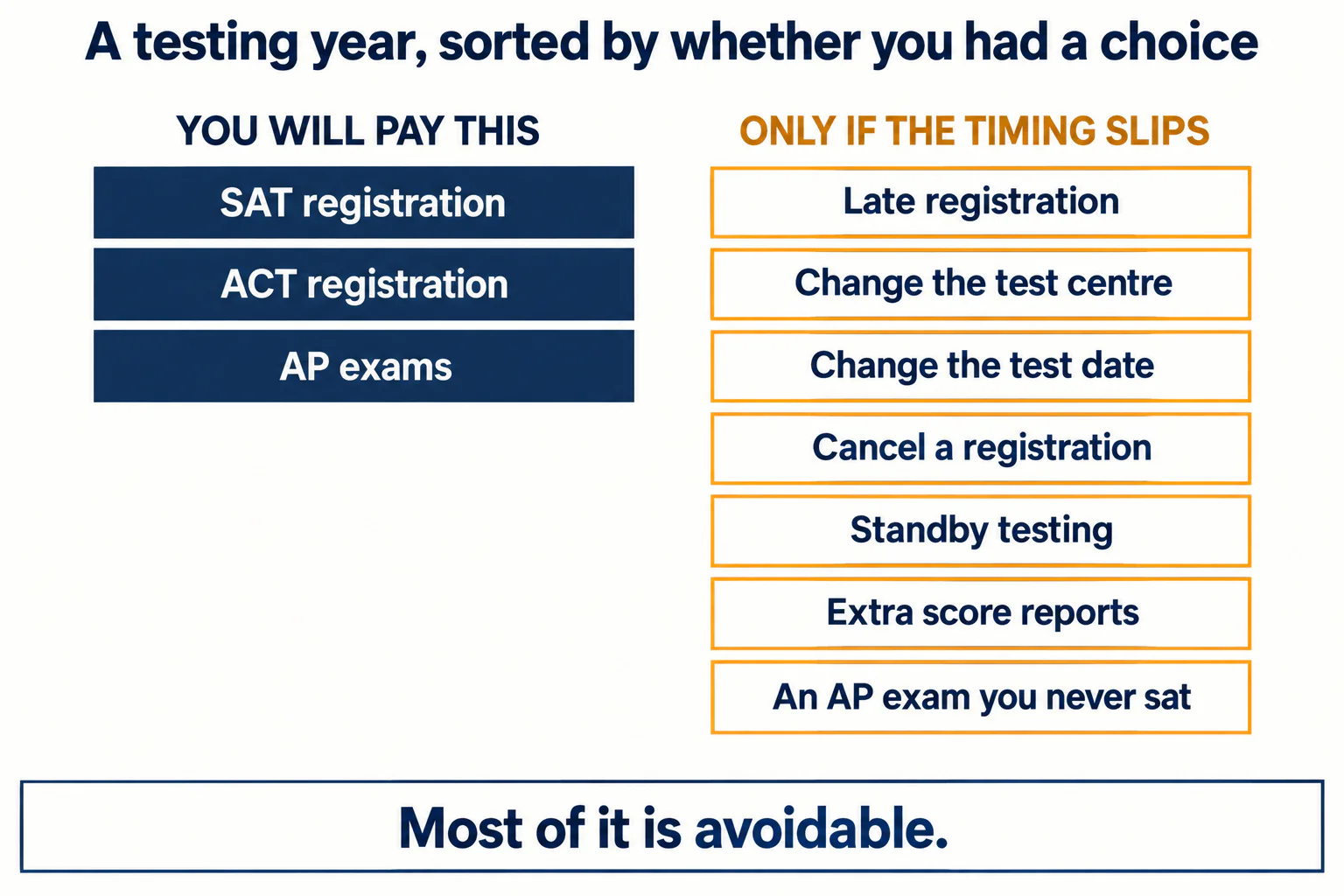
Which of these charges can you actually avoid?
Nearly all of the ones above the base registrations. Set out plainly, here is what each test schedule charges for being late or changing your mind.
| Service | SAT | ACT |
|---|---|---|
| Late registration | 38 dollars | 42 dollars |
| Change test centre | 34 dollars | 49 dollars (change fee) |
| Change test date | No such service: cancel and re-register | 49 dollars (change fee) |
| Cancel before the change deadline | 34 dollars | Fees nonrefundable unless stated |
| Cancel after the change deadline | 44 dollars | Fees nonrefundable unless stated |
| Turn up without registering | Waitlist, 0 dollars | Standby testing, 75 dollars |
| Additional score report | 15 dollars each | 20 dollars each |
| Rush or archived scores | 31 rush, 35 archived | Covered by the change-fee note |
| Score verification | 55 dollars | 67 one section, 134 both |
Two rows in that table are worth stopping on, because they reverse the assumption families usually arrive with.
The SAT waitlist is free and ACT standby is 75 dollars. For the student who decides late that they want to sit, the SAT is the cheap option by 75 dollars. Our guide to changing or cancelling an SAT registration covers how the waitlist radius works in practice.
Score verification is the most expensive thing either organisation sells, and the ACT charges 134 dollars to check both sections. It is also the item most likely to be bought in a panic, which is a bad combination.
Why does changing an SAT date cost twice as much?
Because the service does not exist. College Board's fee page lists a change test centre fee of 34 dollars and then adds the sentence that settles it: "For changing your test center only. (To change the test date, you must cancel and register for a new test.)"
So a date move on the SAT is two transactions, not one:
- 34 dollars to cancel by the change deadline, plus 68 dollars to register again. Total 102 dollars.
- Past the change deadline it is the 44 dollar late cancel fee plus 68. Total 112 dollars.
The ACT treats the same decision as one item. Its 49 dollar change fee explicitly "includes making a Test Form Change, Test Day Change, or Test Center Change", and even a late test date change falls under the 42 dollar late registration line rather than stacking on top of a new registration.
This is not a criticism of either organisation. It is a planning fact with a number attached, and it has one practical consequence: on the SAT, pick the date later and commit once; on the ACT, you can afford to be wrong. A family sitting both tests in one year should put the SAT date in last.
Most of the money families lose to testing fees goes on retakes that were never planned for. A free consultation with Catalyst Test Prep maps which tests your teen actually needs and fixes the dates early, so the change fees above never come up.
Book a Free Consultation →The four free score reports, and the box that decides whether they are free
Both tests give you four college reports at no charge, and on both tests the condition is timing rather than money.
On the SAT: "Your first 4 score reports are free if you order them by 9 days after the test date. Additional reports or reports ordered after that time incur this fee," which is 15 dollars each. Miss the window on four colleges and the same reports cost 60 dollars.
On the ACT the condition is stricter and lands earlier. ACT's pricing "includes reports for you, your high school, and up to four colleges (if codes are provided when you register)." The parenthesis is the policy. Blank boxes at registration leave no credit to spend later, and four reports then cost 20 dollars each, or 80 dollars. Our post on how to send ACT scores works through that deadline in detail, because it closes earlier than most students believe.
One ACT line is genuinely refundable and almost nobody claims it. The 5th and 6th college choices at 20 dollars each are "refundable on written request if you do not test", which makes them the only pre-paid item on either schedule you can get back.
Why the AP line is bigger than the SAT and ACT together
At 99 dollars each, three AP exams come to 297 dollars. An SAT at 68 and a full ACT at 100 come to 168. The AP line is the largest in a typical testing year and it is the one families budget for last, partly because it is invoiced through a school rather than paid at registration.
Two AP-specific charges have no equivalent on the SAT or ACT.
The unused or cancelled exam fee is 40 dollars per exam. Order four in November, sit three, and the fourth still costs 40. Because the school is billed, this one tends to surface as an awkward conversation in May rather than a line on a card statement.
Schools may charge more than the published fee to recover proctoring or administration costs, which College Board explicitly permits. The 99 dollars is a floor, not a price. Ask your AP coordinator for their number, and see our breakdown of the AP registration deadline and fees for how the 13 November ordering date interacts with all of this.
What the PSAT costs, and who pays it
College Board's published school pricing for 2026-27 is 18 dollars for the PSAT/NMSQT and the PSAT 10, and 14 dollars for the PSAT 8/9. SAT School Day is 60 dollars.
Two things follow. The PSAT/NMSQT is the cheapest test in the suite and the only one attached to a national scholarship competition, which is an unusual ratio of stakes to price. And College Board notes the suite "may be paid for by a state, district, or school, or a combination of all three", so a great many families pay nothing for either the PSAT or an in-school SAT.
That makes SAT School Day worth checking before you pay 68 dollars for a Saturday sitting, and our comparison of SAT School Day against the weekend SAT covers what else differs between them besides the price.
What none of this includes
Three categories sit outside every number above and one of them is usually larger than all of them combined.
Preparation. Books, apps, courses and tutoring are a separate decision with a far wider range, and we treat it separately in what 1:1 SAT tutoring actually costs. Nothing on this page is a prep cost.
Fee waivers. If a student qualifies, most of the schedule disappears: an SAT fee waiver makes late registration, cancellation and unlimited score reports free, and returns unused benefits when you cancel. ACT and AP operate separate eligibility rules, so check all three rather than assuming one answer. Start with who qualifies for an SAT fee waiver and ACT fee waiver eligibility.
Travel and the lost Saturday. Not a fee, but a real constraint on how many sittings a family can absorb, and the actual reason to plan the calendar rather than the budget.
A worked total for one realistic student
Take a junior who sits the SAT once, the ACT once with science, orders three AP exams, and sends four reports from each test inside the free window.
68 plus 75 plus 297, and 0 for the reports: 440 dollars.
Now take the same student, late to register for both tests, moving the SAT date once, missing both free report windows on four colleges each, and dropping one AP exam after it was ordered.
440, plus 38 and 42 for late registration, plus 102 for the SAT date move, plus 60 and 80 in reports, plus 40 for the unused exam: 802 dollars.
Not a single item in that second list bought anything the first student did not get. That is the entire point of writing the fees down in October.
Where this leaves you
The published cost of college admission tests is not misleading, it is just incomplete. By the end of a year of registrations, date moves and report deadlines, the number families remember is close to twice the one they were quoted, and the gap is made almost entirely of timing.
Three things to act on. Enter your college codes at ACT registration, because the free reports are decided there and nowhere else. Put your SAT date in last and commit, because it is the only test here with no date change. And order the AP exams you will actually sit, because the fourth one costs 40 dollars whether you turn up or not.
Ready to turn a testing calendar into a plan? Catalyst's 1:1 live online programme starts with a free consultation to benchmark your teen's starting point, decide how many sittings they genuinely need, and build a personalised path to their goal score.
Book a Free ConsultationSources: College Board, SAT Test Fees; ACT, Current ACT Fees and Services; AP Central 2026-27 AP Exam Fees; College Board SAT Suite District and School Pricing Details 2026-27. All figures read from the publishers' own fee schedules and checked 30 October 2026. The two worked totals are our own arithmetic on those published line items.