
Princeton and Columbia will both require an SAT or ACT score from students enrolling in fall 2028. That single sentence, verified on both universities' own admission pages this week, decides whether a current high school junior needs to sit a test in the spring. It also makes this the last cycle in which an application to either school can be submitted without a score.
The question of which colleges require the SAT has become harder to answer than it looks, because the phrase doing most of the work is test optional, and that phrase now covers four genuinely different policies. One of them means a good score helps you. Another means your score is never read by a human being. Treating those two as the same thing is the most expensive mistake in this part of the process, and most published lists invite it.
What follows is the policy landscape as the institutions themselves state it, checked on 19 October 2026, with the dates that actually bind.
Key Takeaways
- Six of the eight Ivies require scores this cycle. Harvard, Yale, Dartmouth, Brown, Cornell and Penn all require the SAT or ACT for 2026-27 entry.
- Princeton and Columbia flip on the same cycle, not different ones. Both require scores from the 2027-28 cycle, for fall 2028 enrolment.
- Your graduation year is the deciding variable. The class of 2028 is the first cohort that must submit scores to Princeton and Columbia; the class of 2027 is the last that need not.
- Test free is not test optional. UCLA will not consider scores for admission or scholarships at all, and a 2021 settlement keeps them away from readers entirely.
- Required sometimes bends. Columbia grants waivers on request and Princeton exempts active military. MIT lists no exception.
Which colleges require the SAT right now?
For students applying in the 2026-27 cycle, the required list already includes most of the institutions that sit at the top of a typical reach list. Six Ivies require scores: Harvard, Yale, Dartmouth, Brown, Cornell and Penn. Outside the Ivy League, MIT, Stanford, Johns Hopkins and Caltech require them, as do the public university systems of Florida, Georgia and Tennessee.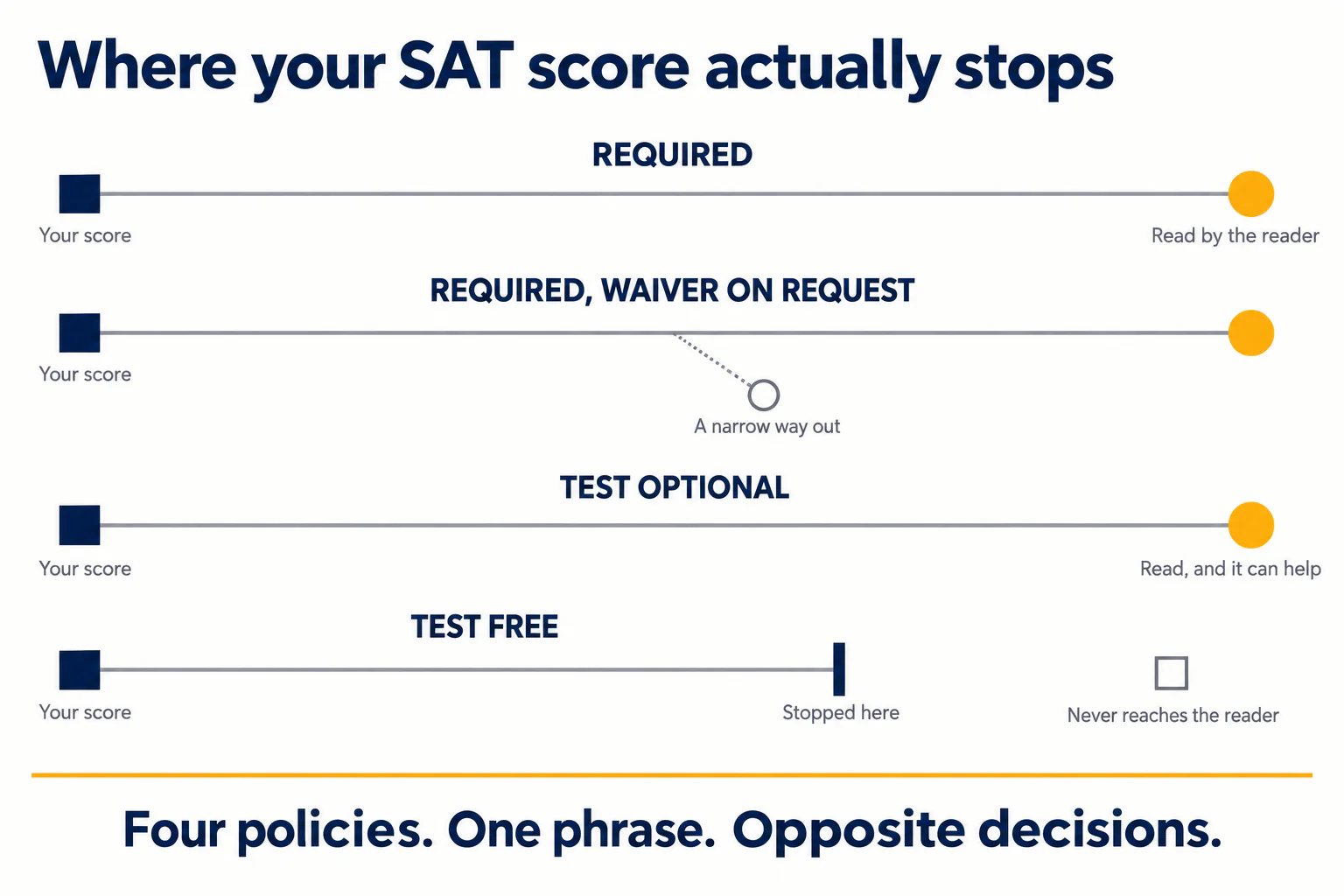
Yale's language is about as plain as admissions prose gets: "All first-year and transfer applicants must include scores from the ACT or SAT." MIT is equally direct, stating that it requires the SAT or the ACT for both prospective first-year and transfer students. Neither school hedges, and neither publishes a cut-off.
Two details inside those requirements are worth knowing, because they save wasted preparation. Yale treats the ACT Science and Writing sections as optional and allows superscoring on both exams. MIT does not require ACT writing, the old SAT optional essay, or SAT science. The requirement is for a core score, not for every section a test maker sells.
Test optional is four different policies, not one
The useful distinction is not required versus optional. It is how the score is treated once it arrives, and there are four answers.
Tier one: required, with no exception offered
MIT states the requirement and lists no waiver. If a school on your list sits here, the test is a fixed cost of applying and the only real question is when to sit it.
Tier two: required, but a waiver exists
Columbia says applicants who face challenges in meeting the requirement may request a waiver at the time of their application. Princeton exempts active military personnel. These are narrow doors rather than general escape hatches, but they exist, and a student in genuinely difficult circumstances should know that asking is a defined part of the process rather than a favour.
Tier three: optional, and a good score is read
Duke, Vanderbilt, NYU, Michigan, Notre Dame, Northwestern, Emory and Tulane remain genuinely test optional. Here a strong score is additional evidence in your favour. Submitting a weak one is the choice you are being given, and declining it carries no stated penalty.
Tier four: test free, where the score is never read
This is the tier that gets flattened into the others, and it is the one with teeth. UCLA's own admissions page says it "will not consider SAT or ACT scores for admission or scholarship purposes". The University of California reached a settlement in 2021 under which submitted scores are not provided to admissions readers at all. The entire UC and Cal State systems operate this way.
So a score sent to UCLA cannot help an application, however high it is. It retains one narrow use: UCLA notes that a submitted score "may be used as an alternative method of fulfilling minimum requirements for eligibility or for course placement after you enrol". That is a registrar function, not an admissions one.
Not sure where your teen stands? A free consultation with Catalyst Test Prep maps exactly which SAT topics need the most work, so you're never guessing about study time.
Book a Free Consultation →Why your graduation year decides the rule
Policy pages are written in admission cycles and enrolment years. Students think in graduation years. Translating between the two is where most of the confusion in this topic lives, and the translation is simple once written down.
A student enrolling in fall 2028 graduates from high school in spring 2028. In October 2026 that student is a junior. So the Princeton and Columbia requirements, which begin with the 2027-28 cycle and fall 2028 enrolment, land on today's juniors, the class of 2028. Current seniors, the class of 2027, are applying in the 2026-27 cycle and can still apply to both schools without a score.
This matters more for juniors than the calendar suggests. A junior who concluded last year that testing was optional, and planned accordingly, now has a list that may require a score, and the spring test dates are the realistic window. That is a planning decision to make this month, not in May.
What Princeton and Columbia actually changed
Both universities published their reasoning, and Princeton's is the more interesting of the two because it is evidence rather than sentiment. Princeton's return to testing followed a five-year data review which found that academic performance at Princeton was stronger for students who chose to submit test scores. Whatever one thinks of the conclusion, it is a university reporting on its own students, which is a different class of claim from a prep company asserting that tests matter.
Several published lists present these two changes as happening in different years. They do not. Checked directly on both admission sites on 19 October 2026, the cycles are identical: test optional for 2026-27, required from 2027-28, fall 2028 enrolment. Both also state explicitly that there are no minimum test score requirements, which is worth repeating to any student who hears "required" and starts hunting for a threshold.
Where "required" still bends
Three exceptions are documented rather than rumoured, and they are narrow.
- Columbia: a waiver may be requested at the time of application by students who face challenges meeting the requirement.
- Princeton: active military personnel are exempt.
- Section-level relief: Yale and MIT both drop specific sections, so ACT Science and Writing and the retired SAT essay need not be prepared for either school.
What does not exist is a general hardship waiver across required schools. Plan on sitting the test and treat any waiver as a specific application you make deliberately, with evidence, to one institution.
Does a strong score help at a test-optional college?
At a tier-three school, yes, and this is where the four-tier distinction pays for itself. A score that sits comfortably inside a college's published middle 50 per cent is evidence you would otherwise have to generate some other way. Declining to submit is not penalised, but it does remove a data point you could have controlled.
At a tier-four school the answer is no, in the strongest available sense: the number is not shown to the people making the decision. A student whose list is entirely UC and Cal State campuses can make a defensible decision not to test at all, and should not be talked out of it by a generic "scores always help" line. A student with one required school on the list has no such option, however test free the rest of the list may be. One required school sets the policy for the whole list.
What should you do before the next deadline?
The dates below are from College Board's own registration and score-release pages, checked on 19 October 2026.
- The 7 November 2026 SAT closes for registration on 23 October 2026, with scores released on 20 November. Registration deadlines expire at 11:59 p.m. ET.
- The 5 December 2026 SAT closes on 20 November 2026, with scores on 18 December. This is the last SAT of the calendar year.
- MIT requires tests completed by 30 November for Early Action and 31 December for Regular Action. A December test date does not work for an Early Action application there.
- Students who need to borrow a testing device must register at least 30 days before test day.
The practical sequence is short. Write down your graduation year. Sort your college list into the four tiers using each school's own admissions page rather than a third-party list. If any school lands in tier one or tier two, pick a test date and work backwards from it. If every school lands in tier four, you have just saved yourself several months. Then read how to send SAT scores before you sit the test, because the free score reports expire sooner than almost anyone expects.
For the wider question of how much weight scores carry now, our analysis of whether SAT scores still matter covers the admissions research, and SAT scores for merit scholarships is worth reading even if your colleges are test free, because scholarship programmes often keep score requirements their universities have dropped. If you are weighing timing, our SAT prep timeline for juniors and seniors sets out the realistic runway, and early decision versus early action explains how the application plan interacts with test dates.
Conclusion
Three things decide whether you need the SAT, and none of them is an average. Your graduation year, because Princeton and Columbia both flip for fall 2028 entry. The tier each college on your list actually occupies, because test free and test optional point in opposite directions. And the next registration deadline, because the decision has a date attached whether or not you make it deliberately.
Check each school's own page rather than a list, including this one. Policy here has moved every year since 2020 and will move again.
Ready to turn a prep plan into real score gains? Catalyst's 1:1 live online SAT programme starts with a free consultation to benchmark your teen's starting point and build a personalised path to their goal score.
Book a Free ConsultationSources checked 19 October 2026:Princeton Undergraduate Admission, standardized testing policy · Columbia Undergraduate Admissions, testing policy update · UCLA first-year requirements · MIT Admissions, tests and scores · Yale Office of Undergraduate Admissions · College Board SAT dates and deadlines