
Search the College Board National Recognition Programs and half the results describe a programme that no longer exists. Award names that were retired are still listed. A GPA threshold that has moved is still quoted. Families read all of it, conclude their child is not close, and never submit.
The current programme is smaller, the academic bar is lower than most people expect, and there is a second qualifying route that has nothing to do with the PSAT at all. This guide sets out what College Board publishes today: the three awards, the exact eligibility rules, and the part of the scoring that decides whether a given PSAT result qualifies.
Key Takeaways
- There are three awards: First-Generation, Rural and Small-Town, and School.
- The GPA bar is B+ or higher, at least 3.3, assessed at the point of submission.
- The test bar is top 10 percent of a named comparison group, not a national score.
- A 3 or higher on two AP Exams by the end of grade 10 qualifies you without any PSAT result.
- Open to grades 10 and 11 only, and citizenship is not required.
What are the three awards?
College Board currently offers three recognition designations, and a student can hold more than one.
| Award | What decides it |
|---|---|
| First-Generation Recognition Award | Your parents' level of education, which you confirm; and performance measured against your state's first-generation test takers |
| Rural and Small-Town Recognition Award | The high school you attend; and performance measured against your state's rural and small-town test takers |
| School Recognition Award | The high school you attend; and performance measured against that school's own test takers |
That is the whole programme. If a guide you are reading lists more than three, it is describing an earlier version. College Board's own newsroom archive from 2021 describes a set of awards built around race and ethnicity alongside a rural and small town programme, with a 3.5 GPA requirement. The awards listed on BigFuture today are the three above and the GPA bar is 3.3. Both facts come from College Board; only one of them is current.
What are the eligibility requirements?
Three conditions, all of which have to hold.
- Grade. You are in grade 10 or grade 11.
- GPA. A cumulative average of B+ or higher, which College Board defines as at least 3.3, or 87 to 89 percent, by the time of submission.
- Academic performance. Either a top 10 percent test result in one of the named comparison groups, or a 3 or higher on two or more distinct AP Exams taken in grade 8, 9 or 10.
Plus a residency condition that catches fewer people than families fear: a permanent address in the United States, a US territory or a US military base, or attendance at a Department of Defense school. US citizenship is explicitly not required.
The 3.3 is the number nobody believes
A B+ average is not a distinction. It is a good, unremarkable report card, and it sits well below where parents assume a national academic honour would draw its line. The 3.5 figure that circulates online is from the earlier version of the programme and it is still the number most people have in their heads.
The practical consequence is a large group of students who clear the bar comfortably and never look, because they have decided in advance that recognition programmes are for someone else. If your child is carrying a B+ average and sat the PSAT, they are in the conversation.
Not sure where your teen stands? A free consultation with Catalyst Test Prep maps exactly which SAT topics need the most work, so you're never guessing about study time.
Book a Free Consultation →What PSAT score actually qualifies?
There is no answer to that question, and understanding why is the most useful thing in this article.
The test requirement is not a score. It is a rank: the top 10 percent of a specific comparison group. College Board names three such groups, and each maps onto one of the awards:
- the test takers at your own high school, for the School Recognition Award;
- your state's first-generation test takers, for the First-Generation award;
- your state's rural and small-town test takers, for the Rural and Small-Town award.
So the qualifying performance is relative, and it moves. The same PSAT result might sit in the top 10 percent at one high school and the bottom half at a selective one twenty miles away. A student at a school where few people take the PSAT seriously has a materially easier path to the School Recognition Award than a student with an identical score at a school full of strong testers.
This is the opposite of how National Merit works, and the two get confused constantly. National Merit runs off the Selection Index, a specific number with a state cutoff attached. Recognition runs off your position inside a cohort. One has a published threshold you can aim at; the other does not, and cannot.
Which PSAT counts
Both the PSAT/NMSQT and the PSAT 10 feed the recognition programmes. That is a genuine difference from National Merit, which only ever counts the PSAT/NMSQT in the junior year. We set the two tests against each other in PSAT 10 vs PSAT/NMSQT, and the recognition eligibility is the main reason the PSAT 10 is worth taking at all.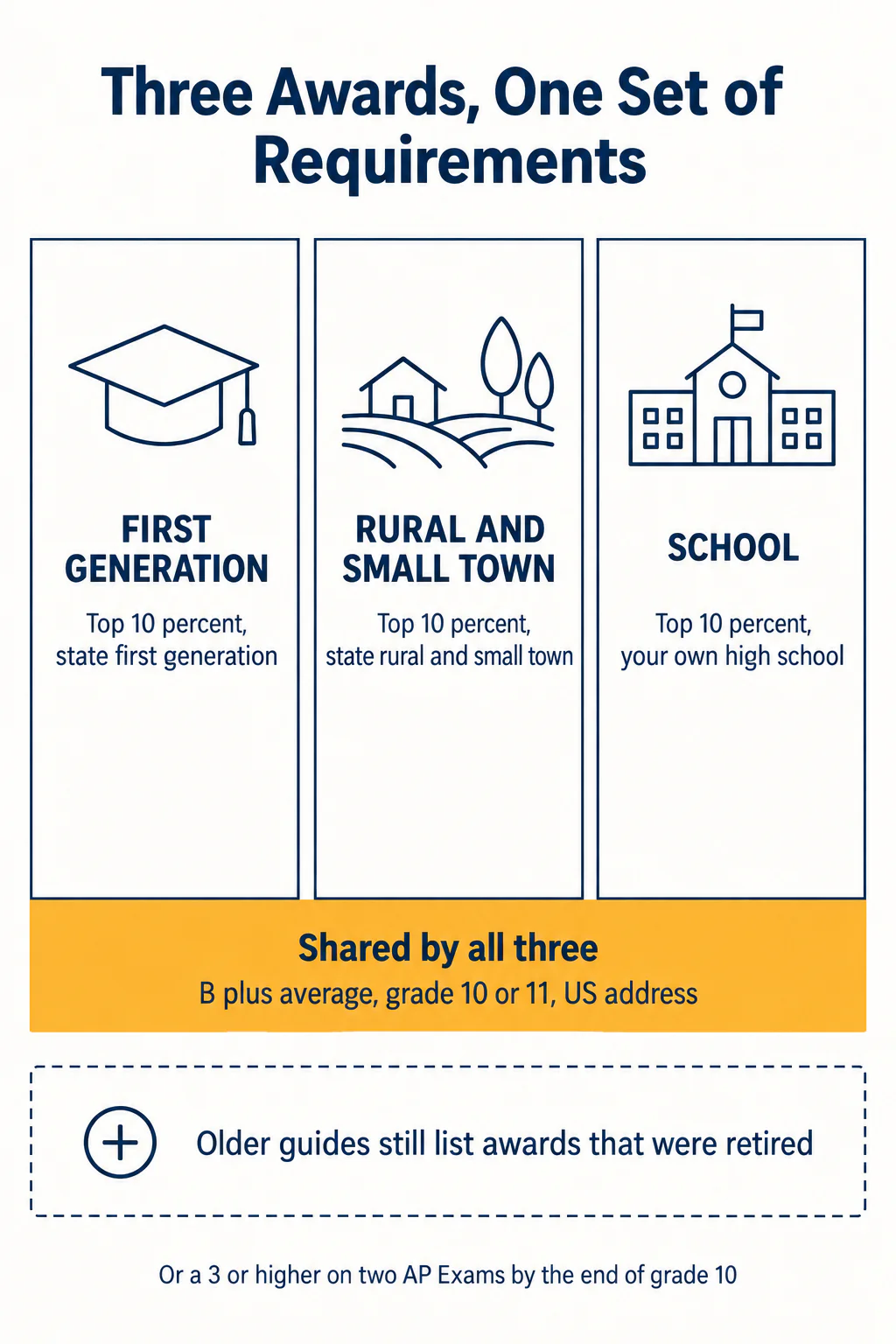
The AP route almost nobody uses
You can qualify with no PSAT result at all. Earn a 3 or higher on two or more distinct AP Exams in grade 8, 9 or 10, and the academic performance condition is satisfied outright.
This route is buried in a bullet on the eligibility page and it changes the calculation for a specific kind of student: the one who takes AP courses early, tests well on content they have studied, and underperforms on a timed reasoning test like the PSAT. For them the PSAT is a weak instrument and the AP route is a direct one.
Two practical notes. The exams have to be distinct, so two sittings of the same exam do not count. And they have to be taken by the end of grade 10, which means the decision to take an AP exam in grade 9 has a consequence nobody mentions at the time. If your school offers AP Human Geography or AP World History to freshmen, that is the route opening. Registration deadlines for those exams fall in the autumn, and we covered how that calendar works in our guide to AP exam registration deadlines and fees.
What is recognition actually worth?
An honour on the application, and a place on lists that colleges recruiting in these categories buy into. It is not, by itself, money.
Some colleges do attach scholarships to College Board recognition, and a number of large public universities have done so as part of their outreach to rural and first-generation applicants. College Board does not guarantee any of it, and the institutions set and change their own terms. Treat a recognition award as a signal that raises your visibility, not as a funding plan you can count on. The awards that come with published dollar amounts attached are usually score-linked merit programmes, which work differently and which we cover in SAT scores and merit scholarships.
The honest summary: it is worth twenty minutes of a family's time because the submission is short and the eligibility bar is lower than the reputation suggests. It is not worth restructuring a study plan around, because you cannot aim at a percentile inside a cohort you cannot see.
What to actually do, and when
The timing is the part that goes wrong, because the window closes before most families are thinking about applications at all.
- In grade 9, if your school offers AP exams to freshmen, know that two 3s by the end of grade 10 is a qualifying route.
- In grade 10, sit the PSAT/NMSQT or PSAT 10. Both count. Skipping the sophomore test removes one of your two chances.
- In grade 10 or 11, check your cumulative GPA against 3.3 and make the submission. It is assessed at submission, so a strong recent term can carry you over.
- Check the current window on BigFuture. College Board does not publish the dates on the eligibility page and they move between cycles, so a date you read in a blog post is not a date to rely on.
- Do not wait for senior year. There is no route in for a grade 12 student.
Step four is the one to take literally, including for this article. Eligibility rules and windows are published by College Board and they change, which is exactly how the internet ended up full of confident descriptions of a programme that has since been restructured.
What to do with this
Three things carry the weight. The College Board National Recognition Programs now award three designations, and a lot of the advice online still describes a version that has been restructured. The GPA bar is 3.3, not the 3.5 most families have in their heads. And the test requirement is a ranking inside your own school or state cohort, so there is no national score to aim at.
The AP route, two exams at 3 or higher by the end of grade 10, is the part worth acting on earliest, because it depends on course choices made in grade 9. Check the current rules and the submission window on College Board's National Recognition Programs page before you rely on any summary, including this one.
Ready to turn a prep plan into real score gains? Catalyst's 1:1 live online SAT programme starts with a free consultation to benchmark your teen's starting point and build a personalised path to their goal score.
Book a Free Consultation