
If you cannot sit the ACT you registered for, the single most expensive thing you can do is quietly register again for the next date. ACT's own registration page states it in one sentence: "If you register for a new test date instead of making a test date change, your basic fee for the original test date will not be refunded." A test date change costs $49.00 and gives that basic fee back. A fresh registration costs you the basic fee twice and refunds nothing.
That distinction is the whole reason this page exists, because almost nobody explains it. Below is what you can change on an ACT registration, what it costs, how late you can do it, what happens if you miss the test entirely, and every 2026-27 deadline you need. All figures are taken from ACT's published fee schedule and checked on 12 October 2026.
Key takeaways
- A test date change refunds your original basic fee. Re-registering does not. The change fee is $49.00 and it is the cheaper route in almost every case.
- There is no refund for cancelling. ACT states registration fees and additional fees are nonrefundable, so "cancel" is not really an option; "move" is.
- Test centre changes stop at the accommodations deadline for that test date, and depend on a seat being free at your preferred centre.
- There is no November 2026 ACT. Moving off 17 October means 12 December, an eight-week wait.
- Fee waivers follow you to the new date but do not cover the change fee. You pay the $49.00 yourself.
Can you change your ACT test date?
Yes. ACT describes a test date change as something that "can be used to sign up for a different test date if you are absent or unable to test on the original test date", and the single $49.00 change fee covers a test date change, a test centre change or a test form change. You make the request inside your MyACT account, or by calling ACT Registration on 319.337.1270.
Two parts of the arithmetic surprise people. You pay the full fee for the new test date as well as the change fee, so the change is not a transfer of what you already paid. And the basic fee from your original date comes back to you only because you processed it as a change. The $70.00 basic fee for the ACT covering English, math and reading, plus the $5.00 science add-on or the $25.00 writing add-on if you chose them, is the money at stake.
The refund trap, and it costs about as much as the test itself
Here is the same decision taken two ways by two students who both miss the 17 October ACT.
Student A opens MyACT and requests a test date change to 12 December. She pays the $49.00 change fee and the fee for the December date, and ACT refunds her original basic fee. Student B assumes a missed test is simply gone, goes to MyACT and registers for December as a new sitting. He pays the December fee and loses the October basic fee entirely, because he never filed a change.
Same outcome on the calendar, and Student B is roughly the price of a basic registration worse off. The route matters more than the timing, and the route is invisible unless you read the registration page closely.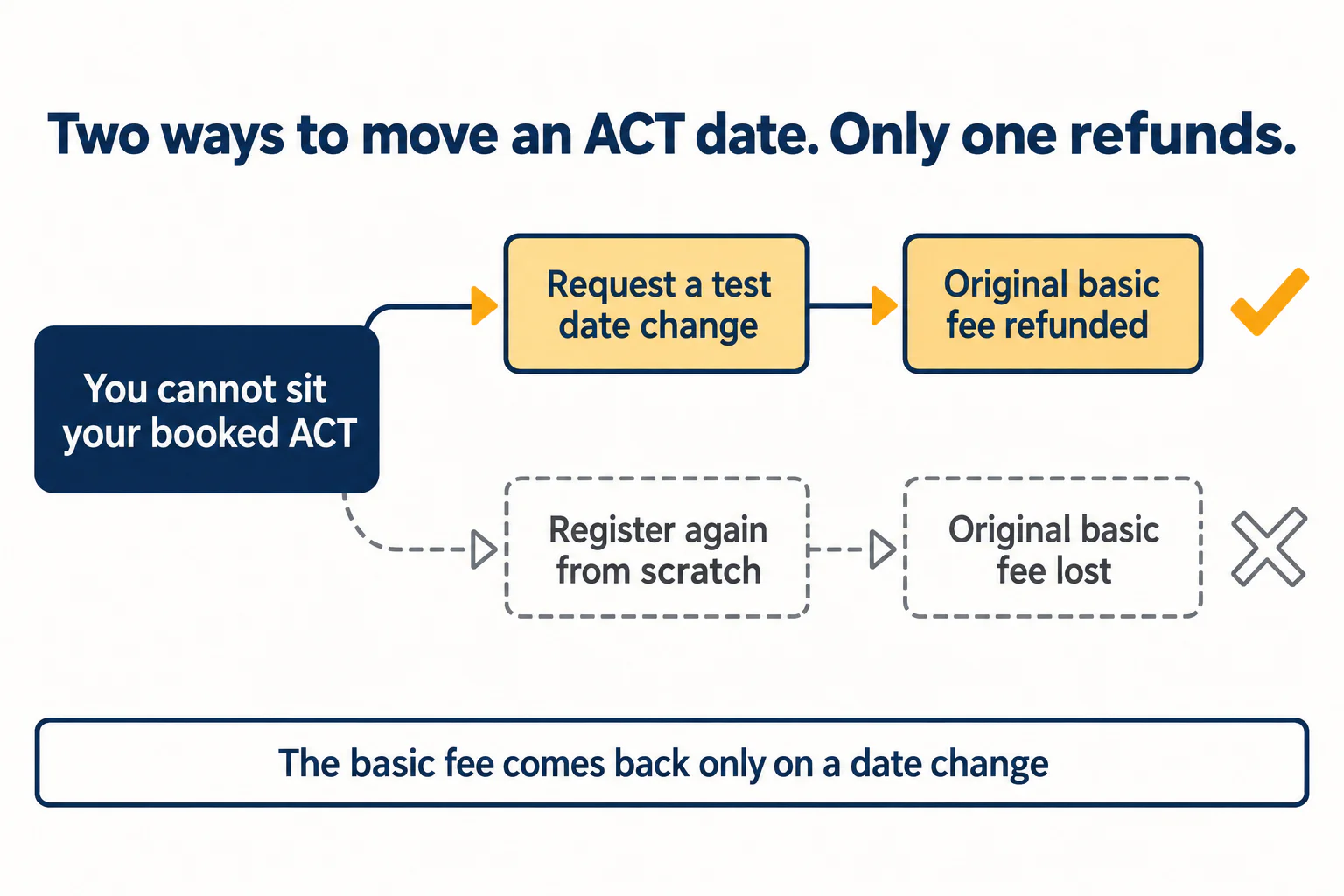
How to change your ACT test date, step by step
- Sign in to MyACT and open your registration for the date you cannot sit.
- Choose to make changes to your registration rather than starting a new registration. This is the step that decides whether your basic fee comes back.
- Select the new test date from the available national dates. Check the registration deadline for that date first; the change still has to land inside it.
- Keep or change your test option. Science and writing are separate add-ons, so this is a free moment to reconsider whether you want them. Our guide on whether the optional ACT science section is worth sitting covers that decision.
- Pay the $49.00 change fee plus the fee for the new date. If you hold a fee waiver, it reapplies to the new date but covers only the test or late fee, not the change fee.
- Check your admission ticket re-issues for the new date and centre before the photo deadline for that test date.
If you are moving the date because you are not ready rather than because you are unavailable, that is a different question and a better one. Work out honestly whether eight more weeks changes anything, which means knowing what a good ACT score looks like for your target colleges and what your current practice scores say.
Not sure whether to sit the next ACT or move it? A free consultation with Catalyst Test Prep benchmarks where your sections actually are, so the date you pick is a decision rather than a guess.
Book a Free Consultation →Can you change your ACT test centre?
Yes, within two limits. The first is availability: ACT says the change goes through "if a seat and materials are available for your test option at your new preferred test center on your preferred test date". The second is a hard cut-off: "You cannot request a test center change after the published accommodations deadline."
That second limit is stricter than most students expect, because the accommodations deadline falls earlier than the late registration deadline. A centre change is therefore one of the first doors to close, not one of the last. If you know a centre is too far or too unfamiliar, move early rather than waiting to see whether a lift materialises.
A test centre change uses the same $49.00 change fee as a date change, and the fee covers one change rather than one of each. Changing both your date and your centre in a single request is the efficient way to do it.
What happens if you miss the ACT entirely?
ACT's wording is deliberately broad: "If you miss the test for any reason, including illness, injury, being denied admission at the test center for lack of ID, or late arrival, your options are listed below." There is no medical exemption, no illness refund and no grace period for arriving late. Being turned away over an ID problem is treated exactly like oversleeping.
Your realistic option is the test date change, which is worth filing even weeks later, because it is what converts a lost basic fee into a credited one. Walking away from the registration is the only genuinely irreversible choice available.
This is also the point at which a retake plan matters more than the lost fee. Read how ACT superscoring works before deciding which sections to sit on the replacement date, because it changes what a second attempt is actually for.
Standby testing, and what it does not include
If the late deadline has already passed, standby is the remaining route. ACT describes it as what you use when "you miss the late deadline to register for a test date", and it "provides a non-guaranteed opportunity to test". It costs $75.00.
Three conditions are worth knowing before you pay for it. Centres "admit standbys on a first-come, first-admitted basis and only if there are available seats, test materials, and staff", so no seat is promised. Accommodations are not available for standby testing, which rules it out entirely for any student testing with extended time or other approved support. And if you are turned away, the standby request "will not transfer to another test date or test center"; ACT instead refunds the standby fee once all answer documents for that test event have been processed.
Every ACT deadline for 2026-27
Each national test date carries four dates that matter: the regular registration deadline, the late registration deadline, the photo upload and standby deadline, and the score release. All of them fall at 11:59pm Central Time.
| Test date | Register by | Late deadline | Photo / standby | Scores |
|---|---|---|---|---|
| 19 September 2026 | 14 August | 1 September | 14 September | 6 October |
| 17 October 2026 | 11 September | 29 September | 12 October | 27 October |
| 12 December 2026 | 6 November | 29 November | 7 December | 22 December |
| 27 February 2027 | 22 January | 9 February | 22 February | 16 March |
| 10 April 2027 | 5 March | 23 March | 5 April | 20 April |
| 12 June 2027 | 7 May | 25 May | 7 June | 23 June |
| 10 July 2027 | 4 June | 22 June | 5 July | 20 July |

Two scheduling details hide in that table. There is no November national ACT, so the gap between 17 October and 12 December is eight weeks, the longest in the autumn. And July testing becomes available to students in New York from 2027, which closes a gap that has existed for years.
What each ACT change actually costs
ACT publishes a single fee schedule covering changes and the services students confuse with them. Reading the whole list at once makes it obvious which of them solve a registration problem and which solve a scoring problem.
| Service | Fee | What it does |
|---|---|---|
| Change fee | $49.00 | One test date, test centre or test form change |
| Late registration | $42.00 | Registers you after the regular deadline |
| Standby testing | $75.00 | A non-guaranteed seat after the late deadline |
| Additional score reports | $20.00 | Sends scores beyond the four colleges included |
| My Answer Key | $36.00 before testing, $44.00 after | Returns your answers and the scoring key |
| Score verification | $67.00 per part, $134.00 for both | Rechecks how your test was scored |
The base ACT fee of $70.00 already "includes reports for you, your high school, and up to four colleges", so additional reports are only needed from the fifth college onward. And two of these are not registration tools at all: My Answer Key and score verification both act on a test you have already sat. If money is the obstacle rather than the date, check ACT fee waiver eligibility before paying anything.
If you are juggling an ACT date against an SAT date, the two organisations handle this differently and the SAT process is worth reading in parallel: see how to change or cancel an SAT registration. Knowing how long the ACT now runs also helps if you are deciding whether to sit both in the same month.
File the change, do not start again
Three things to carry away. Cancelling an ACT registration returns nothing, so the only useful move is a change rather than a cancellation. A test date change costs $49.00 and refunds your original basic fee, while re-registering for the same new date loses it, which makes the route you click more consequential than the date you choose. And the centre change door closes at the accommodations deadline, earlier than most students assume.
Then decide the harder question: whether the next date is genuinely better for your score or just further away. Eight weeks moves a Composite only if those weeks are structured.
Ready to turn a prep plan into real score gains? Catalyst's 1:1 live online ACT and SAT programme starts with a free consultation to benchmark your teen's starting point and build a personalised path to their goal score.
Book a Free ConsultationSources, all checked 12 October 2026: ACT registration, changes and missed tests; ACT fee schedule; ACT national test dates 2026-2027; ACT standby testing.