
You can cancel an SAT score, and almost nobody should. The deadline is 11:59 p.m. Eastern Time one week after your test date, and weekend SAT scores are not released until thirteen days after test day. Work through those two numbers and the awkward truth appears: the cancellation window closes six full days before you find out what you scored.
Every SAT score cancellation is made blind, on a feeling rather than a number. This guide sets out the exact deadline, how the request works, why it cannot be undone, and the option most students should use instead.
Key Takeaways
- The weekend deadline is 11:59 p.m. ET, seven days after test day. School day tests get five days.
- Scores arrive at thirteen days, so you are always deciding without the score in front of you.
- Cancellation is permanent: College Board will not reinstate or report the score to anyone, ever.
- Score Choice already lets you withhold a weak score from most colleges at no cost, which makes cancelling redundant.
- Cancelling does not refund your $68 registration fee.
What is the SAT score cancellation deadline?
For a weekend SAT, College Board's rule is exact: "You must cancel no later than 11:59 p.m. Eastern Time one week after your test date." For an SAT School Day administration the window is shorter, at five days.
Applied to the current test calendar, that produces these dates:
| Weekend test date | Cancel by (11:59 p.m. ET) | Scores released |
|---|---|---|
| October 3, 2026 | October 10, 2026 | October 16, 2026 |
| November 7, 2026 | November 14, 2026 | November 20, 2026 |
| December 5, 2026 | December 12, 2026 | December 18, 2026 |
The release dates come from College Board's score release schedule, which puts every 2026 weekend administration at exactly thirteen days. We worked through that pattern in detail in our guide to when SAT scores come out.
The six-day gap nobody mentions
Look at the October row. The decision has to be made by the 10th. The score appears on the 16th. Those six days are the whole problem with score cancellation as a strategy, and no test prep site seems willing to put it in a headline.
Students cancel because they walked out of the test centre feeling wrecked. That feeling is a poor instrument. Digital SAT students routinely report that the second module felt brutal, which in an adaptive test is frequently a signal that they cleared the threshold in module one and were routed to the harder set. Feeling stretched and scoring badly are not the same event, and our explainer on how the adaptive modules actually work sets out why.
Not sure where your teen stands? A free consultation with Catalyst Test Prep maps exactly which SAT topics need the most work, so you're never guessing about study time.
Book a Free Consultation →How do you actually cancel an SAT score?
Online, through your College Board account. Requests are not accepted by phone or email, so there is no last-minute call that saves a missed deadline.
- Go to mysat.collegeboard.org and sign in.
- Find the specific SAT administration date under My Scores.
- Select the option labelled Unsure about scores?
- Agree to the Cancellation of SAT Scores Agreement.
- Follow the remaining instructions to submit.
The agreement is the point of no return. College Board's wording on its score cancellation page is unambiguous: after a request to cancel scores is submitted, scores cannot be reinstated or reported to you or to any institution.
Read that carefully. Not reported to you either. You will never learn what you scored. Students who cancel and then spend senior year wondering whether they threw away a good result have no way to check.
Why Score Choice makes cancelling unnecessary
Most colleges accept Score Choice, which lets you decide which SAT test dates to send. A score you do not like can simply sit in your account, unsent and unseen by anyone.
Compare the two options honestly:
| Cancel the score | Use Score Choice | |
|---|---|---|
| Cost | Free, but no refund of the $68 | Free |
| Deadline | 7 days, before you see it | Any time, after you see it |
| Reversible | Never | Always |
| You learn your score | No | Yes |
| Sections usable in a superscore | No, gone | Yes |
| Diagnostic value for a retake | None | Full section breakdown |
That last row decides it for most students. A disappointing score report is the single most useful document in a retake plan, because it names which content domains cost the marks. Cancel it and you are preparing for the retake with no information at all, which is how students take the same test twice and get the same result. Our guide to SAT superscore and Score Choice covers exactly which policy applies where.
One caveat worth stating plainly: a small number of colleges ask for every score from every sitting. If your target list includes one of those, cancelling removes the score from the record entirely rather than merely withholding it. That is the one scenario where the calculation genuinely changes, and even then you are still deciding blind.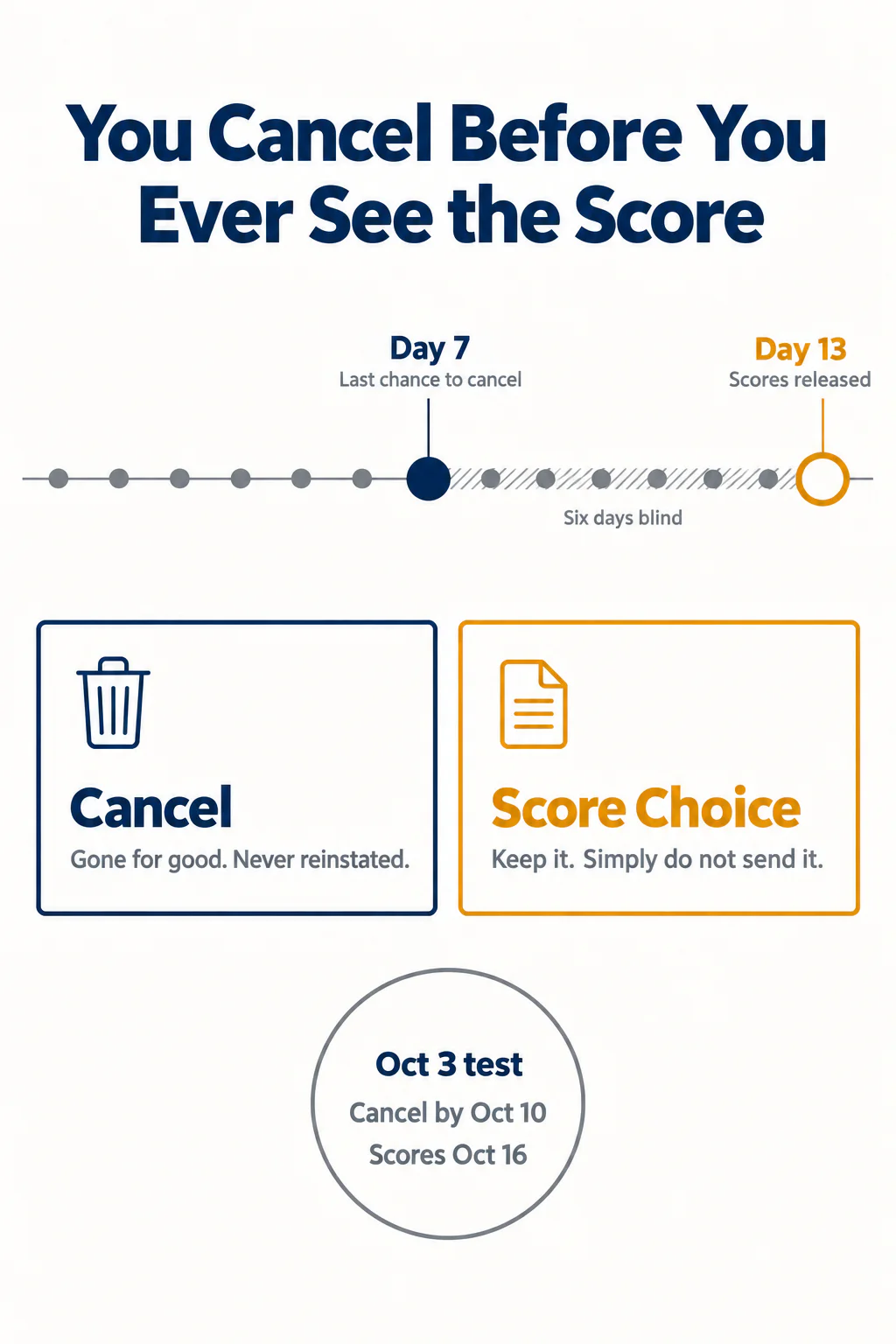
When does cancelling an SAT score actually make sense?
When you can name the specific thing that went wrong, and that thing would have affected a large block of questions rather than a handful.
Real examples: a student who developed a migraine during the first Reading and Writing module and guessed through the rest of it. A student whose device failed and who tested through a long disruption. A student who realised mid-test that they had prepared for the wrong content and left a full module largely unanswered. In each case there is a concrete, describable failure covering a big share of the paper.
What does not qualify: feeling that it "went badly". Running out of time on the last three maths questions. Finding module two hard. Comparing notes afterwards with a friend who found a question easy. These are ordinary test-day experiences, and they correlate weakly with the actual result.
There is a useful test to apply. If you cannot write down in one sentence what went wrong and roughly how many questions it touched, you are cancelling on mood. Wait the thirteen days.
What to do instead during those seven days
Nothing, mostly. That is the honest answer, and it is harder than it sounds.
The productive version of the wait looks like this. Write down, while it is fresh, which sections felt hardest and what specifically slowed you down. Timing on the maths grid-ins. A reading passage type you could not get into. That note is worth having when the score report lands, because by day thirteen the memory has gone and the report alone will not tell you why.
Then check the next test date. If a retake is likely, knowing the registration deadline before the score arrives saves a scramble. The strategic retake guide sets out how far ahead to book. And if the score does come back below target, our walkthrough of going from 1200 to 1400 is the version of the plan that works on specifics rather than on more hours.
Registration cancellation is a different thing entirely
Worth separating, because the two get confused constantly. Cancelling a registration happens before test day and gets you part of your money back: $34 if you cancel by the change deadline, $44 after it, with the refund processed against the $68 fee. Cancelling a score happens after you have tested, costs nothing, refunds nothing, and destroys the result.
If your teen is unwell the week before a test, the registration cancellation is the decision to be making, and it is reversible in the sense that you can simply register again. Fee waiver users have the cancellation charge removed entirely and their unused benefits returned, which we cover in the guide to SAT fee waivers.
The decision, in one paragraph
Cancelling an SAT score is permanent, free of charge, refund-free, and has to be done within seven days on no information. Score Choice does almost everything cancellation does, at no cost, after you have seen the number, and without destroying the section data you need for a retake. Unless a college on your list demands every score and something concrete went wrong on the day, the right answer is to let the seven days pass, read the report on day thirteen, and decide from there.
A disappointing score is not a disaster. It is a diagnostic. Treat it that way and the retake has something to aim at.
Ready to turn a prep plan into real score gains? Catalyst's 1:1 live online SAT programme starts with a free consultation to benchmark your teen's starting point and build a personalised path to their goal score.
Book a Free Consultation