

Search for free ACT prep and you will still be told to sign up for ACT Academy. Try it. The act.org/academy address now redirects to a general learning-resources page, and ACT's own test preparation page does not mention ACT Academy anywhere. Meanwhile, the paid prep sold on that same act.org page, from live classes to virtual tutoring, is powered by Kaplan.
Those two facts reshape the comparison most families are trying to make. This guide sets out the best ACT prep options as they actually exist in November 2026: ACT's free official materials, the official guide, self-paced courses, group classes and 1:1 tutoring. Every vendor claim below was read on the vendor's own page this session. We have sorted the options by the student's situation, because the right answer for a 22 with a test in five weeks is not the right answer for a 30 with a year to go.
Key Takeaways
- ACT Academy no longer exists as a findable product. ACT's free offer now is four official practice tests, section questions, QuizMe, a daily question and eBooks.
- ACT's paid classes, self-paced courses and tutoring are run by Kaplan, and the self-paced one is free to students who register with a fee waiver.
- The enhanced ACT Composite uses English, math and reading only: 131 questions in 125 minutes. Science is optional and adds 40 questions in 40 minutes.
- Guarantees from Magoosh and PrepScholar change or stop at the top of the scale. A student already at 31 has different terms from one at 24.
- Take one free, timed official test before paying for anything. Its section scores decide which option earns your money.
What changed on the ACT, and why it changes the prep decision
The test got shorter and the Composite got narrower. ACT's enhancement flyer says the test has 44 fewer questions, that math questions now have four answer choices instead of five, and that students can take the ACT with or without science. The changes reached online national testing from April 2025 and every national test, in either mode, from September 2025.
On ACT's current test overview, English is 50 questions in 35 minutes, math is 45 in 50 minutes and reading is 36 in 40 minutes. That is 131 questions in 125 minutes for everything that counts toward the Composite. Science, 40 questions in 40 minutes, now produces its own score and a STEM score, and ACT states plainly that science and writing "do not affect your Composite score."
For a prep buyer, that has two consequences. First, any material written before the change teaches a different test, so the format check matters more than the brand. Second, a student who will not sit Science can drop one of the four old scored sections from the plan entirely. Our guide to the optional ACT Science section covers who should still take it.
What happened to ACT Academy?
It is gone in every way that matters to a student. ACT Academy was ACT's free online practice platform, and for years it was the standard free recommendation. Today both act.org/academy and academy.act.org redirect to ACT's learning-resources page, which offers "a full-length official ACT online exam, and video lessons for free" with no Academy branding, and ACT's test preparation page lists no product by that name.
That matters because some of the best-ranked prep guides still describe it in the present tense. PrepScholar's "What Is ACT Academy?" article, updated August 2024, calls it "a free online resource" anyone can access. A family following that advice in 2026 lands on a different page and assumes they have done something wrong.
What ACT actually gives away now is worth knowing precisely. Its free prep page lists four official full-length practice tests, each as an interactive digital version with timed and untimed sections and as a downloadable paper booklet with a scoring key. Around them sit section practice questions, QuizMe quizzes, a question of the day through a free MyACT account, study guides, eBooks and calculator videos. The practice test PDF we opened, Practice Test 2, is marked 2025 | 2026 and uses the enhanced section counts.
The six ACT prep options side by side
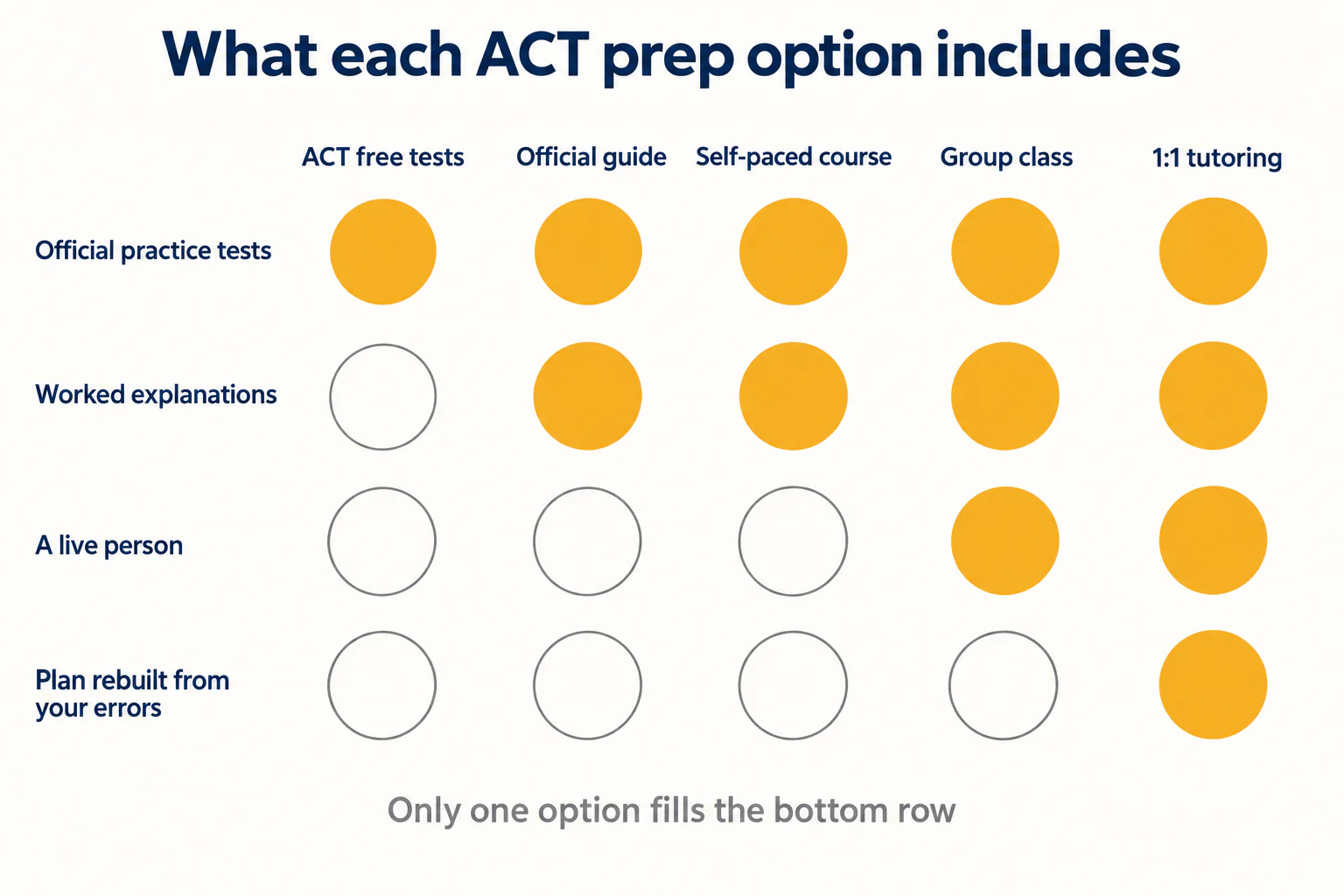
Each option below solves a different problem, and the table shows which problem. "Plan changes when you stall" is the column most families skip and the one that usually decides whether the money worked.
| Option | What you get (verified) | Who reads your mistakes | Plan changes when you stall? | Best for |
|---|---|---|---|---|
| ACT free official materials | 4 full-length tests, section questions, QuizMe, daily question | You, with a scoring key | No | Every student, as the first step |
| Official ACT Prep Guide 2026-2027 | 4 full-length tests in print, worked explanations | You, with explanations | No | Paper learners who self-correct |
| Self-paced courses (Magoosh, PrepScholar, Kaplan) | Lessons, question banks, practice tests, progress tracking | Software, plus written explanations | Partly, by algorithm | Disciplined students with content gaps |
| Group classes (Kaplan, Princeton Review, PrepScholar) | Scheduled live lessons with a teacher | A teacher, shared across the class | Rarely, the syllabus is fixed | Students who need a timetable |
| Marketplace or course-bundled tutoring | Hours with a tutor, often on the vendor's curriculum | A tutor | Depends on the tutor | A narrow gap and a fixed budget |
| Personalised 1:1 programme (Catalyst) | Diagnostic, a plan built from it, live 1:1 teaching | Your own tutor, every session | Yes, that is the job | Large gaps, short timelines, stalled self-study |
ACT's free official materials: what are they good for?
Measurement. Nothing else on this list produces a score on the real scale from questions written by the organisation that writes the exam, and nothing else is free. Four tests is enough for a baseline, two or three checkpoints and a final dress rehearsal, which is a full cycle for many students.
What the free materials do not do is teach. A scoring key tells you a question was wrong. It does not tell you whether you missed a comma rule, misread the question or ran out of time, and those three need different fixes.
Is the Official ACT Prep Guide worth buying?
For the right student, yes, but not for its test count. ACT's page describes The Official ACT Prep Guide 2026-2027 Edition as containing "four authentic, full-length ACT tests" that "reflect the current ACT format", the same number ACT publishes free online. The guide earns its place with worked explanations and paper, which suits a student who learns better away from a screen. We compare the full shelf, including the targeted subject guides, in our review of the best ACT prep books.
What do self-paced ACT courses actually include?
A sequence, a question bank and a progress dashboard. On the vendors' own pages this session:
- Magoosh lists a Premium plan at $129 for 12 months with "over 8,000 practice questions", "over 250 video lessons" and "up to 33 full-length, official practice tests", marked "Enhanced ACT ready". A $399 tier adds 16 hours of on-demand classes, which are recorded rather than live.
- PrepScholar lists Complete Online ACT Prep at $397 for 12 months, or $495 with an AI learning assistant. It says the program was "fully redesigned to reflect the new test", includes 4 official ACT practice tests, and recommends at least 40 hours of study.
- Kaplan sells self-paced courses through ACT's own page, and The Official ACT Self-Paced Course, Powered by Kaplan, is free to students who register for the ACT using a fee waiver. Our guide to ACT fee waiver eligibility covers who qualifies.
One check is worth making before buying any course that advertises a large number of official tests: ask how many are in the enhanced format. ACT itself publishes four free in the current format. An English section that is not 50 questions in 35 minutes, or a math question with five choices, belongs to the old test, and it will train your pacing wrong.
Not sure which of these your teen actually needs? A free consultation with Catalyst Test Prep reads their practice test section by section and tells you whether the gap is content, pacing or follow-through, so you only pay for the fix that matches.
Book a Free Consultation →Are group ACT classes worth it?
For one type of student, clearly. A class supplies a timetable, a teacher and a reason to show up, which is exactly what a student who abandons self-study in week three is missing. ACT's page says Kaplan's live online classes are led by teachers "who scored in the 99th percentile" and lets students try a class free. PrepScholar's live classes cost $895 on its page, run in "a small group of up to 9 students" and include 9 to 36+ hours of live instruction. Princeton Review sells a 31+ Course and an Essentials Course, publishes no prices on its ACT page, and promises "You'll score higher, or we'll refund your tuition", with restrictions.
The limit is the syllabus. A class moves at the pace of the room, so a student who already knows functions sits through functions, and a student who is lost on them gets one pass and a homework set.
When is 1:1 ACT tutoring the right call?
When the problem is specific, the time is short, or self-study has already failed once. Tutoring is the only option where someone reads your errors and changes the plan in response. PrepScholar shows its 1:1 tier at $995 with packages of 4, 10, 18 or 32 hours. Catalyst offers personalised 1:1 online ACT classes with 99th percentile tutors, starting from a diagnostic and building the plan from it.
The cost per hour is the wrong number to compare. Ten hours that fix the one thing costing you three Composite points is cheaper than a semester of class time spent on things you already knew.
Do the ACT score guarantees cover you?
Read the eligibility line before the headline. Two of the most marketed ACT guarantees are written around the middle of the scale, and both change at the top.
- Magoosh promises a 4 point increase "over your old scores (as long as you scored a 30 or below)", after completing its premium program.
- PrepScholar guarantees "an increase of at least 4 points on your ACT" for students starting under 31. Students starting at 31 or higher must reach at least 34 instead. It also requires an official ACT or PreACT score from the four years before you create your account, finishing every assigned lesson and practice test, sitting an official ACT within 60 days of finishing, and claiming within 360 days of purchase.
- Princeton Review promises a higher score or a tuition refund, with restrictions linked from its page.

That prior-score condition matters more than it looks: a student who has never sat the ACT or PreACT has no baseline for PrepScholar's guarantee to measure against. None of this makes the guarantees dishonest. It makes them conditional, and the conditions reward finishing the program, which is the hardest part for the students most likely to need the guarantee. If you want context on where 30 and 34 actually sit, our breakdown of what a good ACT score is uses ACT's own percentile tables.
Which ACT prep option fits your situation?
Four questions sort almost every student. Answer them from a real practice test, not from a guess.
How big is the score gap?
A small gap, roughly one or two Composite points, is usually pacing, careless errors or a single topic. Free official tests plus disciplined review often close it. A large gap means content the student has not learned, and practice tests alone will measure that gap repeatedly without closing it. That needs teaching, from a course or a person.
How long until test day?
Count backward from the date you will actually sit. With months to go, a self-paced course has time to work through its sequence. With five or six weeks, there is no time for a fixed syllabus, and targeted 1:1 work on the two weakest areas usually beats breadth. Our list of upcoming ACT test dates shows the registration deadlines to plan against.
What is the budget band?
Free covers measurement completely. Under a few hundred dollars buys a self-paced course with its own question bank, and on the pages above that band runs from Magoosh's $129 to PrepScholar's $495. Group classes and tutoring sit higher, and Kaplan and Princeton Review do not publish their ACT prices on the pages we checked, so ask for a quote in writing.
Will the student work alone?
Be honest here, because it overrides everything else. A self-paced course bought for a student who does not open it is the most expensive option on the list per point gained. If past self-study has faded within a fortnight, choose something with a timetable or a person attached.
Should you prep for ACT Science at all?
Only if you will sit it. Science does not enter the Composite, so for a student whose colleges do not ask for it, every hour of science prep is an hour taken from the three sections that do count. Students heading for STEM majors, or applying where a science score is expected, should keep it, since it is the only route to the STEM score. If you are still choosing between tests, our comparison of the SAT and the ACT covers the pacing difference that usually decides it.
How to check any ACT prep product in five minutes
- Find one English section. Fifty questions in 35 minutes is the current test. Any other count means an older form.
- Open one math question. Four answer choices is current. Five is pre-2025.
- Ask where the full-length tests come from. Official ACT forms give a score on the real scale. Vendor-written tests give an estimate.
- Read the guarantee's starting-score line. If you are near the top, you may be outside it.
- Ask who changes the plan. If the answer is "you" or "the algorithm", be sure the student will act on it.
PrepScholar's own FAQ adds a practical warning about the official guide: it recommends students avoid taking the four book tests in the publisher's online portal, saying they lack a built-in time limit and do not reflect the real test experience. Whatever tool you use, time yourself to ACT's section limits.
Choosing the best ACT prep option without wasting a season
The best ACT prep option is the one that fixes the problem your practice test actually shows. ACT Academy is no longer part of that decision, ACT's own paid courses are Kaplan's, and four official tests in the current format cost nothing. Start there, read the section scores, then choose: more practice for a pacing gap, a course for a content gap you will work through alone, and a person when the gap is large, the time is short or self-study has already stalled.
Ready to turn a practice score into a plan? Catalyst's personalised 1:1 online ACT classes start with a free consultation to read your teen's section scores and build a path to their goal score, with or without Science.
Book a Free ConsultationSources checked 16 November 2026: ACT test preparation page (Kaplan-powered classes, self-paced courses, virtual tutoring, fee-waiver course access, no ACT Academy listing); ACT free test prep page (four official practice tests, QuizMe, question of the day); ACT learning resources page, and the redirect of act.org/academy and academy.act.org to it; ACT test enhancements page and ACT enhancements flyer (section counts, 44 fewer questions, four math choices, April and September 2025 rollout); ACT Practice Test 2 PDF (2025 | 2026 section counts); ACT Official Prep Guide 2026-2027 page; Magoosh ACT plans page; PrepScholar ACT program page; Princeton Review ACT prep page; PrepScholar "What Is ACT Academy?" article. Kaplan's own site refused automated access, so Kaplan details come from ACT's page. Prices and guarantee terms change, so confirm them on each vendor's page before buying.