
The ACT you will sit is 44 questions shorter than the one most ACT prep books on the shelf were written for. ACT states plainly that on the enhanced test "the total test time has been reduced by 75 minutes, with 44 fewer questions overall", that math now carries four answer choices rather than five, and that the Composite is calculated from English, math and reading alone. Science became an optional add-on. That is not a cosmetic refresh, and it quietly broke a large part of the ACT prep book market.
So the useful question is not which ACT prep book is best in the abstract. It is which books were actually built for the exam now in front of you, and what you should buy given that ACT hands out four full-length official practice tests for nothing. This guide checks the edition of every book it recommends, names the one everybody still recommends that you should treat with care, and tells you which to skip entirely.
Key takeaways
- Check the copyright page, not the cover. Count the answer choices on any math question: four means enhanced ACT, five means the book predates the change.
- ACT publishes four full-length official practice tests at no cost, which is the same number inside the Official ACT Prep Guide. You are paying a book for explanation, not for question supply.
- The Official ACT Prep Guide 2026-2027 (Wiley, May 2026, 752 pages) is the only book whose questions come from the organisation that writes the exam.
- Barron's, Kaplan and Princeton Review each carry six full-length tests across book and online, half again as many as the official guide.
- The ACT Prep Black Book is still on every recommendation list and its second edition is from 2018. Its reasoning holds; its pacing and science chapters do not.
What changed on the ACT, and why it dates a prep book
Four changes matter for anything printed. Math dropped from five answer choices to four, which rewrites every elimination strategy a book teaches. Science moved outside the Composite, so a chapter that treats it as a quarter of your headline score is now arguing for the wrong priority. The test lost 44 questions and 75 minutes of testing time, which invalidates printed pacing tables down to the second. And students who sit science receive a separate STEM score, while those who sit writing receive an ELA score.
The rollout matters too. ACT National and international test takers moved to the enhanced format for the 2025-26 test dates, and state and district administrations began converting in spring 2026. A book published in 2024 was therefore written in good faith for a test that no longer exists, and nothing on its cover will say so.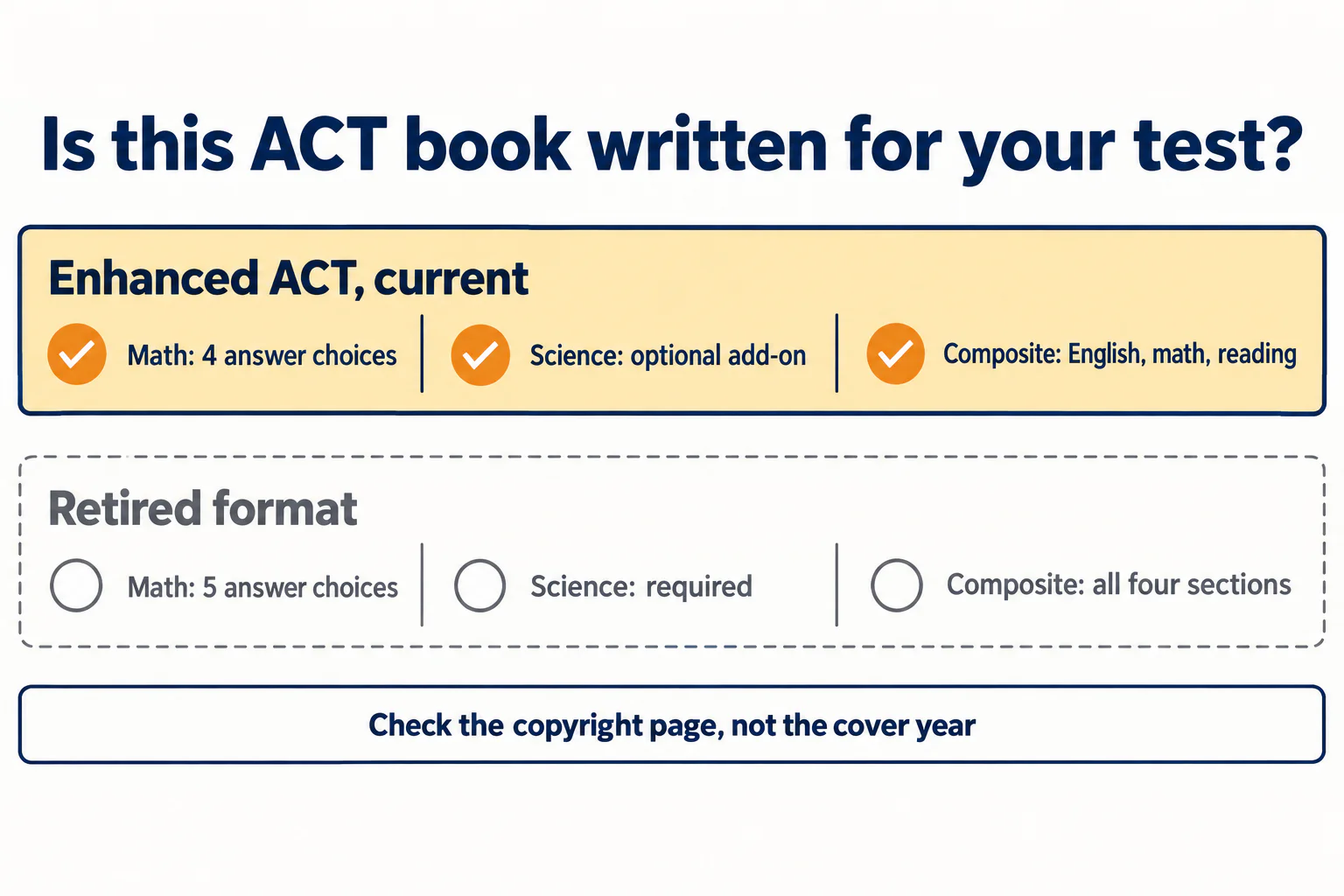
Which ACT prep books are written for the enhanced test?
Four mainstream guides are current, and all four were published or dated for 2026 or later. Here is what each one actually contains, taken from the publishers rather than from retail listings.
| Book | Published | Full-length tests | Extent | Built for enhanced ACT |
|---|---|---|---|---|
| The Official ACT Prep Guide 2026-2027 (Wiley) | May 2026 | 4 | 752 pages | Yes, "four practice tests that reflect the Enhanced ACT experience" |
| Barron's ACT Study Guide Premium 2026 (Brian Stewart) | 6 January 2026 | 6 (4 in book, 2 online) | 708 pages, 2,000+ questions | Yes, subtitled "for the New Enhanced ACT" |
| Kaplan ACT Total Prep, 2nd edition (2026-2027) | 2 June 2026 | 6 (2 in book, 4 online) | 2,000+ questions, 500-question online bank | Yes |
| Princeton Review Enhanced ACT Prep, 2027 | 1 December 2026 | 6 (4 in book, 2 online) | 896 pages | Yes, and it says so in the title |
Two things in that table are easy to miss. The Princeton Review 2027 edition is not on sale until 1 December 2026, so a student sitting the 12 December ACT is realistically buying the previous edition or choosing a different publisher. And ACT sells targeted subject guides for English, math, reading and science in new 2026-2027 editions, which are the right purchase when exactly one section is the problem and the wrong one when you have never seen the format.
Why ACT's free practice tests change the case for buying a book
ACT publishes four official full-length practice tests at no charge, in two formats: interactive digital sections with a scoring guide and diagnostic tools, offered timed and untimed, and downloadable paper PDFs with separate scoring keys. The same free library includes section practice, a tool called QuizMe, a daily question through a free MyACT account, downloadable eBooks and calculator tutorials. Students who register with a fee waiver also get The Official ACT Self-Paced Course, Powered by Kaplan, at no cost.
Count that against the shelf. The Official ACT Prep Guide contains four full-length tests. ACT gives away four. The paid guides that beat it on volume do so by two tests, not by ten. Almost every "best ACT prep books" roundup sells you a book on the promise of practice questions, and practice questions are the one thing ACT is not short of giving away.
This should change what you look for in a book. Judge it on the quality of the answer explanations, on whether the pacing advice matches the current section lengths, and on whether the strategy chapters were rewritten rather than reprinted. Judge it much less on how many tests are advertised on the cover. If you want to see where your current score actually sits before spending anything, work a free official test and run the result through our ACT score calculator, then read how to estimate an ACT score from a practice test before you draw conclusions from it.
Not sure where your teen stands? A free consultation with Catalyst Test Prep maps exactly which ACT sections need the most work, so you are never guessing about study time or about which book to open.
Book a Free Consultation →Which ACT prep book should you buy?
Buy the book that fixes the problem you actually have. Most students buy a 700-page complete guide, read the first ninety pages and never open the section that was costing them points.
- You have never sat the enhanced format. Start with ACT's free official tests. Spend nothing until you know which section is weakest and whether the shorter timing is the issue.
- One section is dragging your Composite down. Buy the targeted official subject guide for that section, 2026-2027 edition. Depth in one section beats breadth across four.
- You know the content but keep losing marks. That is a strategy and timing problem, so buy a current strategy-led guide. Barron's 2026 edition rewrote its strategy chapters specifically for the shorter format and the extra time per question.
- You need volume to drill. Kaplan's online question bank of 500 items plus six full tests is the most practice per purchase of the four.
- You are weighing the ACT against the SAT. Do not buy anything yet. Read whether the SAT or ACT is better for you first, because buying for the wrong test is the most expensive mistake in this whole process.

The book to treat with care, and it is the one everybody recommends
The ACT Prep Black Book by Mike and Patrick Barrett appears on nearly every ACT book recommendation list, and deservedly so on reasoning: it teaches how ACT questions are designed rather than drilling content. Its second edition was published in 2018. That edition was written for a test with five math answer choices, a mandatory science section that counted toward the Composite, 44 more questions and 75 more minutes.
The part of the book that still works is its account of how ACT builds a wrong answer, which has not changed. The parts to ignore are its pacing plans, its minute-per-question arithmetic and its treatment of science as a Composite section. Nobody writing a listicle mentions that, because checking a copyright page is more work than copying last year's list.
Two other categories deserve the same caution. Any book whose title carries a year earlier than 2026 should be assumed to be pre-enhancement unless the copyright page says otherwise. And self-published ACT guides appear and disappear quickly on retail sites with "2026-2027" in the title and no verifiable publisher behind them; if you cannot find the publisher's own product page, treat the claim of being updated as unverified.
How do you check any ACT book in 30 seconds?
Do these three things in a shop or in the preview pane of an online listing, in this order.
- Open the copyright page. The cover year is marketing; the printing date is a fact. A 2026 cover on a 2023 printing happens.
- Find any math question and count the answer choices. Four is enhanced. Five is not, and no amount of "fully updated" on the cover changes that.
- Look up science in the index. If the book never describes science as optional or never mentions the STEM score, it was written before the change. Our guide to whether to sit the optional ACT science section covers what that decision now involves.
That takes less time than reading a single review and it is more reliable than every one of them.
What an ACT prep book cannot do
A book has no idea what is wrong with your test. It cannot see that you answered reading question 30 correctly but took four minutes doing it, or that your math errors cluster in one domain, or that your science score is fine and your English score is what is capping your Composite at 26. It presents all four sections at equal weight to every reader, because it has to.
That is the real limit, and it is why two students with identical books and identical study hours finish three points apart. The diagnosis is the scarce thing, not the material. Before committing a term to any book, work out what a good ACT score looks like for your target colleges and read how to read your ACT score report, because the report tells you where the points are going. The book only tells you what the test contains.
Buy for the test you are sitting
Three things decide whether an ACT prep book is worth your money. It has to be printed for the enhanced format, which you verify on the copyright page and by counting math answer choices. It has to earn its price on explanations, because ACT already gives away four full-length official tests. And it has to match the problem you have, which means knowing which section is costing you points before you spend anything.
Get those three right and a single book plus the free official tests will take most students as far as self-study can go. Get them wrong and you will own 700 pages written for an exam that was retired.
Ready to turn a prep plan into real score gains? Catalyst's 1:1 live online ACT and SAT programme starts with a free consultation to benchmark your teen's starting point and build a personalised path to their goal score.
Book a Free ConsultationSources, all checked 12 October 2026: ACT free test prep; Wiley, The Official ACT Prep Guide 2026-2027; ACT counselor blog on the enhanced ACT; Penguin Random House listing for Princeton Review Enhanced ACT Prep 2027.