

The Ivy League schools that did not require test scores reported the higher SAT ranges. Columbia, Penn, Princeton and Cornell were test-optional for the class that entered in fall 2025, and every one of them reported a 25th percentile of 1490 or above. Harvard, Yale, Brown and Dartmouth required a test, and every one of them reported 1480 or below.
That is the first thing to understand about the average SAT score at Ivy League schools, and almost no score table mentions it. A published range only describes the students who chose to send a score. When fewer students send one, the range floats upward. We pulled section C9 of each university's own 2025-26 Common Data Set (CDS), the standard disclosure every school files in the same format, so all eight are measured the same way. Below are the real numbers, which schools require a score for the class you are applying to join, and what the ranges cannot tell you.
Key Takeaways
- The eight Ivies' 25th percentile SAT scores average about 1480 and their 75th percentiles about 1560, for students who entered in fall 2025.
- The test-optional Ivies post the higher floors. Only 43% to 60% of their first-years sent an SAT, against 67% to 79% at the four that required testing.
- Harvard's range fell when testing became required. Its section scores add up to about 1510 at the 25th percentile in fall 2024 and about 1450 in fall 2025.
- Seniors applying for fall 2027 face six requirements; Princeton and Columbia stay optional. Juniors applying for fall 2028 face a requirement at all eight.
- Compare your section scores, not just your total, and remember that most Ivy ranges are superscores built from each student's best sittings.
Average SAT and ACT Scores at All Eight Ivy League Schools
The table gives the 25th, 50th and 75th percentile scores for first-year students who enrolled in fall 2025, with the share who submitted each test. Every figure comes from the school's own Common Data Set 2025-26, section C9, downloaded from its institutional research office on 16 November 2026.
| School | SAT 25th / 50th / 75th | SAT R&W 25th–75th | SAT Math 25th–75th | ACT 25th / 50th / 75th | Sent SAT | Sent ACT | Policy for this class |
|---|---|---|---|---|---|---|---|
| Columbia (College and Engineering) | 1510 / 1540 / 1560 | 740–777 | 760–800 | 34 / 35 / 35 | 50% | 17% | Test-optional |
| Penn | 1510 / 1550 / 1570 (sections added) | 740–770 | 770–800 | 34 / 35 / 35 | 52% | 18% | Test-optional |
| Princeton | 1490 / 1530 / 1560 | 740–780 | 760–800 | 34 / 35 / 35 | 60% | 20% | Test-optional |
| Cornell | 1490 / 1530 / 1550 | 730–770 | 770–800 | 33 / 34 / 35 | 43% (calculated) | 13% (calculated) | Test-optional |
| Yale | 1480 / 1540 / 1560 | 730–780 | 740–790 | 33 / 34 / 35 | 67% | 25% | Test-flexible (SAT, ACT, AP or IB) |
| Brown | 1470 / 1520 / 1550 | 730–770 | 730–790 | 33 / 35 / 35 | 77% | 28% | Required |
| Harvard | 1450 / 1520 / 1560 (sections added) | 720–770 | 730–790 | 33 / 35 / 35 | 79% | 27% | Required |
| Dartmouth | 1440 / 1520 / 1550 | 720–770 | 720–790 | 32 / 34 / 35 | 69% | 33% | Required |
Three notes on the table. Harvard and Penn do not report an SAT composite in their CDS, only the two sections, so their totals are the section figures added together. Cornell left its submission percentages blank; the 43% and 13% are its reported counts (1,639 SAT and 486 ACT submitters) divided by its 3,827 enrolled first-years. And the SAT and ACT shares overlap, because many students send both. Yale's own announcement says 90% of its fall 2025 entrants included an ACT or SAT score, which is less than 67% plus 25%.
Average the eight schools and you get a middle 50% of roughly 1480 to 1560, with a median near 1530. That is a fair one-line answer. It is also the least useful number on this page, for the reason in the next section.
Why Do the Test-Optional Ivies Report Higher SAT Scores?
Because a student with a lower score could keep it to themselves, and many did. When submitting is optional, the reported range describes a self-selected group, and the students most likely to withhold are the ones whose scores sit below the school's usual range. The range does not get harder to reach. It just stops counting the people at the bottom of it.
The split in the fall 2025 data is clean. The four schools that required a test (Harvard, Yale, Brown, Dartmouth) had 67% to 79% of first-years send an SAT, and their 25th percentiles run from 1440 to 1480. The four that were optional (Columbia, Penn, Princeton, Cornell) had 43% to 60% send one, and their 25th percentiles run from 1490 to 1510. Not one school breaks the pattern. The ACT shows the same shape: three of the four optional schools report a 34 at the 25th percentile, while no required school reports higher than 33.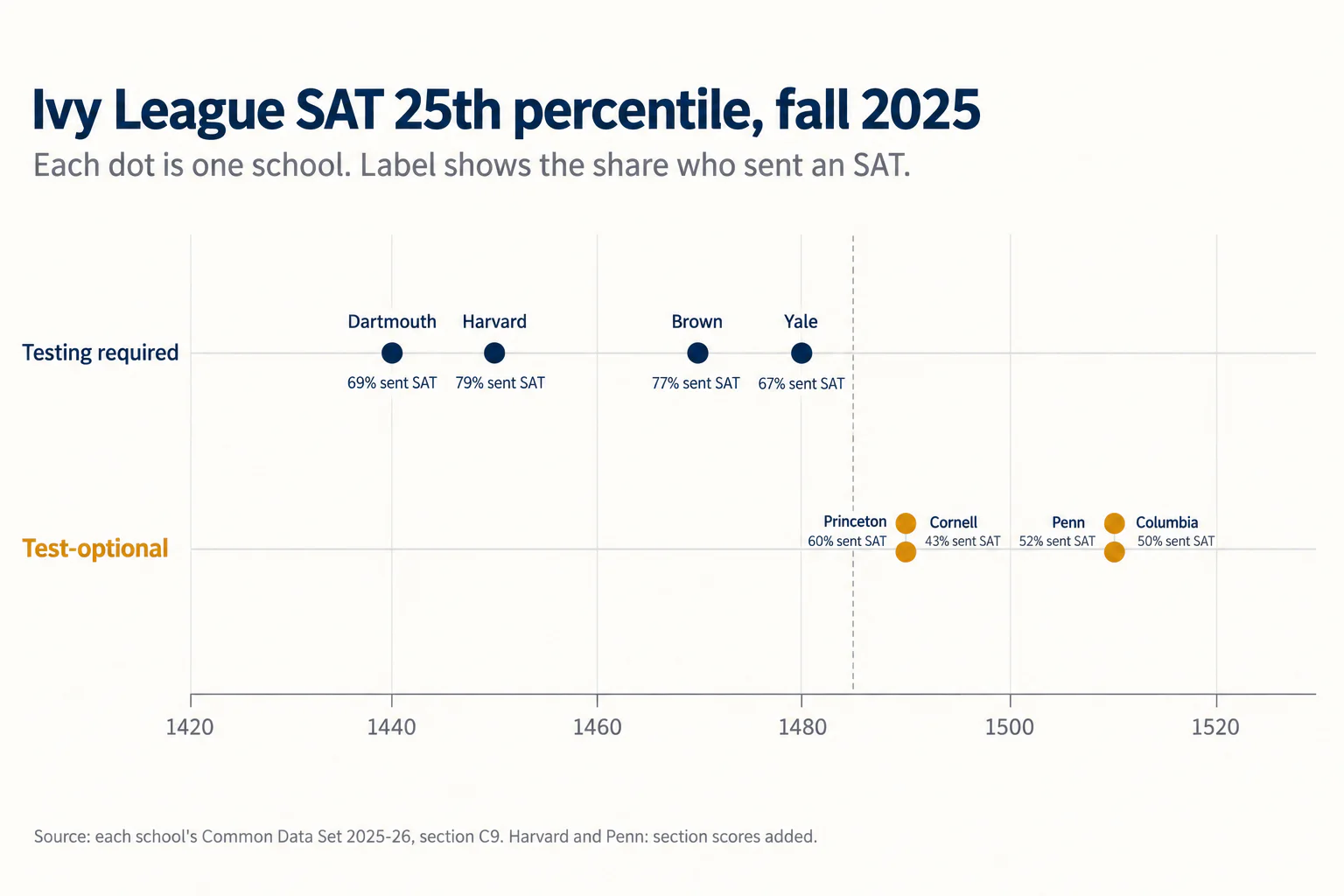
Dartmouth's faculty saw this from the inside before reinstating its requirement. Their study, quoted in Dartmouth's testing FAQ, found that "many high-achieving less-advantaged applicants choose not to submit scores", even when those scores would have helped them. Withholding is not a neutral act, and it shapes the numbers the school then publishes.
What Happened to Harvard's Range When Testing Became Required?
It dropped, and that is the strongest single piece of evidence that test-optional ranges overstate the bar. Harvard announced the return to required testing in April 2024, starting with the class that entered in fall 2025. Its CDS lets you compare the last optional class with the first required one directly.
- Fall 2024, test-optional: 54% of first-years sent an SAT. Reading and Writing ran 740 to 780 and Math 770 to 800, which adds up to roughly 1510 to 1580.
- Fall 2025, testing required: 79% sent an SAT. Reading and Writing ran 720 to 770 and Math 730 to 790, which adds up to roughly 1450 to 1560.

Nobody believes Harvard became easier to get into between those two years. What changed is who was counted. This is why 1510 to 1580 and similar figures still circulate as "Harvard's SAT range": they come from test-optional years, and they describe the confident half of the class rather than the class.
Yale makes a useful contrast. Its switch from test-optional to test-flexible for fall 2025 lifted the share sending an SAT only from 61% to 67%, and its reported middle 50% stayed exactly where it was, at 1480 to 1560. A small change in who reports produced no change in the range. Harvard's 25-point jump in reporting produced a 60-point drop.
Not sure where your teen stands? A free consultation with Catalyst Test Prep maps exactly which SAT topics need the most work, so you're never guessing about study time.
Book a Free Consultation →Which Ivy League Schools Require the SAT Now?
For students applying this autumn to start in fall 2027, six of the eight require the SAT or ACT. Princeton and Columbia are the two that remain test-optional, and both have already scheduled the end of that. Here is each school's current policy, read from its own admissions site on 16 November 2026.
- Harvard: SAT or ACT required. AP, IB and certain other exams count only in exceptional cases where the SAT and ACT are not accessible.
- Yale: ACT or SAT required from the 2026-27 cycle. The test-flexible option that let AP or IB scores stand in has ended; AP and IB results can now only be sent alongside an ACT or SAT.
- Penn: SAT or ACT required since the 2025-26 cycle, with a hardship waiver for applicants who have not tested. Penn combines your highest Reading and Writing and highest Math across sittings.
- Brown: SAT or ACT required since the 2024-25 cycle. Brown will superscore the SAT, the ACT, or both.
- Dartmouth: SAT or ACT required for applicants from US high schools from the Class of 2029, the class that entered in fall 2025. It considers your highest result on each section regardless of test date.
- Cornell: SAT or ACT required for fall 2026 entry and beyond. It considers highest section scores across dates and participates in Score Choice.
- Princeton: test-optional for fall 2027 entry, required for fall 2028 entry. It does not superscore between the paper and digital SAT, and it accepts only your highest ACT composite.
- Columbia: test-optional for the 2026-27 cycle, then required from August 2027 for the 2027-28 cycle, with a waiver available. Its testing policy page was updated on 8 June 2026.

The Columbia change is the one most score guides have not caught up with. Many still describe Columbia as permanently test-optional, which was true until this year. For the wider picture beyond the Ivies, our list of colleges requiring SAT scores tracks the other selective schools that have moved.
Four Things the Common Data Set Numbers Do Not Tell You
The CDS is the most reliable comparable source there is, and it still needs reading with care. Four limits matter for anyone using these ranges to set a target.
They are usually superscores. The CDS instructions tell schools to report scores the way they use them, so a school that takes your best Reading and Writing from one date and your best Math from another reports that combination. Your single-sitting score is being compared with other students' best-of composites. If you are still testing, our guide to SAT superscoring and Score Choice explains how to make that work for you.
Added sections overstate the composite slightly. The student at the 25th percentile in Math is rarely the same student at the 25th percentile in Reading and Writing, so a range built by adding sections is a little wider than the true composite range. Treat Harvard's and Penn's totals as close estimates, not exact figures.
Some figures are calculated, not observed. Columbia reports a 75th percentile Reading and Writing score of 777. SAT section scores move in steps of ten, so no student scored 777; it is an interpolated value. That is fine for orientation and a reason not to argue over ten points.
They describe enrolled students, not admitted ones. C9 covers first-years who actually enrolled in fall 2025. It is one cycle behind the class being admitted now, and it does not show what recruited athletes or other specific groups scored.
Setting a Target Score for an Ivy League Application
Aim at the median of the specific school, not the league average, and read the required schools' ranges as the more honest guide to the full class. For most of the Ivies that means a target around 1520 to 1550, with section scores that do not leave an obvious weak spot.
The CDS score distributions show how much room sits below that. At Dartmouth, which required testing, 83% of SAT submitters scored 1400 or above, so about one in six of its enrolled SAT submitters scored below 1400. At Columbia, where submitting was optional, 98% of submitters reported 1400 or above. If you are deciding whether your current score belongs in the conversation at all, our breakdown of whether 1400 is a good SAT score puts that number in national context.
Three practical rules follow from the data:
- At or above a school's median: your score is helping. Spend the remaining time on essays and coursework rather than another sitting.
- Between the 25th percentile and the median: you are inside the range at every Ivy. Retake only if one section is clearly lagging and you have a sitting left before the deadline.
- Below the 25th percentile at a school still optional for you: Princeton and Columbia, for fall 2027 entry, are the only two left. Withholding is a legitimate choice there, and nowhere else in the league.
Closing the last 100 points is a different problem from the first 100, because the errors left are few and specific. Our guide to breaking the 1400 to 1500 SAT score barrier covers how students at that level usually find them. To turn a Bluebook practice result into a projected score first, use our digital SAT score calculator.
Where These Numbers Come From
Every SAT and ACT figure above is from section C9 of the university's own 2025-26 Common Data Set, the edition describing students who enrolled in fall 2025. For Columbia we used the Columbia College and Columbia Engineering filing, not General Studies. Brown publishes its CDS as an interactive dashboard rather than a PDF; the others publish documents. Harvard's comparison figures come from its 2024-25 CDS, and Yale's from its 2024-25 CDS.
We used one source type for all eight on purpose. A mix of press releases, class profiles and third-party estimates cannot be compared, because each counts a slightly different group. If you want the same treatment for a different conference, our analysis of average SAT and ACT scores at Big Ten schools works from the federal College Scorecard instead.
What the Average SAT Score at the Ivy League Really Tells You
The average SAT score across the Ivy League is roughly 1480 to 1560 for the middle half of enrolled students, with a median near 1530. The more important finding is the direction of the bias: the Ivies that let students withhold scores reported the higher floors, and Harvard's own range fell by about 60 points the year it required everyone to submit. By fall 2028 all eight will require a score, and the published ranges at Princeton and Columbia are likely to look more like Harvard's and Dartmouth's when that happens. Set your target against each school's median, using section scores, and treat any range from a test-optional year as an optimistic reading of the bar.
Ready to turn a prep plan into real score gains? Catalyst's 1:1 live online SAT programme starts with a free consultation to benchmark your teen's starting point and build a personalised path to their goal score.
Book a Free ConsultationSources checked 16 November 2026: Common Data Set 2025-26, section C9 and section C1, for Brown (Office of Institutional Research dashboard), Columbia College and Columbia Engineering (OPIR), Cornell (Institutional Research and Planning), Dartmouth (Office of Institutional Research), Harvard (Office of Institutional Research and Analytics), Penn (Institutional Research and Analysis), Princeton (Office of Institutional Research) and Yale (Office of Institutional Research); Harvard and Yale Common Data Sets 2024-25; testing policy pages of Brown, Columbia, Cornell, Harvard, Penn, Princeton and Yale undergraduate admissions; Penn Admissions blog post on its testing policy (14 February 2025); Harvard FAS announcement "Return to Required Testing" (11 April 2024); Yale News, "Undergraduate admissions updates testing policy" (27 May 2026); Dartmouth's standardized testing reactivation FAQ.