

Of the three groups a 2025 study of Texas students tracked into their twenties, the one that earned least at age 24 was the group that took AP or IB and no dual enrollment. Students who did both earned the most. Students who did only dual enrollment came second. The route most families treat as the premium option finished third.
That result, from Columbia's Community College Research Center, is the reason AP vs dual enrollment is usually argued badly. The question is posed as a choice between two ways of getting college credit in high school, and the data suggests the interesting students are the ones who stopped treating it as a choice. Below is what each route actually is at the level of mechanics, where they genuinely differ, and the one asymmetry that should change how a nervous student picks.
Key takeaways
- 🔴 A weak AP score can be permanently deleted at no charge. A weak dual enrollment grade is on a college transcript and cannot be removed, including a W for withdrawal.
- CCRC found students who combined both routes had the strongest outcomes, and AP or IB without dual enrollment was the lowest-earning of the three groups at age 24.
- Dual enrollment is now enormous: 3.1 million students in 2024-25, and 23% of all community college enrolment.
- AP is not more generous, it is more predictable: you can read a college's AP policy before you sit the exam. Dual enrollment transfer is decided per course, per institution pair.
- AP costs a knowable 99 dollars per exam. Dual enrollment tuition is set by state policy, so no national comparison figure exists.
What is the actual difference?
Strip the branding and the two routes differ in what they produce.
An AP course produces an exam score, 1 to 5, owned by College Board and sent to colleges at your direction. The course is taught in your high school by a high school teacher. Nothing about it is a college enrolment, and the credit you eventually receive is granted by the receiving college against your score.
Dual enrollment produces a college grade. You are admitted as a student of a specific college, usually a community college, and you sit in its course under its grading policy. CCRC's figures show how normal this now is: 3.1 million high school students took at least one dual enrollment course in 2024-25, up from 2.8 million the previous year, with about 70 percent, roughly 2.2 million, taking them at a community college. Those students are now 23 percent of total community college enrolment, growing 9 percent year on year.
So one route gives you a score that a college interprets. The other gives you a transcript entry at a college you have actually attended. Almost every real difference between them follows from that sentence.
Which one produces better outcomes?
CCRC published a study on 14 October 2025 tracking Texas students expected to graduate in 2015-16 and 2016-17 for six years after high school, with supporting data from the 2019-20 and 2022-23 cohorts. Its finding on the combined group is unambiguous: "Students who combine dual enrollment and AP/IB courses have the strongest college outcomes."
The numbers behind it:
- More than 90% of students who took both routes enrolled in college or completed a credential by the first year after high school.
- 71% had earned a credential by the sixth year, including 60% with a bachelor's degree.
- At age 24, median quarterly earnings were 10,306 dollars for the combined group, 9,746 dollars for dual enrollment only, and 8,934 dollars for students who took AP or IB but no dual enrollment.
CCRC notes the gap "persisted after accounting for student demographics, test scores, and school characteristics."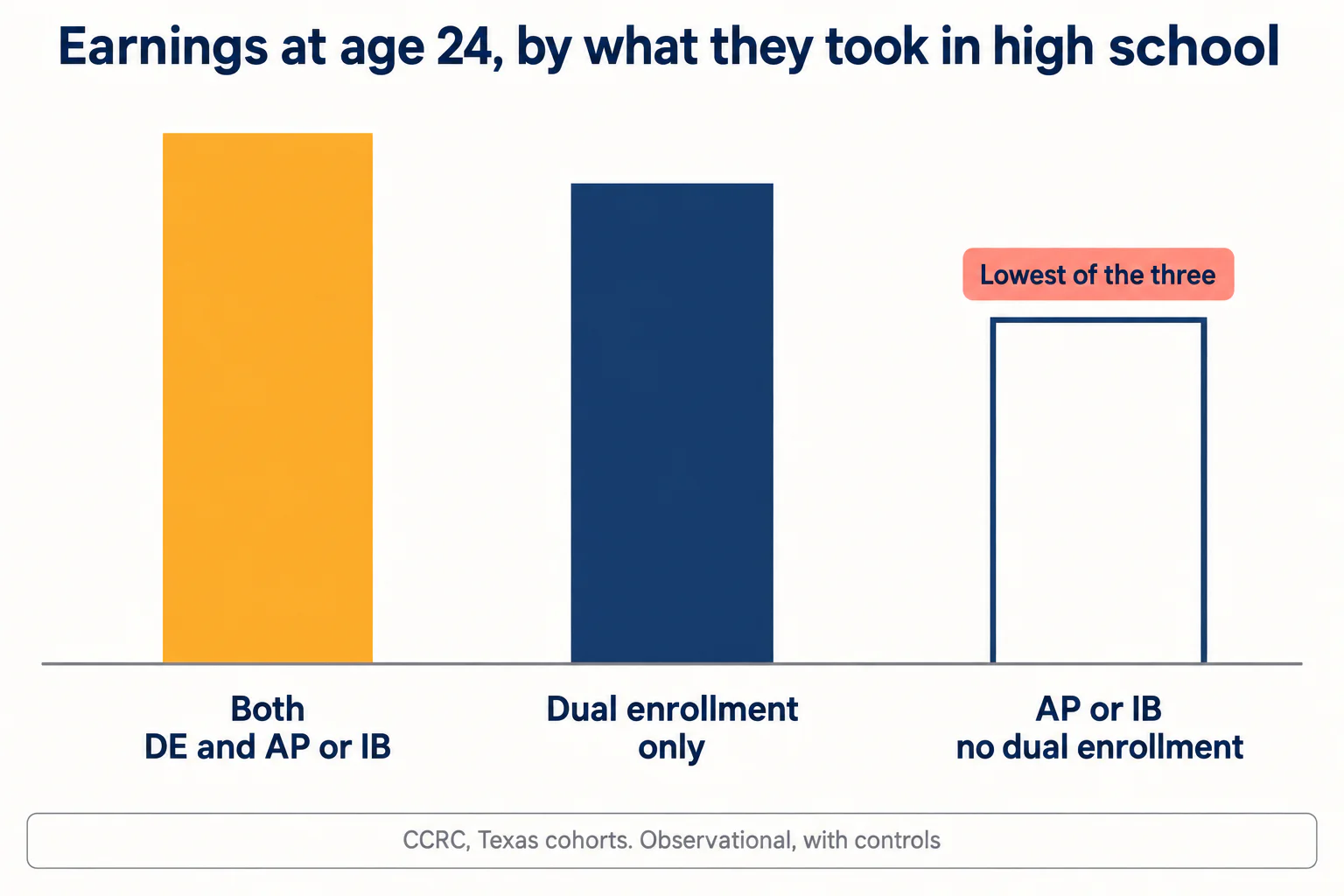
Read that honestly, because it is not a causal result. Controlling for demographics, test scores and school characteristics is a real control and not an experiment. Students who manage to take both routes are plausibly different in ways no covariate captures: they are at schools offering both, with timetables and advising that make both possible. The defensible reading is not "dual enrollment causes higher earnings". It is that there is no evidence base for treating AP as the prestige route and dual enrollment as the fallback, which is exactly how most families rank them.
Why a dual enrollment grade is permanent and an AP score is not
This is the structural difference that matters most to an individual student, and almost nobody puts it in a comparison table.
An AP score can be erased. College Board's cancellation policy is explicit: "your exam won't be scored, and if it has already been scored, the score will be permanently deleted from our records. Once a score is canceled, it can't be reinstated." It goes further on what colleges then see: "Neither the exam name nor score will be shown on the score reports sent to colleges, universities, or scholarship programs once canceled." There is no fee, and the deadline is 15 June of the year you sat the exam. A separate withhold service exists at 10 dollars per score per recipient and is reversible, which our guide to sending, withholding and cancelling AP scores works through.
A dual enrollment grade cannot be. Florida Atlantic University's registrar states it plainly: "All grades, including a 'W' for withdrawal, become a part of your permanent college transcript," and "Grades earned through Dual Enrollment will be applied to both your high school and FAU record (transcript)." The same page warns that "earning a low grade or a 'W' in a Dual Enrollment course may result in difficulty meeting future college admissions requirements and financial aid/scholarship qualifications."
That is the whole asymmetry. A student who sits an AP exam is buying a lottery ticket they can tear up. A student who enrols in a college course is signing a transcript. Both can be the right decision. They carry completely different downside, and the downside falls hardest on exactly the student who is least sure they can cope with the course.
A spring holding three AP exams and a college course is the point where most strong students come unstuck on timetabling rather than on content. A free consultation with Catalyst Test Prep maps what your teen is actually carrying and where the collisions are.
Book a Free Consultation →Which credit is more likely to be accepted?
The usual claim is that dual enrollment credit transfers more reliably because it is "real college credit". That gets the mechanism backwards.
AP's advantage is that the answer is published in advance. College Board maintains one national lookup of institutional AP credit policies, so a student can read what a specific college grants for a specific score before deciding to sit the exam. Our breakdown of what an AP score is actually worth in credit covers how to read one of those policies, including the difference between credit and placement, which is where most of the real value sits.
Dual enrollment transfer is a question about a pair of institutions. Whether College A's course counts at College B depends on accreditation, on how B maps the course against its own catalogue, and on whether it lands as a specific requirement or as generic elective credit. Within a state system with an articulation agreement this is often clean and well documented. Across state lines, or into a selective private university, it frequently is not, and the answer may not exist until you apply.
So neither is more generous. AP is knowable in October of junior year; dual enrollment is often knowable only after a transfer evaluation. For a student with a settled in-state target, that favours dual enrollment. For a student applying widely or to selective privates, it favours AP.
Does dual enrollment count in a college GPA?
At the teaching institution, yes, by definition: the grade sits on that college's transcript and in its GPA. At a different college you later attend, it depends on policy, and the two questions come apart in a way that catches people out. A receiving college can accept the credit without importing the grade, which is common, or it can decline the credit while the grade still exists on the original transcript, which is the worst of both.
There is a third case worth naming. Some professional and graduate programmes, medicine and law in particular, ask for transcripts from every post-secondary institution attended. A dual enrollment transcript from a community college in year 11 is a post-secondary transcript. Nobody mentions this to a sixteen-year-old choosing their options.
Four questions that actually decide it
Not a scoring system. Four questions whose answers point in different directions, which is the honest shape of this decision.
- Is the target college list settled and in-state? A known public system with an articulation agreement makes dual enrollment credit far more predictable. A wide or out-of-state list favours AP, where the policy is published nationally.
- How confident are you of a strong result? If there is real doubt, AP carries the erasable downside and dual enrollment does not. This question alone should settle it for a borderline student.
- Which course would be taught better? A well-taught AP class beats a poorly supported online college course, and the reverse is equally true. The teaching is a bigger variable than the format, and the AP score distributions show how much of an exam's outcome is really about the cohort and the teaching.
- What does the spring look like? AP exams land in a fixed fortnight in May. College courses have their own finals. Stacking both against SAT or ACT dates is the practical failure mode, and balancing SAT prep with school and AP exams is written about exactly that collision.

What this means if you are deciding now
For a sophomore or junior with options to pick, three practical conclusions.
Stop ranking the two routes and check your own constraints. The CCRC data gives no support to the hierarchy most families assume, and the two routes are not substitutes: one is an exam you can walk away from, the other is an enrolment.
Look up the AP policy for your realistic target colleges before you commit to an exam, because that information exists and is free. Then ask your prospective dual enrollment provider, in writing, what has historically transferred to those same institutions.
Use the asymmetry deliberately. Put the subject you are least sure about through AP, where a bad outcome can be deleted by 15 June. Put the subject you are confident in through dual enrollment, where a strong grade is permanent and that is exactly what you want. That is the one piece of advice in this article that follows from the mechanics rather than from a preference, and it is also the one almost nobody gives.
Where this leaves you
The two routes are not two grades of the same product. One is an exam whose result you control and can delete; the other is an enrolment that creates a permanent record at a real institution. The outcome data gives no reason to rank them, and gives a mild warning to anyone treating AP as the serious option and dual enrollment as the easy one.
So decide on constraints rather than prestige. Check the published AP policies for your actual target list.Ask in writing what has historically transferred from your dual enrollment provider to those colleges. And route your least certain subject through the exam you can cancel, because that option costs nothing and expires on 15 June.
Ready to turn a course-selection decision into a plan? Catalyst's 1:1 live online programme starts with a free consultation to benchmark your teen's starting point, map the spring calendar, and build a personalised path to their goal score.
Book a Free ConsultationSources: Community College Research Center, Columbia University, 14 October 2025; CCRC Community College FAQs, dual enrollment participation figures for 2024-25; College Board, Cancel Scores and College Board, Withhold Scores; Florida Atlantic University Registrar, Grades and Transcripts for Dual Enrollment; AP Central 2026-27 AP Exam Fees; College Board AP credit policy search. All quotations and figures checked 30 October 2026. The CCRC earnings comparison is observational with controls, not a causal estimate, and is described as such above.