

Fifteen per cent of students who sat AP Biology in 2026 earned a 5. At MIT, every one of those scores is worth exactly nothing, because MIT's own credit page states that no credit is given for the AP Biology exam. Across the country at the University of California, a 3 on that same exam earns credit towards graduation. The lower score, at the other university, is worth more.
That is not an anomaly to be explained away. It is how AP score college credit actually works, and it is why "is a 3 a passing score" is the wrong question to be asking in the autumn, when students are still deciding which exams to sit in May.
This guide uses four universities' own published policies, checked on 24 October 2026, to show what a 3, a 4 and a 5 are really worth. It also separates the two things students conflate constantly, credit and placement, because at some of the strictest universities the placement is the valuable half.
Key takeaways
- College Board calls a 3 "Qualified" and rates it equivalent to a B-, C+ or C. It grants no credit itself.
- UC grants credit for a 3 or higher on designated exams. MIT grants credit only for a 5, with no partial credit.
- MIT gives no credit at all for AP Biology, Chemistry, Computer Science or Statistics, whatever the score.
- Dartmouth has granted no AP credit since 2014, but still uses scores for placement and exemption.
- Credit shortens your degree. Placement does not, and is often worth more.
What does an AP score of 3 actually mean?
It means College Board considers you qualified, and nothing more than that. The published AP score scale is explicit about what it is doing: it "shows the recommendation that each AP score offers about how qualified you are to receive college credit and placement". A recommendation is not a grant.
| Score | College Board's label | College grade equivalent |
|---|---|---|
| 5 | Extremely well qualified | A+ or A |
| 4 | Very well qualified | A-, B+ or B |
| 3 | Qualified | B-, C+ or C |
| 2 | Possibly qualified | none given |
| 1 | No recommendation | none given |
The word doing the damage is "qualified". Students read it as "passed", and "passed" implies something was awarded. Nothing was. The exam produces evidence; the university decides what the evidence buys, and universities disagree with each other more than almost anyone expects.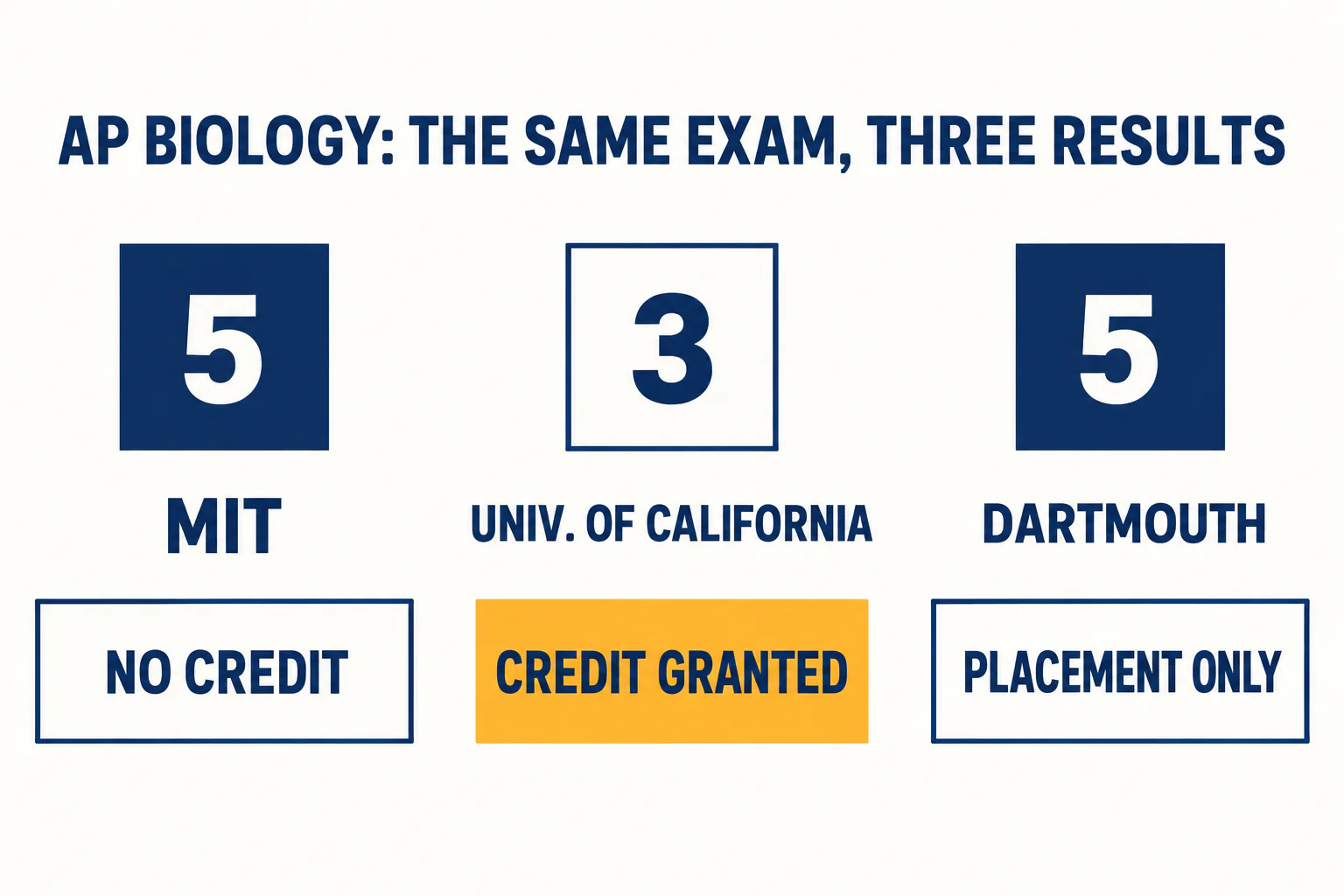
Does a 3 get you college credit?
At some universities, yes, routinely. The University of California states it directly: "Students who earn scores of 3 or higher on designated College Board Advanced Placement tests will receive credit toward graduation." For a student heading to a UC campus, a 3 is a genuine result with a material payoff.
At others it is worth nothing. MIT's credit policy is equally direct, in the opposite direction: "MIT grants credit for a score of 5 on some College Board Advanced Placement (AP) exams. It does not grant credit for secondary school courses teaching AP curricula, or partial credit for lower scores." There is no sliding scale. A 4 at MIT is treated the same as a 1.
Dartmouth takes the third position, which most students do not know exists. It stopped exchanging AP scores for credit in any subject from autumn 2014, and the policy holds today. In its own statement, the change was made to "require our students to take full advantage of the faculty expertise and unique academic resources that characterize a Dartmouth educational experience".
Why a 5 can be worth less than a 3
Here is the comparison that should change how a student picks exams. MIT publishes a list of AP exams that earn no credit regardless of score, and it is not a list of fringe subjects. It includes AP Biology, AP Chemistry, AP Computer Science, AP Environmental Science and AP Statistics, plus AP Physics 1 and 2 taken separately.
So consider two students who both sat AP Biology in May 2026. One scored a 5 and is going to MIT. One scored a 3 and is going to Berkeley. The 5 converts to zero credit. The 3 converts to credit towards graduation. On the raw College Board scale those two results are three bands apart, and in the only currency that matters to them, the ranking inverts.
The 2026 distributions make this concrete, because they show how many students are in each position. These are College Board's own published figures.
| 2026 exam | Scored 5 | Scored 4 | Scored 3 | Scored 3 or higher |
|---|---|---|---|---|
| AP Biology | 15% | 25% | 31% | 71% |
| AP Statistics | 17% | 23% | 22% | 62% |
| AP Computer Science Principles | 10% | 23% | 30% | 63% |
| AP Music Theory | 18% | 17% | 24% | 59% |
Three of those four exams earn no MIT credit at any score. The fourth, Music Theory, falls under the Arts heading, where a 5 earns 9 units of unrestricted elective credit. A student aiming at MIT who sat AP Biology, AP Statistics and AP Computer Science Principles could score 5, 5 and 5 and arrive with no credit from any of them.
Not sure where your teen stands? A free consultation with Catalyst Test Prep maps exactly which SAT topics need the most work, so you're never guessing about study time.
Book a Free Consultation →Credit and placement are not the same thing
This is the distinction that rescues the whole picture, and it is why the MIT and Dartmouth policies are less brutal than they sound.
Credit reduces what you still have to take
Credit counts towards the total required to graduate. Enough of it and a student can finish a term or a year early, or carry a lighter load, or take a second major without overloading. That is the thing Dartmouth withdrew.
Placement changes what you take, not how much
Placement lets you skip the introductory course and start higher. The degree is the same length; the content is harder and more interesting. Dartmouth kept this half explicitly, saying that "incoming students with qualifying AP scores will continue to be able to place out of certain introductory courses or be exempted from certain requirements".
Why placement is often the better prize
A student who places out of a first-year course they already understand has swapped a term of revision for a term of new material. A student who takes the credit instead has bought a slightly shorter degree and skipped the same course anyway. At a university where you want to be taught by that faculty, the second outcome is the weaker one. MIT's Calculus AB rule is built on exactly this logic: a 5 does not grant credit, it "allows you to enroll in the accelerated Calculus sequence of 18.01A/18.02A".
How to check what your AP score will be worth
Do this before you register for May exams, not after results land in July. The information is published and it takes a few minutes per university.
- Go to the university's own registrar or admissions site and look for a page titled AP Credit, Credit at Entrance or Transfer Credit. This is the authoritative source and the only one that will be right.
- Find your specific exam in the table. Policies are set exam by exam, not subject area by subject area, which is how students get caught out by Physics C being treated differently from Physics 1.
- Read the minimum score column, then check whether the row grants credit, placement or both. If the page only mentions placement, there is no credit.
- Check any cap. Several universities limit how much AP credit can count towards a degree even when individual exams qualify.
Then make the registration decision on that basis. If every college on your list gives no credit for AP Statistics, the exam may still be worth sitting for placement or for the strength of your transcript, but you should be choosing that knowingly. Our guide to AP exam registration deadlines and fees covers the ordering side, and sending, withholding and cancelling AP scores covers what to do once results arrive.
Choosing exams when credit is the goal
Worth checking one thing before you commit to a subject: AP is not the only route to the same credit, and the two routes behave very differently if the result is weak. Our comparison of AP against dual enrollment covers which credit transfers more predictably and why one of them is permanent.
If the aim is genuinely to arrive with credit, the pattern across these policies points in a clear direction. Calculus and the humanities travel best. MIT grants credit for a 5 on Calculus BC and for a 5 on any exam in Arts, English, History and Social Sciences, or World Languages and Cultures, at 9 units each. The laboratory sciences and computing travel worst, because those are precisely the courses selective universities most want to teach their own way.
A student with a mixed college list should plan for the strictest university on it, not the average. The exams that earn credit at MIT will also earn credit at UC; the reverse is not true. Planning to the strictest policy costs nothing and removes the risk of a wasted May.
One more practical point for juniors: AP season and SAT season overlap badly in the spring, and the exams reward different kinds of revision. We set out how to handle that collision in balancing SAT prep with school and AP exams, and if you are still choosing between calculus courses, AP Calculus AB versus BC compares them directly.
Conclusion
A 3 is a real result at many universities and worthless at some. A 5 is decisive at many and worthless at a few, in exactly the subjects students most often assume are safe. The score on the certificate is only half the fact; the other half is written on your university's credit page, and it is published a year before you sit the exam.
Look it up now, pick your May exams against the strictest college on your list, and treat placement as a prize in its own right rather than a consolation. For the revision itself, the best AP prep books covers what is worth buying and what is not.
Ready to turn a prep plan into real score gains? Catalyst's 1:1 live online SAT programme starts with a free consultation to benchmark your teen's starting point and build a personalised path to their goal score.
Book a Free ConsultationSources checked 24 October 2026: College Board AP score scale table; College Board 2026 AP score distributions; MIT Advanced Placement credit policy; University of California AP exam credits.