

Eighty-two percent of students who sat the AP Precalculus exam in May 2026 scored a 3 or higher, one of the highest pass rates College Board publishes. At every University of California campus, those scores convert to nothing. UC's own AP credit page says it plainly: "No credit is awarded for the Precalculus exam offered in 2024 and beyond."
That does not make the course a bad choice. It makes it a different choice from the one most families think they are making. AP Precalculus is mostly a preparation course with an optional credit bonus, and the bonus varies from zero to one precalculus course depending on the college. It is never calculus credit at any university we checked.
This guide covers what the course teaches (four units, only three tested), the exam format, the 2026 score distribution, credit policies at six named universities, and how it compares with honors precalculus, AP Calculus AB and dual enrollment. Every figure comes from College Board or the university's own page, checked on 12 November 2026.
Key Takeaways
- Unit 4 is taught but not tested. The exam covers units 1 to 3 only; Unit 4 is listed as "Not Assessed on the AP Exam".
- In 2026, 29% scored a 5 and 82% scored 3 or higher, the same 3+ rate as Calculus BC.
- Credit, where it exists, is for precalculus or college algebra, not calculus. UC grants none at all; Auburn requires a 4.
- The strongest case for the course is what comes next: 60% of launch-year takers in grades 9 to 11 enrolled in AP Calculus the following year.
- 2027 exam orders for full-year courses close on 13 November 2026 at 11:59 p.m. ET, so decide now.
What does AP Precalculus cover, and which units are on the exam?
Four units are taught and three are tested. College Board's assessment page says the exam "will measure your understanding of the mathematical content included in units 1–3", and the course page marks Unit 4 "Not Assessed on the AP Exam".
| Unit | Title | Share of the multiple-choice score |
|---|---|---|
| 1 | Polynomial and Rational Functions | 30%–40% |
| 2 | Exponential and Logarithmic Functions | 25%–40% |
| 3 | Trigonometric and Polar Functions | 30%–35% |
| 4 | Functions Involving Parameters, Vectors, and Matrices | Not assessed |
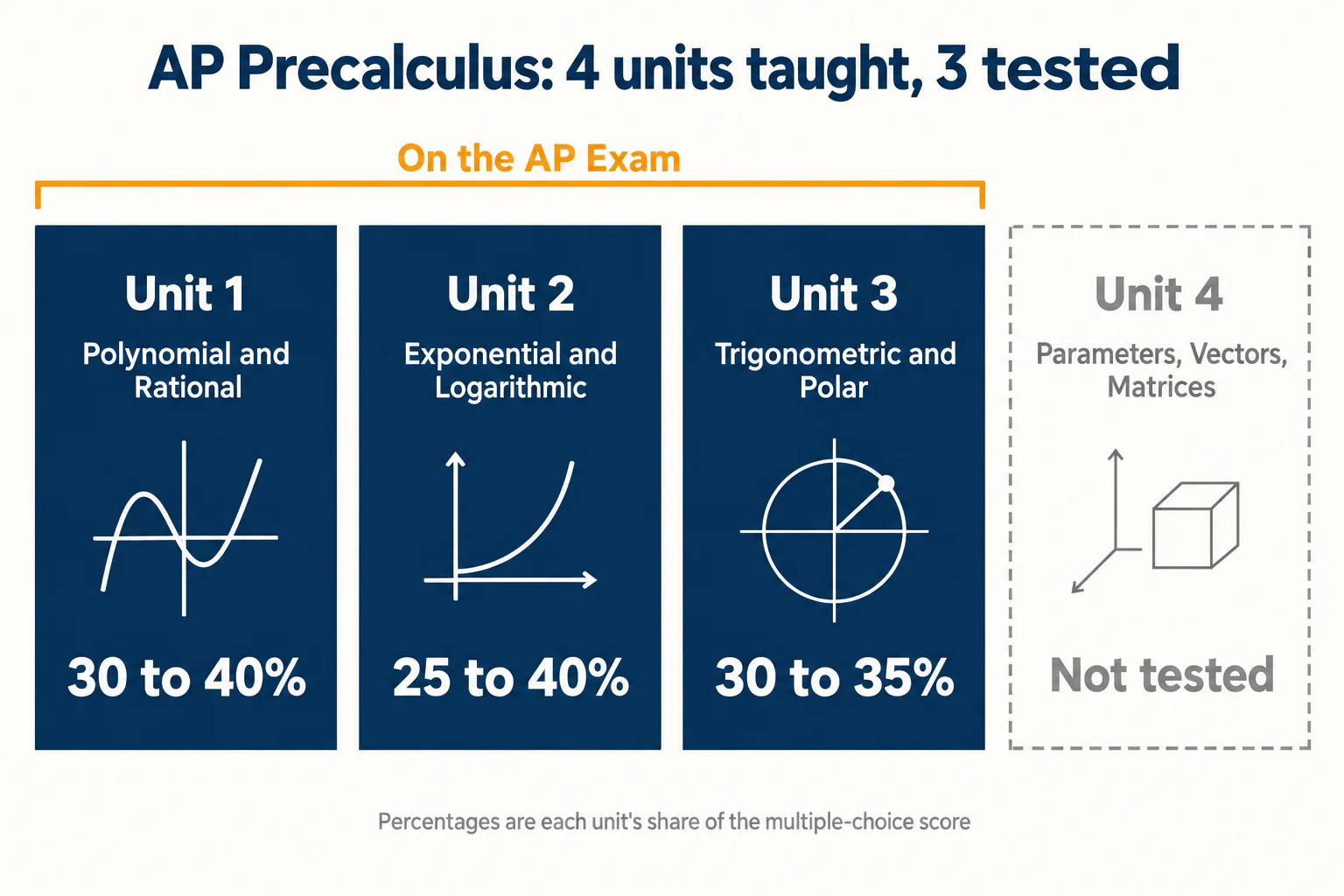
AP Central explains the purpose of Unit 4 in one line: it "describes additional topics you might include based on state or local requirements." In practice that gives schools room to teach it in late May, after the exam, or to compress it. Two things follow for a family. First, a student who struggles with vectors and matrices is not losing exam points for it. Second, a student heading into AP Calculus BC or a physics course should not assume the school covered Unit 4 properly, because nothing in the exam forced it to.
The recommended prerequisites are introductory algebra and geometry. College Board lists comfort with linear functions, factoring, the quadratic formula, right-triangle trigonometry, systems of equations, piecewise functions, exponents, radicals and complex numbers. In most schools that means Algebra 2 first.
What is the AP Precalculus exam format?
The exam runs 2 hours 55 minutes in two sections, and it is hybrid digital: multiple-choice answers go into the Bluebook app, while free-response answers are handwritten in a paper booklet. The 2027 exam is on Tuesday, 11 May 2027, in Session 1; your AP coordinator confirms the time and room.
| Part | Questions | Time | Calculator | Weight |
|---|---|---|---|---|
| Section I, Part A | 29 multiple choice | 65 min | Not permitted | about 44% |
| Section I, Part B | 13 multiple choice | 40 min | Graphing calculator required for some | about 19% |
| Section II, Part A | 2 free response | 35 min | Graphing calculator required | about 19% |
| Section II, Part B | 2 free response | 35 min | Not permitted | about 19% |
The single biggest block of the score, about 44%, is answered without a calculator. Add the no-calculator free-response part and roughly 63% of the exam is done by hand. Students who lean on a graphing calculator in class are the ones most surprised in May.
The four free-response questions are fixed in type: Function Concepts, Modeling a Non-Periodic Context, Modeling a Periodic Context, and Symbolic Manipulations. Each is worth 6 points, and the two modelling questions use a real-world context. Because the question types never change, past free-response sets are unusually good practice. Our guide to which released AP exams are actually available explains what College Board keeps public.
How did students score on AP Precalculus?
Well, on paper. College Board's 2026 distributions put AP Precalculus at 29% fives and 82% scoring 3 or higher. In the 2024 launch year, more than 184,000 students sat the exam, the largest course launch in AP history according to College Board Research, and 76% scored 3 or higher.
| 2026 exam | 5 | 4 | 3 | 2 | 1 | 3 or higher |
|---|---|---|---|---|---|---|
| AP Precalculus | 29% | 29% | 24% | 11% | 7% | 82% |
| AP Calculus AB | 20% | 28% | 17% | 24% | 11% | 65% |
| AP Calculus BC | 46% | 22% | 14% | 14% | 4% | 82% |
| AP Statistics | 17% | 23% | 22% | 17% | 21% | 62% |
Do not read that as "the easy AP maths exam". A distribution describes the students who sat it, not the difficulty of the questions, which is the argument we make in detail in AP score distributions explained. College Board's launch-year research shows who those students were. Of the 185,521 exam takers it analysed, 55% were in 11th grade, about a quarter in 10th grade and 17% in 12th grade. Average PSAT 10 Math scores fell sharply with grade: 589 for 10th graders, 521 for 11th graders and 462 for 12th graders.
So a sophomore in AP Precalculus is usually in an accelerated track and sitting a test aimed slightly below where they are. A senior taking it as a final maths course is a very different candidate. The headline 82% blends both.
Not sure where your teen stands? A free consultation with Catalyst Test Prep maps exactly which AP and SAT topics need the most work, so you're never guessing about study time.
Book a Free Consultation →Does AP Precalculus earn college credit?
Sometimes, and when it does, the credit is for precalculus or college algebra rather than calculus. We checked six universities' own pages. Not one maps an AP Precalculus score to a calculus course, and the most generous outcome is a single precalculus course.
| University | Score 3 | Score 4 or 5 | AP Calculus AB at a 3, same school |
|---|---|---|---|
| University of California | No credit | No credit | Credit (2.6 semester / 4 quarter units) |
| MIT | Not on MIT's AP credit list | Not on MIT's AP credit list | No credit; a 5 gives access to an accelerated sequence |
| Auburn | No credit | MATH 1150, 4 hours | MATH 1130 and 1610, 7 hours |
| UT Austin | M 301 College Algebra | M 305G Preparation for Calculus | M 408K, 408N or 408R, a first calculus course |
| Ohio State | Math 1150 Precalculus | Math 1150 Precalculus | Math 1151 Calculus I |
| Florida Atlantic | MAC 1140, 3 credits | MAC 1140 and MAC 1114, 6 credits | MAC 2311, 4 credits |
Three details in that table are easy to miss.
- The same score buys a lower course in some places. At UT Austin a 3 maps to M 301, College Algebra, which the UT catalog says "may not be counted toward a degree in mathematics". The precalculus course, M 305G, needs a 4 or 5.
- Credit is not the same as readiness. Ohio State's maths department grants Math 1150 for a 3, but lists Calculus I for those students as "Allowed but not recommended".
- Credit can disappear later. UT Austin's catalog states that credit for M 305G may not be earned after a student has received credit for any calculus course with a C- or better. A student who goes on to AP Calculus and earns calculus credit can find the precalculus credit is redundant.

Compare that with AP Calculus AB at the same schools. A 3 on AB earns seven hours across MATH 1130 and 1610 at Auburn, Calculus I at Ohio State, MAC 2311 at Florida Atlantic and four quarter units at UC. The credit value of a calculus score is simply larger. Our breakdown of what a 3, 4 and 5 are worth in college credit sets out the wider rules, including why placement can matter more than credit.
College Board itself is careful here. AP Central says units 1 to 3 describe what students need to "qualify for college credit or placement", and points families to its AP Credit Policy Search rather than promising credit. Use the university's own registrar page, as above, for the final word.
How does it compare with honors precalc, AP Calculus AB and dual enrollment?
Each option answers a different question. AP Precalculus adds an external exam to the course most students would take anyway. AB replaces it with calculus. Dual enrollment replaces the exam with a college grade.
| AP Precalculus | Honors precalculus | AP Calculus AB | Dual enrollment precalc | |
|---|---|---|---|---|
| External exam | Yes, May | No | Yes, May | No; the college course grade counts |
| Typical credit if earned | Precalculus or college algebra, at some colleges | None | Calculus I at many colleges | The college's own course, if the receiving college accepts it |
| 2026 share scoring 3+ | 82% | n/a | 65% | n/a |
| Prerequisite | Algebra 2 | Algebra 2 | Precalculus | Set by the college |
| Main risk | Credit is small or zero | No standardised signal | Weak precalc foundations | A permanent college transcript grade |
Against honors precalculus, the AP version usually wins when both are well taught. The content overlaps heavily, and AP adds a standardised score and a common framework. In College Board's survey of about 1,400 launch-year teachers, the most common reason for recommending the course was preparation for later maths, with one teacher writing that the curriculum was "much more comprehensive and in-depth versus the traditional Precalculus curriculum currently taught at my school". That is a teacher survey run by the exam's owner, so weigh it accordingly.
Against AP Calculus AB, it is a sequence, not a rivalry. AB assumes the trigonometry, logarithms and function work that precalculus teaches. A student who skips precalculus with gaps in Unit 3 pays for it all year in AB. If you are already deciding between calculus courses, AP Calculus AB versus BC covers that choice.
Against dual enrollment, the trade is a single May exam against a semester of college grades. College Board lets a student cancel an AP score permanently at no charge, or withhold it from a specific college; a weak dual enrollment grade stays on a college transcript. Our guide to AP versus dual enrollment walks through that difference in full.
Who should take AP Precalculus?
Take it if precalculus is the next maths course on your teen's track anyway and the school offers the AP section. The exam is then a low-cost extra, and the course is the better-documented version of what they would study regardless.
The launch-year research supports that framing. Among exam takers in grades 9 to 11, 60% enrolled in AP Calculus the next year, 78% in some AP STEM course and 87% in at least one AP course. Among students new to AP, 48% went on to AP Calculus. For seniors it played a different role: 56.5% of 12th-grade takers had no prior or concurrent AP STEM exam, so for many of them it was a first and only AP maths course.
Be more cautious in three situations:
- The student is aiming for credit and can reach calculus. A calculus score is worth far more at almost every university in the table above.
- The target colleges grant no precalculus credit, as at UC. The course still counts for rigour on the transcript, but the exam fee buys no units there.
- Algebra 2 was shaky. About 44% of the exam is no-calculator multiple choice. Weak algebra shows up immediately, and fixing it first is the better use of the year.
What should you decide before the ordering deadline?
Whether to sit the exam, and your school needs the answer within days. College Board's 2026-27 timeline sets the final ordering deadline for full-year and fall courses at 13 November 2026, 11:59 p.m. ET. Orders after that carry a late fee, and cancelling after it carries a fee too. Our guide to AP exam registration deadlines and fees has the full schedule and the current amounts.
A quick decision routine:
- Look up two or three target colleges' AP credit pages and find the Precalculus row. If it is missing or says no credit, the exam is for placement and transcript signal only.
- Check the first-semester grade in Units 1 and 2. A student comfortable with polynomial, rational, exponential and logarithmic functions by November is on course for a 4 or 5.
- Ask the teacher how Unit 4 is handled. It will not be on the exam, but a student going on to BC or physics needs vectors and matrices from somewhere.
The verdict
AP Precalculus is worth taking for most students already on the precalculus step, because it is a well-built course with a high pass rate that leads directly into calculus. It is a weak choice if the goal is college credit, because the credit is small, often needs a 4, sometimes lands on college algebra, and at the University of California is zero.
Take it for the preparation. Treat any credit as a bonus, check it college by college, and order the exam before 13 November.
Ready to turn a course plan into real score gains? Catalyst's 1:1 live online AP and SAT programmes start with a free consultation to benchmark your teen's starting point and build a personalised path to their goal score.
Book a Free ConsultationSources checked 12 November 2026: College Board AP Precalculus course page (units, weightings, Unit 4 not assessed, prerequisites); AP Precalculus exam page (format, timing, calculator rules, 11 May 2027 date); AP Central AP Precalculus course page (Unit 4 purpose, credit and placement wording); College Board 2026 AP score distributions; College Board Research, "AP Precalculus: Who Participated and What We Learned in Launch Year" (July 2025); AP Central 2026-27 key dates; University of California AP credits; MIT Advanced Placement credit page; Auburn University registrar AP credit table; UT Austin Testing and Evaluation Services exam search and course catalog; Ohio State Department of Mathematics AP credit page; Florida Atlantic University AP credit table; College Board AP score cancellation page. Credit policies change each year, so confirm on the university's own page before relying on any row.