

College Board puts it in one sentence: parents and students cannot order AP Exams directly. That is the whole problem. Self-studying the content of an AP course is allowed, normal, and done successfully every year. Getting a seat at the exam is the part that stops people, because the only route to one runs through an AP coordinator at a school that may have no other reason to help you.
So the useful version of how to take an AP exam without taking the class is not a study plan. It is a sequence of phone calls, and it has a date on it. The final ordering deadline for the 2027 exams is 13 November 2026. There is also an exception to that deadline which applies to almost everybody reading this and which is published in one place almost nobody looks.
Key takeaways
- You cannot register yourself. Every AP exam is ordered by a school's AP coordinator. Your job is to find one and ask.
- Search the AP Course Ledger by city and state, then telephone and ask for the coordinator. Whether a school hosts outside students is the school's decision, not College Board's.
- The final ordering deadline is 13 November 2026, 11:59 p.m. ET. Schools almost always set an earlier internal one.
- 🔴 Missing it is not fatal for you specifically. A coordinator can ask AP Services to waive the late order fee up to 12 March 2027, and that waiver exists only for homeschooled students and students whose school does not administer the exam.
- Three subjects resist self-study for structural reasons, not administrative ones: AP Seminar, AP Research and AP Art and Design, where the exam is not the whole score.
Can you take an AP exam without taking the AP class?
Yes, for most subjects, and College Board says so plainly: "Homeschooled students can self-study for most AP Exams; taking a formal AP course first is recommended but not required." No proof of instruction is required, no transcript is checked, and the paper you sit is the same paper the enrolled students sit.
Read that sentence twice, though, because "most" is carrying real weight and the exceptions are not where people expect them. They are covered further down, and they are not a matter of permission.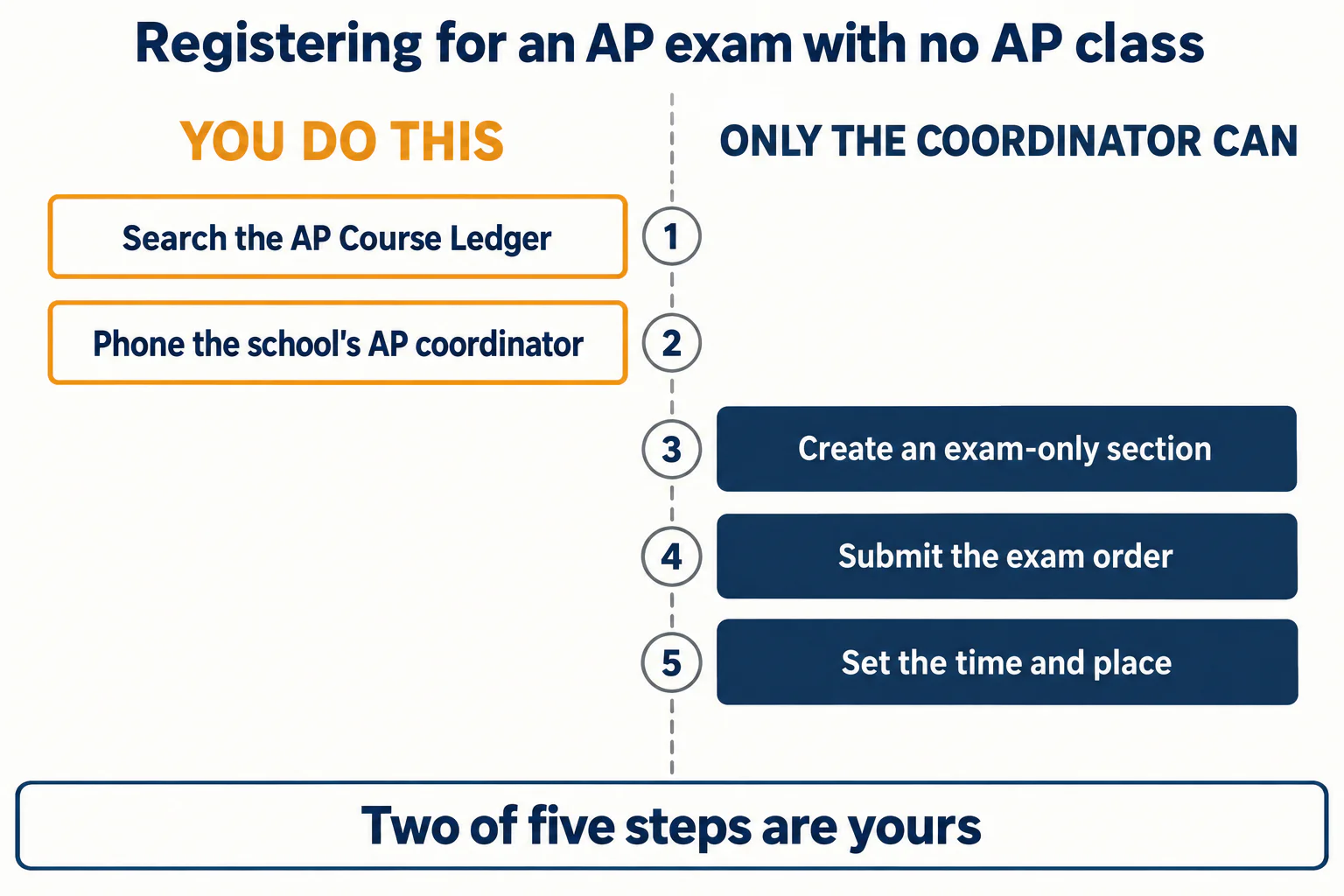
Why can you not register for an AP exam yourself?
Because the ordering system is a school system. AP Registration and Ordering is reached by staff at schools that have passed the AP Course Audit, and the coordinator there is the only person who can place an order. College Board describes the coordinator's role in three parts: they are responsible for "ordering your exam materials, telling you when and where to report for the exams, and collecting the exam fees."
That has a consequence worth absorbing early. The school is not processing a request, it is taking on work and liability, including proctoring you on a secure exam day alongside its own students. A coordinator who says no is not being obstructive. They are declining unpaid work, which is why the tone of the first phone call matters more than most guides admit.
How do you find a school that will test you?
Start at the AP Course Ledger, which College Board calls "the official, up-to-date, comprehensive list of schools that have passed the AP Course Audit." Search by city and state. The Ledger also tells you which courses each school is authorised for, which matters: a school authorised for AP Chemistry is a far better bet for an AP Chemistry exam than one that has never ordered it.
Then telephone. College Board's own instruction is to "call and ask to speak with the school's AP coordinator to learn if the school is allowing homeschooled students to test there this year." The verb is allowing. This is discretionary and it is decided annually, so a school that said yes two years ago is not a commitment.
Four practical points that change the hit rate:
- Call, do not email. Coordinators are usually teachers with a timetable, and an unsolicited email from an outside family is the easiest thing in the inbox to leave unanswered.
- Ask for the internal deadline first. It is the number that actually binds you, and it is often weeks before 13 November.
- Offer to cover the real cost. Schools are permitted to charge more than the published fee, and saying so unprompted removes the main reason to decline.
- Widen the radius before you widen the ask. One yes forty minutes away beats four maybes nearby, and exam day is a single morning.
Note one timing quirk: College Board states that "updates will be made to the AP Course Ledger every November." The list you search in late October is last year's authorisation picture, which is another reason to confirm the subject by phone rather than trusting the entry.
Self-study takes the syllabus away as well as the teacher, and the gap you cannot see is the one that costs the score. A free consultation with Catalyst Test Prep benchmarks your teen against the actual course framework, so May is not the first time anyone checks.
Book a Free Consultation →What is an exam-only section, and what does joining one do?
Once a coordinator agrees, there is a specific mechanism they use. College Board's instruction to coordinators handling students from outside the school is to "create an exam only section for each exam subject" and to "provide the join code for each exam only section to the students so they can enroll."
An exam-only section is a container with no teaching in it. You will get a join code per subject, enrol in My AP, and see the exam listed. One trap follows, and it catches enrolled students too: joining a section is not the same as being registered for the exam. The section records your intention. The coordinator still has to submit the order, and until they do, nothing has been bought. Confirm the submission explicitly rather than inferring it from a tidy-looking My AP screen.
Which AP exams can you not self-study?
This is where "most" stops being a hedge. Three subjects are closed to self-study because of how the score is built, not because of a rule forbidding it.
AP Seminar takes its score from three components: the Team Project and Presentation at 20%, the Individual Research-Based Essay and Presentation at 35%, and a two-hour end-of-course exam at 45%. The first two are performance tasks completed and submitted during the course, with a student submission deadline of 30 April 2027 and teacher scores due by 10 May. So 55% of the score is produced inside a taught course and scored by a teacher. A self-studier can sit the 45% and nothing else, which is not a score. AP Research, the other half of AP Capstone, leans on through-course work even harder.
AP 2-D Art and Design has no written exam at any point. The assessment is a portfolio submitted through the AP Digital Portfolio: 15 digital images for the Sustained Investigation at 60% of the score, and 5 images of 5 artworks for Selected Works at 40%, each with written documentation, due 7 May 2027. There is nothing to turn up for.
AP Computer Science Principles sits in between and is the interesting case. It carries a Create performance task, which sounds like the same barrier, and it is not: College Board publishes a specific route for non-enrolled students, using the same exam-only section mechanism, and notes that "additional support by the AP coordinator will be required for exam day." So CSP is open to self-study but costs your host school more effort. Raise it on the first call rather than the last.
Everything else in the catalogue, including every science, every maths course, both English courses and the histories, is a written exam carrying the whole score. That is the set to choose from.
The 13 November deadline, and the exception almost nobody publishes
The hard date is 13 November 2026 at 11:59 p.m. ET, the final ordering deadline covering all exam-only sections. Our guide to the AP exam registration deadline and fees sets out what that date means for a student inside a school, where it genuinely is the wall.
🔴 For you, it is not. College Board's page on ordering exams for students who do not attend the school says this: "AP coordinators can contact AP Services no later than March 12 to request the late order fee be waived", and it adds that this "applies only for homeschooled students and students whose school doesn't administer the AP Exam(s)."
Three things follow, and they are worth stating separately because the aggregator guides collapse them.
First, the order can still be placed after 13 November, which contradicts the way every summary writes up that date. Second, the 40 dollar per exam late order fee is waivable, and the two eligible categories are exactly the two categories of person reading this page. Third, the waiver is not automatic and it is not yours to request. The coordinator contacts AP Services. If they do not know the provision exists, nothing happens, so the useful move is to name it for them.
None of which is an argument for being late. A November order gets you a calmer coordinator, a confirmed seat and six months to prepare. It is an argument against giving up on 14 November, which is the actual mistake this provision exists to prevent.
What it costs, and who gets billed
The published base fee for 2027 exams is 99 dollars per exam at schools in the United States, its territories, Canada and DoDEA schools, and 129 dollars per exam elsewhere. A late order adds 40 dollars per exam unless the waiver above applies. College Board's fee reduction for eligible students is 37 dollars per exam, and homeschooled students from low-income families may qualify.
Two figures matter more to an outside candidate than the headline.
Schools may charge you more. College Board permits a school to "charge students a higher fee to recover additional proctoring or administration costs," and hosting one outside student is precisely the situation where those costs are real. Ask for the school's total number in the first conversation.
The unused or cancelled exam fee is 40 dollars per exam. Order three exams in November, sit two, and the third carries that charge. The school is billed, not you directly, which means a school that has already stretched to host you absorbs it unless you settle up. That is a fast way to become the reason the school stops hosting outside students, so decide on the third exam before November rather than in April.
What to do in the next two weeks
- Pick the exams, then check the structure. If the subject is Seminar, Research or Art and Design, it is off the list. Our breakdown of what an AP score is actually worth in credit is the better filter than a pass rate.
- Search the Ledger and build a call list of six schools, filtered by whether they are authorised for your subject.
- Call this week. Ask three questions: are you hosting outside students this year, what is your internal ordering deadline, and what will you charge me in total.
- Get the join code and then confirm the order was submitted. Two separate things.
- Start on the material now. Self-studiers lose points to coverage gaps rather than to difficulty, and what official released AP material actually exists is thinner than most students assume. Choosing an AP prep book matters more without a teacher, not less.
The 2027 exams run 3 to 7 May and 10 to 14 May. Everything above has to be finished before a six-month stretch of preparation that nobody is going to set for you.
Where this leaves you
The academic question is settled and always was: you may sit nearly any AP exam without ever enrolling in the course. The real work is logistical, it runs through a stranger with a timetable, and it has a November date attached.
Three things to hold onto. You cannot order the exam, so the phone call is the whole job.Seminar, Research and Art and Design are closed to you by construction, so choose around them rather than arguing about them. And 13 November is a soft wall for your category specifically, with a named provision running to 12 March that your coordinator may need to be told about.
Ready to turn a self-study plan into a score? Catalyst's 1:1 live online programme starts with a free consultation to benchmark your starting point against the real course framework and build a path to your target score by May.
Book a Free ConsultationSources: AP Central, Ordering Exams for Students Who Don't Attend Your School or Independent Study Students; College Board AP Students, homeschooled students help centre; AP Central 2026-27 AP Exam Fees; College Board All Access, Homeschoolers' Guide to College Board Assessments; AP Central AP Seminar Exam page; College Board AP Students, AP 2-D Art and Design assessment; AP Central AP Computer Science Principles FAQ for non-enrolled students; College Board AP Exam Calendar 2027. All figures and quotations checked 30 October 2026.