The most expensive decision in the AP calendar is made in November, six months before anyone sits an exam. AP exam registration for the May 2027 administration closes on November 13, 2026 at 11:59 p.m. ET, and that date does something specific: it ends the free-change window. Before it, a school can revise its order as many times as necessary at no cost. After it, moving in either direction costs $40 per exam.
Which means "sign up and see how it goes" is no longer a free strategy, and neither is waiting. Fifty-five days from now, every AP decision in your household becomes a priced one. Here is what the 2027 exams cost, where the $40 charges attach, and what to work out before the deadline rather than after it.
Key Takeaways
- November 13, 2026, 11:59 p.m. ET is the final ordering deadline for full-year and fall semester AP courses.
- Until that moment, orders can be changed as many times as necessary with no fee. That is the window to use.
- After it: $40 per exam to order late, and $40 per exam for an exam ordered and not taken, through March 12, 2027.
- Base fees for 2027 are $99 in the US and $129 outside it, with a $37 reduction for significant financial need.
- Exams run May 3 to 7 and May 10 to 14, 2027, with late testing May 17 to 21 and scores in July.
When is the AP exam registration deadline?
November 13, 2026, at 11:59 p.m. ET. That is the final deadline for AP coordinators to submit exam orders for full-year courses, fall semester courses and exam-only sections. A second deadline, March 12, 2027, closes spring course orders and any remaining changes to existing orders.
Students do not submit the order themselves. They join their class section in My AP with a join code from the teacher, usually handed out in the first week of school, and indicate their exam intention there. The coordinator then places the school's order. It is worth saying plainly to a teenager: joining a section is not registering for the exam, and neither is telling a teacher you are probably taking it.
What the 2027 AP exams actually cost
The published fees for the 2027 administration are below, drawn from College Board's AP exam fees page.
| Item | Amount | When it applies |
|---|---|---|
| Base exam fee, United States | $99 per exam | Every exam |
| Base exam fee, outside the US | $129 per exam | Every exam taken abroad |
| Fee reduction, significant financial need | Less $37 per exam | Qualifying students |
| Late order fee | $40 per exam, on top of the base fee | Ordered Nov. 14, 2026 to Mar. 12, 2027 |
| Unused or cancelled exam fee | $40 per exam | Cancelled after Nov. 13, 2026 |
The $37 reduction is the College Board portion only. Many states and school districts add subsidies on top, and some cover the remainder entirely, so a family that qualifies should ask the coordinator what the net figure actually is rather than budgeting from the published number.
The $40 fee that catches families twice
Notice that the same $40 appears in two places, pointing in opposite directions. Order late and it is $40. Order on time and then withdraw and it is also $40. There is no path through the spring that avoids it once November 13 has passed.
That symmetry is the whole design. College Board is not penalising indecision so much as pricing it, and the effect is to move the real deadline forward. The decision that matters is not "will my teen sit this exam in May", it is "do we know enough by early November to commit". Those are different questions and only the second one is answerable now.
Not sure where your teen stands? A free consultation with Catalyst Test Prep maps exactly which SAT topics need the most work, so you're never guessing about study time.
Book a Free Consultation →Why the November decision is the expensive one
Here is what the top search results on this topic will not tell you. The families who lose money on AP exams are rarely the ones who miss the deadline. They are the ones who let it pass without a conversation, order everything on optimism in November, and cancel two exams in February when the grades come in.
Two cancellations is $80, and the more significant loss is the four months of study time that went into a course the student was never going to convert into a 3. The first marking period grade, which most schools issue in late October or early November, is the single best predictor available before the deadline. It arrives just in time to be used, and it is mostly ignored.
A student sitting comfortably at a B or better in October has a realistic path to a 3 or above. A student at a low C has a path too, but it requires changing how they are studying rather than continuing, and November is when that is still possible. Waiting until an April practice exam to find out is how a $99 exam becomes a wasted spring. Our guides to choosing between AP Calculus AB and BC and between AP Lang and AP Lit cover the same logic earlier in the pipeline, at the point of choosing the course.
What if a course starts after the November deadline?
Then the late order fee does not apply. Exams for courses that begin after the November ordering deadline are exempt, as are exams for students who transfer into a school after it. Spring semester courses order against the March 12, 2027 deadline instead, without penalty.
This is a genuine exemption rather than a loophole, and it is worth confirming with your coordinator if your teen's schedule includes a second-semester AP course. The exemptions are specific, and the AP Coordinator's Manual holds the full list.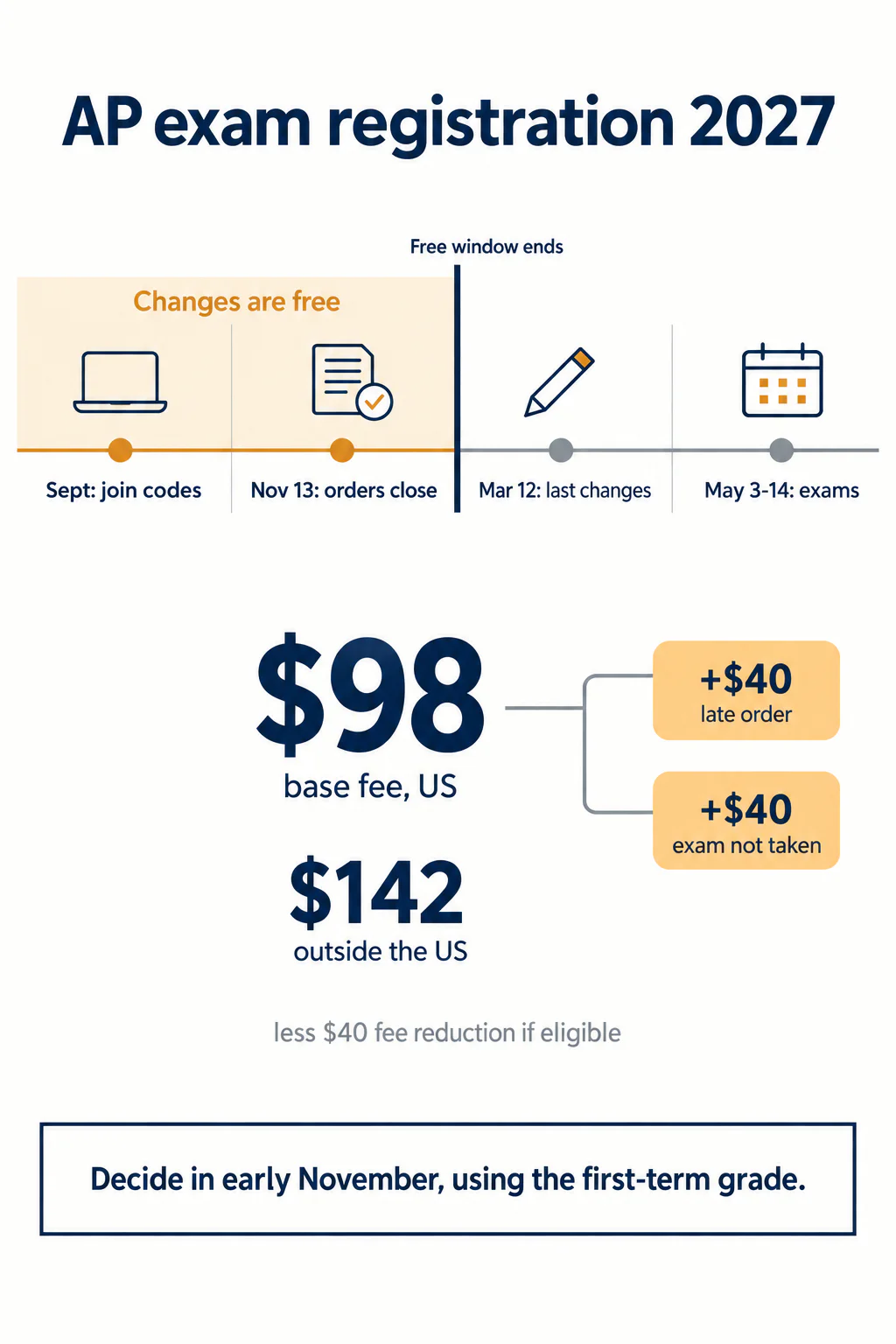
Two new courses launch with the cancellation fee waived
The unused and cancelled exam fee is waived for new AP courses in their launch year, and for 2026-27 that covers AP Business with Personal Finance and AP Cybersecurity.
That waiver changes the calculation for those two subjects specifically. A student curious about either can order the exam in November and step back later without the $40 charge, which is exactly the flexibility no other AP subject offers this year. If your teen is in one of these courses and undecided, ordering is the low-risk choice. If they are in AP Chemistry and undecided, it is not.
The dates worth putting in a calendar
All of these come from College Board's AP key dates page for 2026-27.
| Date | What happens |
|---|---|
| November 13, 2026, 11:59 p.m. ET | Final ordering deadline. Free changes end. |
| January 22, 2027 | Accommodations request deadline for May 2027 exams |
| March 12, 2027, 11:59 p.m. ET | Spring orders and final order changes close |
| May 3 to 7 and May 10 to 14, 2027 | AP Exams |
| May 17 to 21, 2027 | Late testing exams |
| July 2027 | Scores released to students and colleges |
The accommodations date deserves particular attention. It is a separate process from ordering, it runs through College Board's Services for Students with Disabilities, and approval can take up to seven weeks with another seven if documentation is requested. January 22 is the last day to submit, not a sensible day to start.
What to do in the next eight weeks
- Confirm your teen has joined every class section in My AP. A missing join code in September becomes a missing exam order in November.
- Get the first marking period grade for each AP course and treat it as the forecast it is.
- Ask the AP coordinator two questions: what the school's internal ordering deadline is, which is often earlier than November 13, and how the school handles the $40 cancellation charge.
- Decide exam by exam, not course by course. A student can take the course and skip the exam, and for a borderline subject that is sometimes the right answer.
- Start any accommodations request now, rather than in January.
- Check whether any target college awards credit for a 3, or only for a 4 and above. That threshold changes whether a borderline exam is worth sitting at all.
That last point is worth a paragraph of its own. AP credit policies vary sharply between institutions, and a score of 3 that earns credit at one university earns nothing at another. Where scores also feed scholarship consideration, the stakes rise again, much as they do with SAT scores and merit aid. And for students carrying AP courses alongside SAT or ACT preparation, the sequencing problem is real: our guide to balancing test prep with school and AP exams covers how to fit both into one spring.
Before November 13
Three things to carry away. The free-change window closes on November 13, 2026, and after that every adjustment costs $40 per exam in either direction. The base fee is $99 in the US and $129 abroad, with a $37 reduction available and often more from the school or state. And the first marking period grade, which lands just before the deadline, is the best forecast anyone will have in time to act on it.
Use it. A conversation in early November about which exams are genuinely worth sitting is worth more than any amount of revision in April.
Ready to turn a prep plan into real score gains? Catalyst's 1:1 live online SAT programme starts with a free consultation to benchmark your teen's starting point and build a personalised path to their goal score.
Book a Free Consultation