Here is the fact that reframes this decision, and almost nobody leads with it.
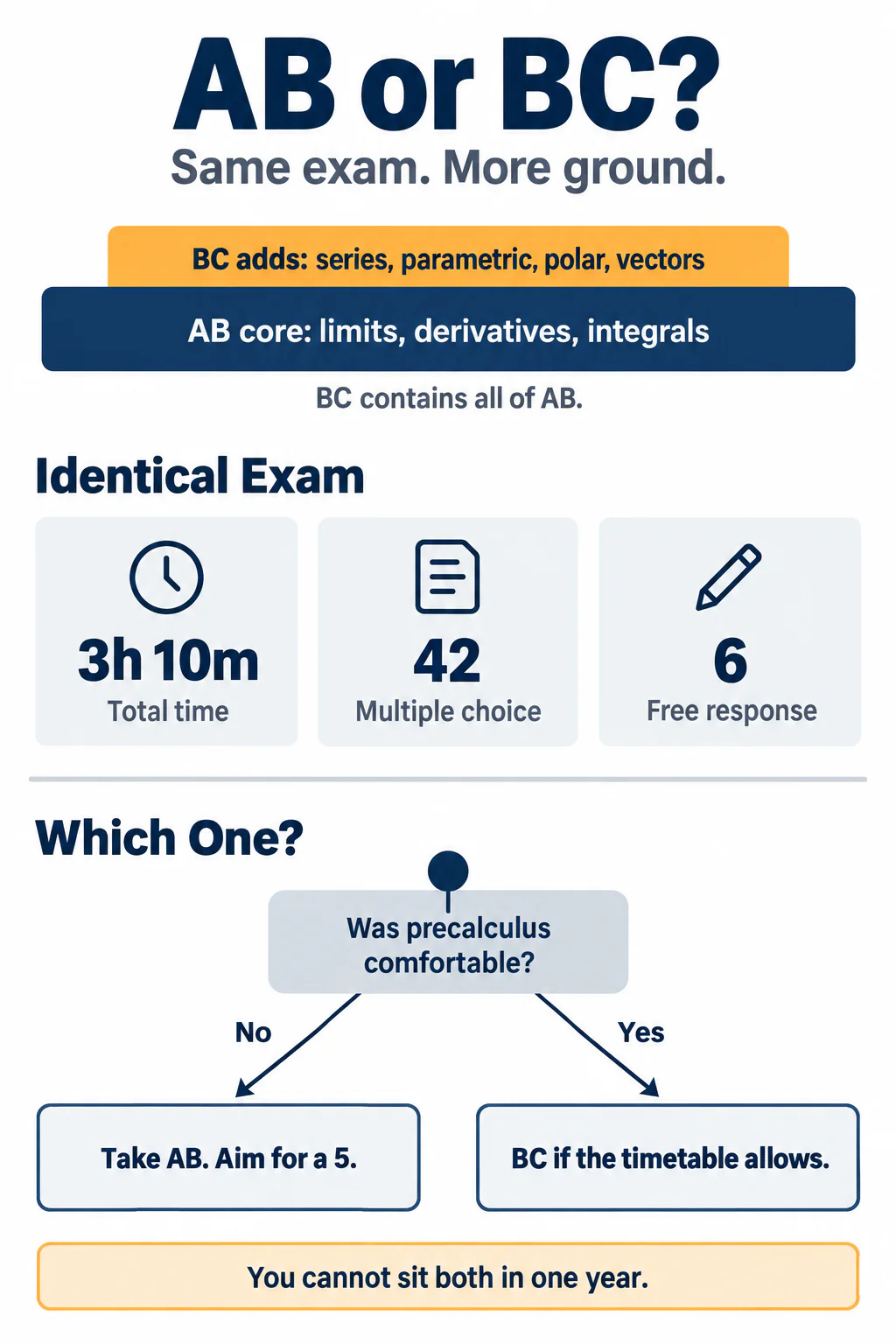
The AB and BC exams have identical formats. Both run 3 hours 10 minutes. Both have 42 multiple-choice questions in 1 hour 40 minutes and 6 free-response questions in 1 hour 30 minutes. Both split each section into calculator and non-calculator parts. Both weight the two sections 50 percent each.
So the choice between AP Calculus AB vs BC is not a choice between an easier exam and a harder one in any structural sense. It is a choice about how much material your teen covers at that same pace, in the same school year, in the same three hours.
Key Takeaways
- The exams are structurally identical: 3 hours 10 minutes, 42 multiple choice, 6 free response, 50/50 weighting.
- BC contains everything in AB plus series, parametric and polar work, and more integration technique.
- College Board does not allow a student to sit both exams in the same year.
- BC is harder because of pace and volume, not because individual questions are dramatically nastier.
- A 5 on AB beats a 2 on BC for essentially every purpose, including selective admissions.
What BC actually adds
BC is not a different subject. It is AB plus a further block of material, taught in the same number of school weeks.
Everything in AB appears in BC: limits, derivatives, applications of differentiation, integration and its applications, and differential equations. On top of that, BC adds infinite sequences and series, parametric equations, polar functions, vector-valued functions, and additional techniques of integration.
The usual comparison is that AB corresponds to roughly one semester of college calculus and BC to a full year. The part students consistently find hardest is series, partly because it arrives late in the year when everyone is tired and partly because it demands algebraic fluency that the course does not stop to rebuild.
Why BC feels harder
It is worth being precise, because "harder" sends families to the wrong conclusion.
A typical BC multiple-choice question is not much more demanding than a typical AB one. What changes is that the same 42 questions now have to sample a meaningfully larger syllabus, which means less repetition of any single idea and less room to recover from a topic that never quite landed.
The pressure shows up in the classroom rather than the exam hall. A BC course moves faster from week one. A student who loses a fortnight to illness in October has more to rebuild, and the material that follows assumes the missing piece.
That is why the honest predictor is not how clever a student is. It is whether they can stay current when a week goes badly.
Not sure where your teen stands? A free consultation with Catalyst Test Prep maps exactly which SAT topics need the most work, so you're never guessing about study time.
Book a Free Consultation →You cannot sit both in one year
This catches families out, so it is worth stating plainly. College Board's position is direct: you may not take both the AP Calculus AB and Calculus BC exams within the same year.
There is no hedging option where a student sits BC and falls back on AB as insurance in May. The decision is made once, and it is made at course selection.
What some students do instead is take AB in one year and BC the next. That is a legitimate and often excellent route, especially for a student who reached calculus early. It costs two years of the timetable rather than one, which is the real trade-off.
How to actually decide
Use precalculus performance rather than ambition. Four questions, in order of how much they matter.
- How comfortable was precalculus, especially trigonometry? Not the grade. The comfort. A student who worked very hard for a B will find BC's pace punishing in a way the grade does not predict.
- Is algebra automatic? Series work assumes a student can manipulate expressions without thinking about it. If algebra still costs effort, that effort compounds every week.
- What does the intended degree need? Engineering, physics, computer science and economics programmes generally expect the most demanding maths a school offers. Most other paths do not.
- What else is in the timetable? BC alongside three other AP subjects and a competitive sport is a different proposition from BC as the one demanding course.
| AP Calculus AB | AP Calculus BC | |
|---|---|---|
| Exam length | 3 hrs 10 mins | 3 hrs 10 mins |
| Multiple choice | 42 questions, 1 hr 40 mins | 42 questions, 1 hr 40 mins |
| Free response | 6 questions, 1 hr 30 mins | 6 questions, 1 hr 30 mins |
| Roughly equivalent to | One semester of college calculus | A full year |
| Extra content | None beyond core calculus | Series, parametric, polar, vectors, more integration |
| Best suited to | Solid precalculus, busy timetable, most degree paths | Fluent algebra, quantitative degree intent, room to keep pace |
The mistake worth avoiding
The common failure is choosing BC as a signal rather than as a fit.
Families hear that selective colleges want the hardest available course, which is broadly true, and conclude that BC is therefore always the stronger application. Then a student who was a good but not fluent precalculus candidate spends the year underwater and finishes with a 2.
That outcome is worse on every axis. The transcript shows a struggle, there is no college credit, and the student has spent a year concluding they are bad at maths when what actually happened is a pacing mismatch.
A 5 on AB is a better outcome than a 2 on BC. It is better for admissions, better for credit, and considerably better for whether the student takes another quantitative course.
AB is a full college-level calculus course. Treating it as the soft option is inaccurate, and acting on that inaccuracy is how a year gets wasted.
If the choice has already been made
If your teen is a few weeks into BC and visibly struggling, that is worth acting on now rather than in February.
Most schools allow a move from BC to AB early in the first term, and the conversation is dramatically easier in October than after the winter break, when the gap has compounded and a transfer means covering AB material that BC had already raced past.
If staying in BC is the right call, the intervention that helps most is keeping current rather than revising harder. AP calculus difficulty is nearly always a pace problem, and pace problems respond to weekly support rather than to a revision push in April. Our guide to balancing SAT prep with school and AP exams covers how to fit that alongside testing, which matters because junior year usually carries both.
For the courses themselves, we run AP Calculus AB and AP Calculus BC as 1:1 live online classes.
Frequently Asked Questions
What is the difference between AP Calculus AB and BC?
Scope, not exam format. BC covers everything AB covers and adds further topics, most notably infinite series, parametric and polar functions, and additional integration techniques. Roughly, AB corresponds to a first semester of college calculus and BC to a full year compressed into the same school year.
Is the BC exam harder than the AB exam?
Individual questions are not dramatically harder. The exam is harder because there is more ground to cover in the same time. Both exams run 3 hours 10 minutes with 42 multiple-choice and 6 free-response questions, so BC tests a wider syllabus at the same pace.
Can my teen take both AP Calculus AB and BC?
Not in the same year. College Board states you may not take both the AP Calculus AB and Calculus BC exams within the same year. Some students take AB one year and BC the next, which is a legitimate route but means two years of calculus rather than one.
What are the exam formats for AB and BC?
Identical. Both are 3 hours 10 minutes. Section I is 42 multiple-choice questions in 1 hour 40 minutes, worth 50 percent. Section II is 6 free-response questions in 1 hour 30 minutes, also 50 percent. Each section has a calculator part and a non-calculator part.
Which one do colleges prefer?
Neither is preferred in the abstract. Selective programmes in engineering, physics, computer science and economics tend to expect the most demanding maths available at your school, which is usually BC. A strong AB score is better than a weak BC score for almost every purpose.
Does BC get you more college credit?
Often, because it covers more material, but credit policy is set by each institution rather than by College Board. Check the specific policies of the colleges your teen is considering before choosing on this basis. Two universities can treat the same score very differently.
How strong does my teen need to be to take BC?
Comfortable rather than merely passing in precalculus, particularly with trigonometry and function manipulation. Series work in BC assumes fluency with algebra that is never re-taught. A student who is still working hard for a B in precalculus will usually get more from AB done well.
Is AB a soft option?
No, and treating it that way causes real damage. AB is a full college-level calculus course and a 5 on AB demonstrates genuine mastery. Students pushed into BC to avoid looking unambitious, who then score a 2, would have been better served by AB in every respect.
When should the decision be made?
Ideally during course selection the spring before, using precalculus performance rather than ambition. If your teen is already enrolled and struggling in the first term, most schools allow a move from BC to AB early in the year. That conversation is far easier in October than in February.
How does Catalyst support AP Calculus students?
Catalyst runs 1:1 live online classes for both AP Calculus AB and BC. Because AP calculus difficulty is usually about pace rather than any single concept, sessions focus on keeping a student current with the syllabus and on the free-response technique that separates a 3 from a 5.
The short version
Same exam shape, more ground. That is the whole distinction, and it means the question is not whether your teen is clever enough for BC but whether they can hold a faster pace across a full year while everything else in the timetable continues.
Judge it on how comfortable precalculus felt rather than on what grade it produced, and on whether algebra is automatic yet. Then remember that the decision is final for the year, because both exams cannot be sat together.
And if it is genuinely close, take AB and aim for a 5.
Ready to turn a prep plan into real score gains? Catalyst's 1:1 live online SAT programme starts with a free consultation to benchmark your teen's starting point and build a personalised path to their goal score.
Book a Free ConsultationSources: College Board on the AP Calculus AB exam and College Board on the AP Calculus BC exam.