

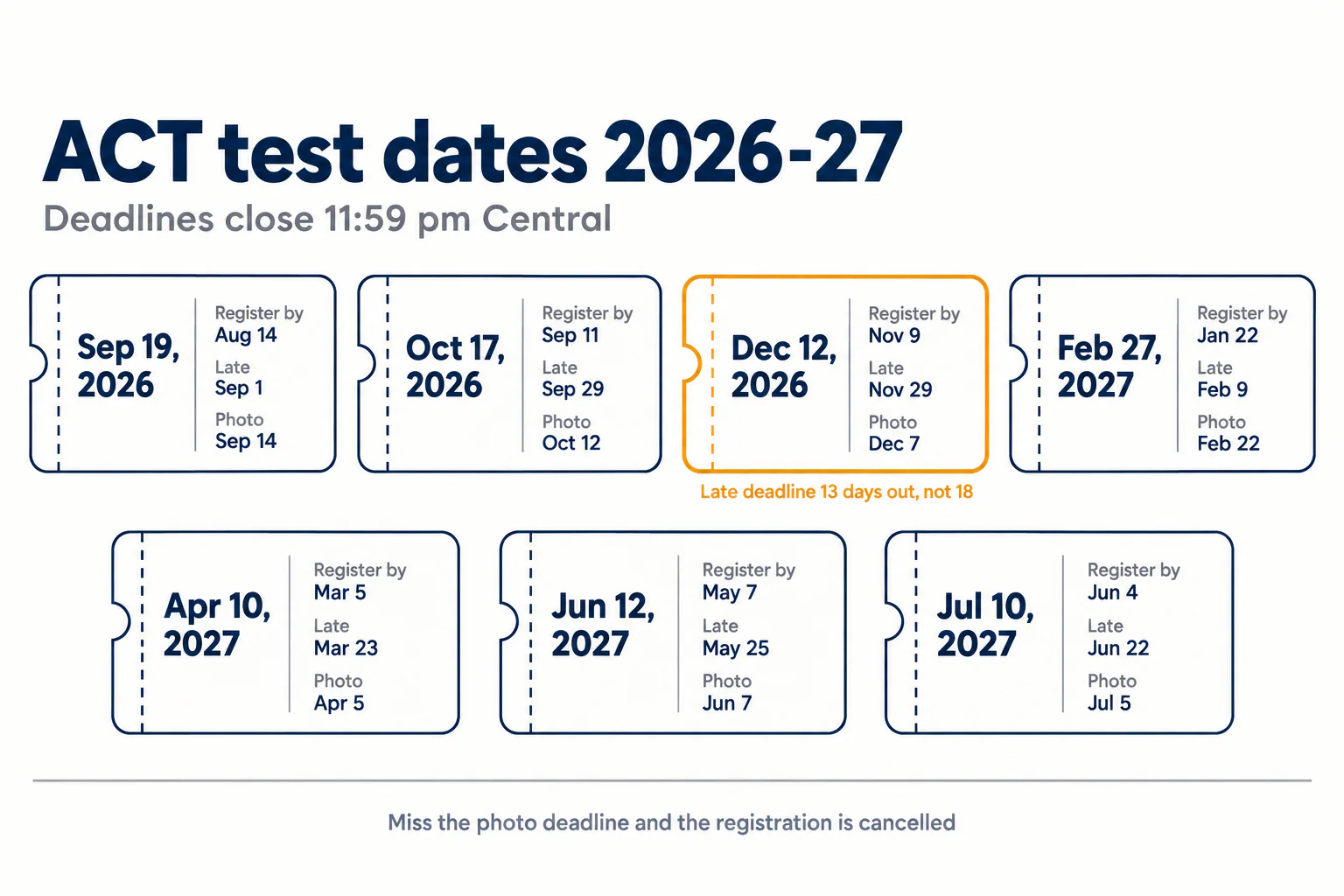
There are seven national ACT test dates in the 2026-27 school year, and five of them are still ahead of you: December 12, then February 27, April 10, June 12 and July 10, 2027. Every one has three deadlines and two score release dates, and most date tables online show you fewer than that.
The one they drop is the most useful. ACT's main test dates page lists only the paper score release date. ACT's separate scores page lists the online release too, and on five of the seven dates online scores arrive five or six days sooner. On the other two, September and February, there is no head start at all. Below is the full schedule taken from act.org this week, what each deadline actually controls, and which date fits a junior, an early applicant and a regular decision senior.
Key Takeaways
- The December 12 ACT now has a November 9 regular deadline after an extension, not the November 6 that several prep sites still print. Late registration runs to November 29.
- The photo upload deadline is five days before each test and it is a hard stop: miss it and ACT cancels the registration without a refund.
- Online scores come out five or six days before paper on October, December, April, June and July dates. September and February release on the same day for both.
- February scores arrive on March 16, after April's regular deadline of March 5, so a February-then-April plan means registering blind or paying the late fee.
- June paper scores (June 23) land one day after July's late deadline (June 22). Online June testers see theirs on June 17.
ACT test dates 2026-27: the full schedule
ACT runs seven national Saturday tests a year. These dates apply in the United States, US territories and Puerto Rico, and every deadline closes at 11:59 pm Central Time.
| Test date | Regular deadline | Late deadline | Photo and standby deadline | Online scores | Paper scores |
|---|---|---|---|---|---|
| September 19, 2026 | August 14 | September 1 | September 14 | October 6 | October 6 |
| October 17, 2026 | September 11 | September 29 | October 12 | October 22 | October 27 |
| December 12, 2026 | November 9 | November 29 | December 7 | December 17 | December 22 |
| February 27, 2027 | January 22 | February 9 | February 22 | March 16 | March 16 |
| April 10, 2027 | March 5 | March 23 | April 5 | April 15 | April 20 |
| June 12, 2027 | May 7 | May 25 | June 7 | June 17 | June 23 |
| July 10, 2027 | June 4 | June 22 | July 5 | July 15 | July 20 |
Two location notes from ACT's own pages. There were no New York test centres for July 2026, and ACT says July testing becomes available in New York starting in 2027. Students outside the US are on a different schedule entirely, and ACT states that for them the test is only available online.
ACT has already published projected dates for 2027-28: September 11, October 16 and December 11, 2027, then February 26, April 8, June 10 and July 15, 2028. ACT labels them subject to change, so treat them as a planning sketch for current sophomores rather than a booking.
What does each ACT deadline actually control?
Three different things, and they close in a fixed order: regular registration roughly five weeks out, late registration roughly two and a half weeks out, then photo and standby five days out.
Regular registration
Register by this date and you pay the base fee only. ACT's registration page now calls it "early registration", while its dates table still says "registration deadline", so do not let the label change confuse you: it is the same date. It matters for two other reasons. The accommodations request deadline is the regular registration deadline from June 2026 onward, and a test date change has to be made by the regular deadline of the new date to avoid a late fee as well.
Late registration
After the regular deadline, you can still register until the late deadline for an extra fee, which ACT's fee table lists at $42. This is also the last point to add or drop the science or writing test, or to switch between paper, online and bring-your-own-device testing. ACT is explicit that the format cannot be changed at the test centre.
Photo upload and standby
This is the deadline people overlook because it arrives after they think they are done. ACT's photo page is blunt: if your photo is not added by the deadline, your registration will be cancelled and you will not be admitted, and the registration fee is not refunded. You also cannot print your admission ticket until the photo is in. Scanned driver's licence or school ID photos are rejected for quality, so take a fresh head-and-shoulders shot against a plain wall.
The same date is the cut-off for standby testing, which is ACT's route for students who missed late registration. ACT's standby page says it is non-guaranteed, admitted first come first served after every registered student is seated, available for paper testing only, and not available with accommodations. The standby fee is refunded if you are turned away.
If you are already registered and need to move, our guide to changing or cancelling an ACT registration walks through the test date change. One warning from it is worth repeating here: a test date change keeps your original basic fee, a fresh registration does not.
Not sure which ACT date leaves enough prep time? A free consultation with Catalyst Test Prep maps exactly which ACT sections need the most work, so you can pick a date with a plan behind it.
Book a Free Consultation →When do ACT scores come out for each date?
Between 5 and 17 days after the test for the initial release, depending on the date and on whether you test online or on paper. The full pairs are in the table above. The pattern is the useful part.
ACT explains the gap on its scores page: when you test online, ACT receives the test attempt as soon as testing completes and can start scoring and validation sooner. Paper answer documents have to travel first. That is the whole reason the head start exists, and why it disappears on two dates when ACT has chosen a single release day for both formats.
Three details change how you should read any release date:
- "Initial" means the first batch, not every score. ACT says over 97% of scores are available online within one to four weeks. Late-arriving answer documents, a mismatch between your answer document and your ticket, or an irregularity at the centre can hold a score back.
- Writing slows the release to colleges. You see your Composite as soon as it is ready, but ACT does not send anything to score recipients until every score from that test date is available, so the essay can hold up a college report.
- ACT's own pages disagree on the range. The test dates page says roughly two to four weeks, the scores page says one to four, and an older online testing FAQ still says two to eight weeks. The dated tables are more reliable than any of those ranges.
Once your scores are out, sending them is a separate job with its own deadlines. Our guide to how to send ACT scores covers why the four free reports have to be chosen at registration, not after you see the result.
Can you see one score before registering for the next date?
On three of the six back-to-back pairs, comfortably. On the other three, not without paying for it or gambling on standby. This is the planning detail that matters most for a retake.
| First test | Scores out | Next test | Next regular / late deadline | Verdict |
|---|---|---|---|---|
| September 19 | October 6 | October 17 | September 11 / September 29 | Scores arrive after the late deadline. Standby only. |
| October 17 | October 22 online, October 27 paper | December 12 | November 9 / November 29 | Works at the regular fee. |
| December 12 | December 17 online, December 22 paper | February 27 | January 22 / February 9 | Works at the regular fee. |
| February 27 | March 16 | April 10 | March 5 / March 23 | Misses the regular deadline. Late fee or register blind. |
| April 10 | April 15 online, April 20 paper | June 12 | May 7 / May 25 | Works at the regular fee. |
| June 12 | June 17 online, June 23 paper | July 10 | June 4 / June 22 | Online: late fee. Paper: one day after the late deadline. |
The June to July row is the sharpest case for the online format. A paper tester in June sees scores on June 23, one day after July's late deadline of June 22, so the only remaining route into July is standby. An online tester has the score on June 17 and five days to register late.
Which ACT date should you pick?
Work backwards from your earliest deadline, not forwards from when you feel ready. ACT's own registration page advises taking the test at least two months before your earliest college and scholarship application deadlines, which is stricter than most students plan for.
Juniors
ACT's grade-by-grade guide describes a typical path as a first test in the fall of junior year, a retake in the spring of junior year, and a final attempt in the fall of senior year. For a current junior who has not tested yet, December 12 or February 27 is the realistic first score. December gives you the cleaner follow-up, because its scores land before February's regular deadline. February followed by April runs into the March 5 problem in the table above, so February testers are usually better aiming at June, with July as a reserve.
Seniors applying early decision or early action
Early deadlines often fall on 1 November, as MIT's does. The October 17 ACT is the last 2026 date whose scores arrive before then: October 22 online, October 27 on paper. Some colleges accept later tests, but check the exact wording. MIT, for example, sets its Early Action deadline at November 1 and requires applicants to take required tests before November 30, which rules out the December 12 ACT for that plan. For the difference between the plan types, see our explainer on early decision versus early action.
Seniors applying regular decision
December 12 is the last date for most January deadlines. Scores arrive December 17 online and December 22 on paper. MIT's Regular Action rule, tests taken before December 31, accepts it. The February 27 ACT releases on March 16, which is after most regular deadlines have passed, so treat February as a fallback only where a college has told you in writing that it will take a later score.
If you are also weighing the SAT, our 2026-27 SAT test dates guide uses the same deadline-first approach, so you can lay both calendars side by side.
How do online, paper and school-day ACTs differ for dates?
The test dates are the same for online and paper national testing. The release dates, standby rules and change rules are not.
- Online at a test centre. Choose "Computer" when you register, then either bring your own device or use one the centre provides. ACT states the online test is not a remote exam, and personal Chromebooks, Windows S Mode, iPads and tablets are not supported for bring-your-own-device testing. If you registered for BYOD and arrive without a device, you cannot test.
- Paper. Slower score release on five dates, and the only format open to standby testers. Scratch paper is not allowed on paper; you annotate the booklet. Online testers get scratch paper from the centre.
- School-day state and district testing. This is a separate programme run through your school, not a national date. ACT reports that 78% of 2024 graduates who took the ACT tested through state and district programmes, which ACT describes as school-day testing at no cost to students. The national release tables above do not apply to it, and ACT's rules limit you to one set of scores per state administration.
Whichever format you choose, the same calculator rules apply on test day. Online testers also get a built-in calculator, but you can still bring your own permitted model. Our ACT calculator policy guide lists the models ACT bans.
Is there a December ACT deadline problem right now?
Only the late window is left. The December 12 regular deadline of November 9 has passed, so any registration now carries the late fee, and the photo must be uploaded by December 7. If you miss November 29 as well, standby is the only route, and it is paper only.
The next date with a regular-fee window is February 27, with registration open until January 22. For a senior with January deadlines, February is almost certainly too late. For a junior, registering for February in early December and keeping December's result as a first look is a reasonable plan.
Picking a date that leaves room for a second try
The ACT calendar has seven dates, but only three clean retake pairs: October to December, December to February, and April to June. Online testing buys five or six days on most dates, and on June to July that margin decides whether you can register at all. The photo deadline is the one that cancels registrations, and the December 2026 regular deadline moved to November 9 after many guides had printed November 6.
Pick the ACT test date from your earliest deadline backwards, put the photo deadline in your calendar the day you register, and choose online if you think you might want a quick retake.
Ready to turn an ACT date into a real score target? Catalyst's 1:1 live online ACT programme starts with a free consultation to benchmark your starting point and build a personalised path to your goal score before your test date.
Book a Free ConsultationSources checked 16 November 2026: ACT test dates and deadlines (2026-27 schedule, projected 2027-28 dates, New York note); ACT scores page (online and paper initial release dates, writing and release caveats); ACT registration, photo submission requirements, standby testing, fees, online testing, accommodations and "When should you take the ACT" pages on act.org; ACT 2024 graduating class data page (78% State and District figure); MIT Admissions first-year deadlines and testing pages. Deadlines and fees change, so confirm in MyACT before you register.