
The ACT superscore quietly changed arithmetic, and a lot of students are still planning retakes around the old version. The Composite now uses three sections instead of four. Science is out. A student who sat the legacy ACT, posted a 33 in science and is counting on it to lift their Superscore is counting on something that no longer exists.
This guide covers how ACT superscoring is calculated now, which test records count, what colleges actually receive, and how the change should reshape a retake plan. All of it is drawn from ACT's own superscore documentation.
Key Takeaways
- The Superscore Composite is best English plus best Math plus best Reading, divided by three, rounded to the nearest whole number.
- Science and writing are excluded from the Composite. Science now pairs with Math in a separate STEM score.
- Superscoring is automatic after your second sitting, but colleges receive nothing unless you order and pay for a report.
- Records from September 2016 onward count, and legacy and enhanced administrations mix freely.
- The report still shows the full score set from each contributing test event, so a weak date is not hidden.
How is the ACT superscore calculated?
Take the highest English, Math and Reading scores you have earned across all your ACT sittings, add those three numbers together, divide by three and round to the nearest whole number. That figure is your Superscore Composite.
ACT's own superscore FAQ gives both versions of the sum. For the legacy ACT: add English, math, reading and science, divide by four. For the enhanced ACT: add English, math and reading, divide by three.
Worked through with real numbers, the mechanism is easy to see:
| Section | Test 1 | Test 2 | Test 3 | Best |
|---|---|---|---|---|
| English | 32 | 29 | 30 | 32 |
| Math | 26 | 31 | 28 | 31 |
| Reading | 28 | 27 | 33 | 33 |
| Composite that day | 29 | 29 | 30 |
Three sittings, no single Composite above 30. The Superscore is (32 + 31 + 33) divided by 3, which is 32. That is a two-point lift over the best individual test date, and two points at the top of the scale is a meaningful move in admissions terms.
Why the divide-by-three change matters
Under the old calculation, science was one of four equal contributors. A student who was strong in science and weak in maths could lean on it. Now the Composite is built from English, Math and Reading only, which means every available point now sits in those three. Maths carries a third of the Composite rather than a quarter.
That is a genuinely different study plan. Students who chose the ACT specifically because science played to their strengths are now sitting a test where their best subject does not touch the headline number. It still appears on the report, and it still feeds the STEM score alongside Math, but the Composite ignores it. We looked at the flip side of this change in our guide to whether to skip the optional ACT science section.
Not sure where your teen stands? A free consultation with Catalyst Test Prep maps exactly which SAT topics need the most work, so you're never guessing about study time.
Book a Free Consultation →Which ACT scores count toward a superscore?
Any ACT taken from September 2016 onward, and legacy and enhanced administrations mix together without restriction. You become eligible the moment you have tested more than once.
This is where the mixing creates a trap worth understanding. Suppose a student sat the legacy ACT in spring, scoring English 30, Math 28, Reading 29, Science 34, for a Composite of 30. Then they sat the enhanced ACT in autumn, scoring English 31, Math 28, Reading 30.
The Superscore takes best English (31), best Math (28) and best Reading (30), giving 89 divided by 3, which is 29.67 and rounds to 30. The 34 in science, the student's standout result, does not appear anywhere in that calculation. Their Superscore equals their old Composite, and the improvement in English bought nothing because the loss of science from the formula cancelled it out.
Nobody is going to warn them about that in advance. It is the single most useful thing to know before booking a retake.
Do colleges get the ACT superscore automatically?
No. ACT calculates the Superscore automatically, but sending it is a separate, paid action that you initiate from your scores dashboard.
This trips up more students than the arithmetic does. "Automatic" describes the calculation, not the delivery. A student who assumes their colleges can already see the Superscore, and never orders a report, has an excellent number sitting in an account nobody is looking at.
When you do send it, the recipient receives more than one figure:
- The Superscore Composite.
- The highest section scores, including science and writing if you completed them.
- The STEM and ELA Superscores.
- The full set of scores from each test event in which you earned each highest section score.
That last item deserves attention. Superscoring presents your best sections, it does not erase the dates they came from. A college receiving a Superscore built from three sittings sees the contributing sittings in full. Students who believe superscoring hides a bad test day have the model wrong.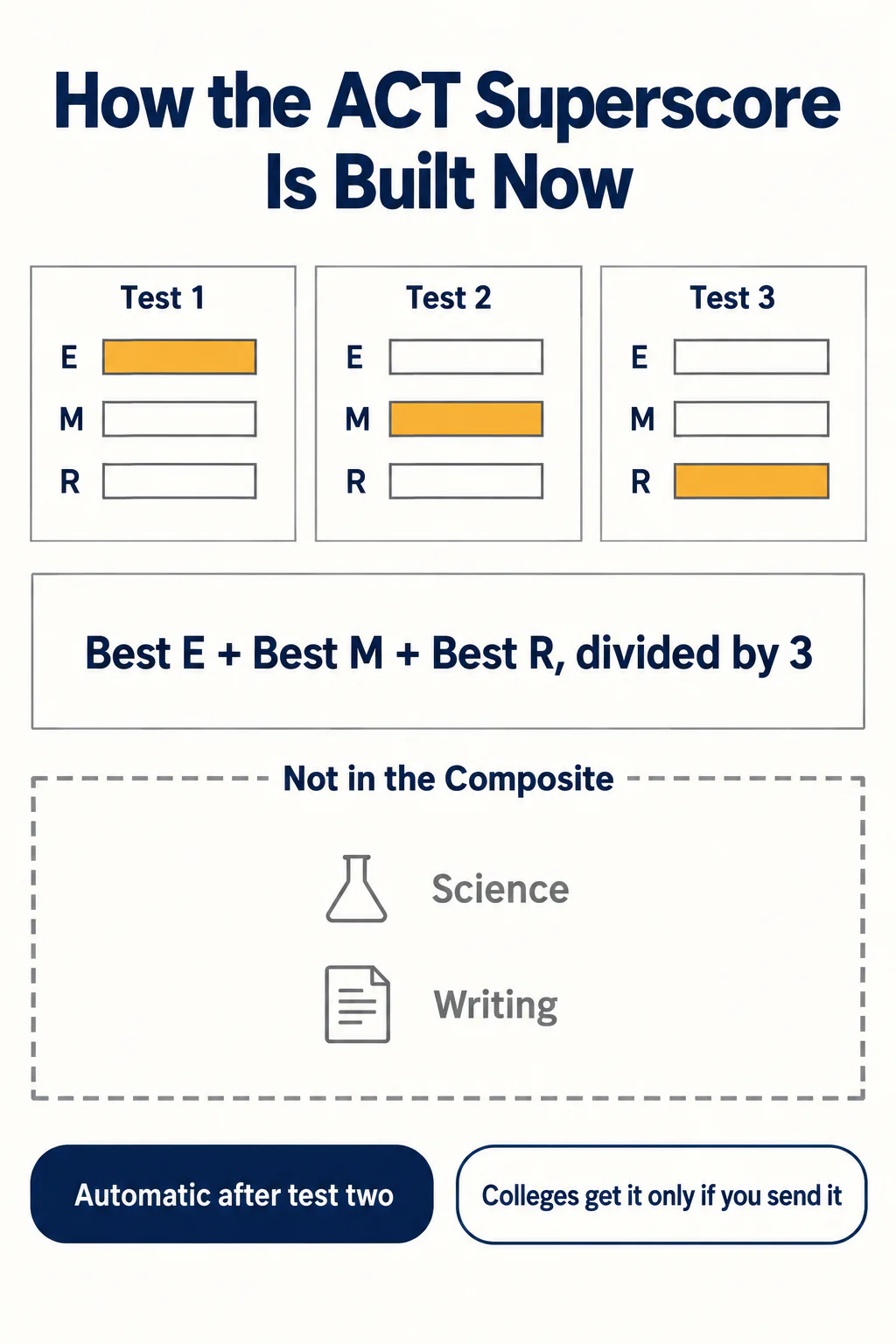
How does ACT superscoring differ from the SAT?
Both reward retaking, but the arithmetic and the granularity are different enough that strategies do not transfer.
| ACT superscore | SAT superscore | |
|---|---|---|
| Components combined | 3 sections: English, Math, Reading | 2 sections: Reading and Writing, Math |
| Method | Average, rounded to nearest whole | Sum of the two best section scores |
| Scale | 1 to 36 | 400 to 1600 |
| Calculated by the test maker | Yes, automatically | Varies by college |
| Excluded parts | Science and writing | None |
The practical difference is how much a single retake can move. With only two SAT sections, a retake that lifts one section moves half the total. With three ACT sections it moves a third. That makes ACT retakes a slower instrument, but it also means a student with one clearly weak section has a cleaner target. Our companion guide to SAT superscore and Score Choice covers the SAT side, and SAT or ACT, which is better works through the choice itself.
How superscoring should change a retake plan
It should make it narrower. This is the part students resist.
Without superscoring, a retake means preparing for the whole test again, because the whole Composite has to hold up on one day. With superscoring, only your best result in each section survives, so revising a section you already scored well in is effort with no possible payoff. If your best English is a 33, nothing you do to English on the next attempt can help unless you beat 33.
The plan that follows from the arithmetic:
- Identify the two sections with the largest gap between your best score and your realistic ceiling. Those are the only two worth serious time.
- Accept that you may go backwards elsewhere. A lower English on the retake costs you nothing, because your previous 33 still stands.
- Plan the sitting for after real preparation, not simply for the next available date. A retake with no change in preparation reproduces the previous result.
- Order the score report. The Superscore is worth nothing in an account.
Point two is the liberating one. Superscoring converts a retake from a risk into a one-way bet on the sections you target. That is exactly the situation where focused 1:1 work outperforms grinding through another full-length practice test, and it is the case we make in 1-on-1 tutoring versus group classes.
One thing to check before you rely on any of this
Superscoring is a college policy, not a universal rule. ACT will calculate and send a Superscore to anyone, but whether an admissions office uses it is entirely up to them. Some take the Superscore Composite. Some take your single strongest test date. A minority look at every sitting.
Check each college on your list directly on its admissions page. It takes ten minutes and it determines whether the retake strategy above is worth building at all. Applying a superscore plan to a college that only reads your best single date is wasted effort, and it is the kind of assumption that is easy to make and expensive to discover late.
What to do with this
Three things carry the weight. The ACT superscore now averages English, Math and Reading and divides by three, so science is out of the Composite even when it was your best subject. It is calculated for you after two sittings but never sent unless you order a report. And it does not conceal the test dates it was built from.
Used properly, superscoring makes a retake a targeted exercise on one or two sections rather than a full rerun. That is the real gain, and it only materialises if the second sitting is planned around the gaps rather than booked because a date came up.
Ready to turn a prep plan into real score gains? Catalyst's 1:1 live online SAT programme starts with a free consultation to benchmark your teen's starting point and build a personalised path to their goal score.
Book a Free Consultation