The ACT science section can now be skipped without touching the Composite score, and that single change has quietly created one of the more consequential decisions on a teenager's testing calendar. Skipping it saves 40 minutes. It also removes a number from the report that some programmes read closely, and ACT will not tell you which ones, because it calls that an institution-specific decision.
So the answer is not "skip it" or "take it". It depends on where your teen is applying and what they are applying for, and the deadline for the October 17 test has already passed for regular registration. Late registration closes on September 29. Here is what the enhanced ACT actually changed, what disappears from the report when science is skipped, and how to make the call in an evening rather than a fortnight.
Key Takeaways
- Science and writing are both optional on the enhanced ACT, and neither counts toward the Composite, which is English, math and reading only.
- Because science cannot lower the Composite, the only cost of taking it is 40 extra minutes of testing.
- Skipping science removes the STEM score entirely, since STEM combines science and math.
- ACT calls the requirement an institution-specific decision, so you have to check each college and each scholarship yourself.
- The October 17, 2026 late registration deadline is September 29; the December 12 test closes on November 6.
Is the ACT science section optional?
Yes. On the enhanced ACT, science and writing are optional, and neither affects the Composite score. A student who takes science receives a separate science score and a STEM score, both reported and both sent to the colleges they designate.
The change was phased in through 2025 and applies to the national test now. The score scale is unchanged at 1 to 36, and ACT confirms that benchmarks and state achievement standards were not altered, so a 28 today means what a 28 meant before. What changed is which sections feed the headline number.
What changed on the enhanced ACT
The redesign was mostly about length. The test is roughly 70 minutes shorter with about 44 fewer questions, which works out to more time per question rather than less material. Math also moved from five answer choices to four, which quietly removes one wrong option from every question.
| Section | Questions | Time | In the Composite? |
|---|---|---|---|
| English | 50 | 35 minutes | Yes |
| Math | 45 | 50 minutes | Yes |
| Reading | 36 | 40 minutes | Yes |
| Science | 40 | 40 minutes | No, optional |
| Writing | 1 prompt | 40 minutes | No, optional |
The three core sections total 125 minutes. Add science and the test runs 165 minutes of testing time. Full detail sits on ACT's test enhancements page.
The score that disappears when you skip science
Skip science and the report loses more than one line. The STEM score is calculated from science and math together, so with no science score there is no STEM score to calculate.
That matters because the STEM score is not decoration. It is the number that lets an engineering admissions reader see quantitative and scientific reasoning in one figure, and it appears in some merit aid formulas. A Composite of 31 with a STEM of 33 tells a different story from a Composite of 31 with the STEM line blank, and the blank version is not neutral. It is simply absent, and an absent number cannot argue for anything.
Superscoring follows the same logic. Since April 2025 the ACT Superscore Composite has been calculated from English, math and reading only, so science sits outside that calculation too while still being reported.
Not sure where your teen stands? A free consultation with Catalyst Test Prep maps exactly which SAT topics need the most work, so you're never guessing about study time.
Book a Free Consultation →Who should still take ACT science?
Take it if any of the following is true, and the list is broader than most families assume.
- Any STEM-adjacent intended major. Engineering, computer science, pre-med, nursing, physics, environmental science. The STEM score is read in these files.
- Merit scholarships with a STEM component. Institutional engineering scholarships frequently reference it, and those criteria are set separately from admissions requirements.
- A student who is genuinely good at science reasoning. Data interpretation and experimental design are learnable skills, and a strong score here is free upside given it cannot lower the Composite.
- Any college on the list that has not published a clear policy. Absence of a statement is not permission to skip.
- Students applying internationally, where admissions offices may be working from older assumptions about what an ACT report contains.
Who can safely skip it
Skipping is reasonable for a student heading into humanities, business, arts or social sciences, where no target programme asks for science and no scholarship references STEM. It is also reasonable for a student whose stamina genuinely collapses in the final 40 minutes, because a tired science section that drags nothing down still costs attention that Module-style fatigue may have already spent.
The one case where skipping is clearly right: a student retaking the ACT purely to lift one core section, who already has a science score on file from an earlier sitting. There is nothing to gain from repeating it.
What does 40 extra minutes actually buy?
Forty minutes and 40 questions, at the very end of a 165-minute test. That is the real trade, and it is worth being honest about the fatigue rather than pretending it does not exist.
But weigh it properly. The 40 minutes are spent once. The blank STEM line sits on every report sent to every college for the rest of the cycle. For a student with any quantitative ambition, that asymmetry points one way. For a student certain of a humanities path, the 40 minutes are better spent on reading pace, and our comparison of ACT reading against SAT reading covers where that pressure actually comes from.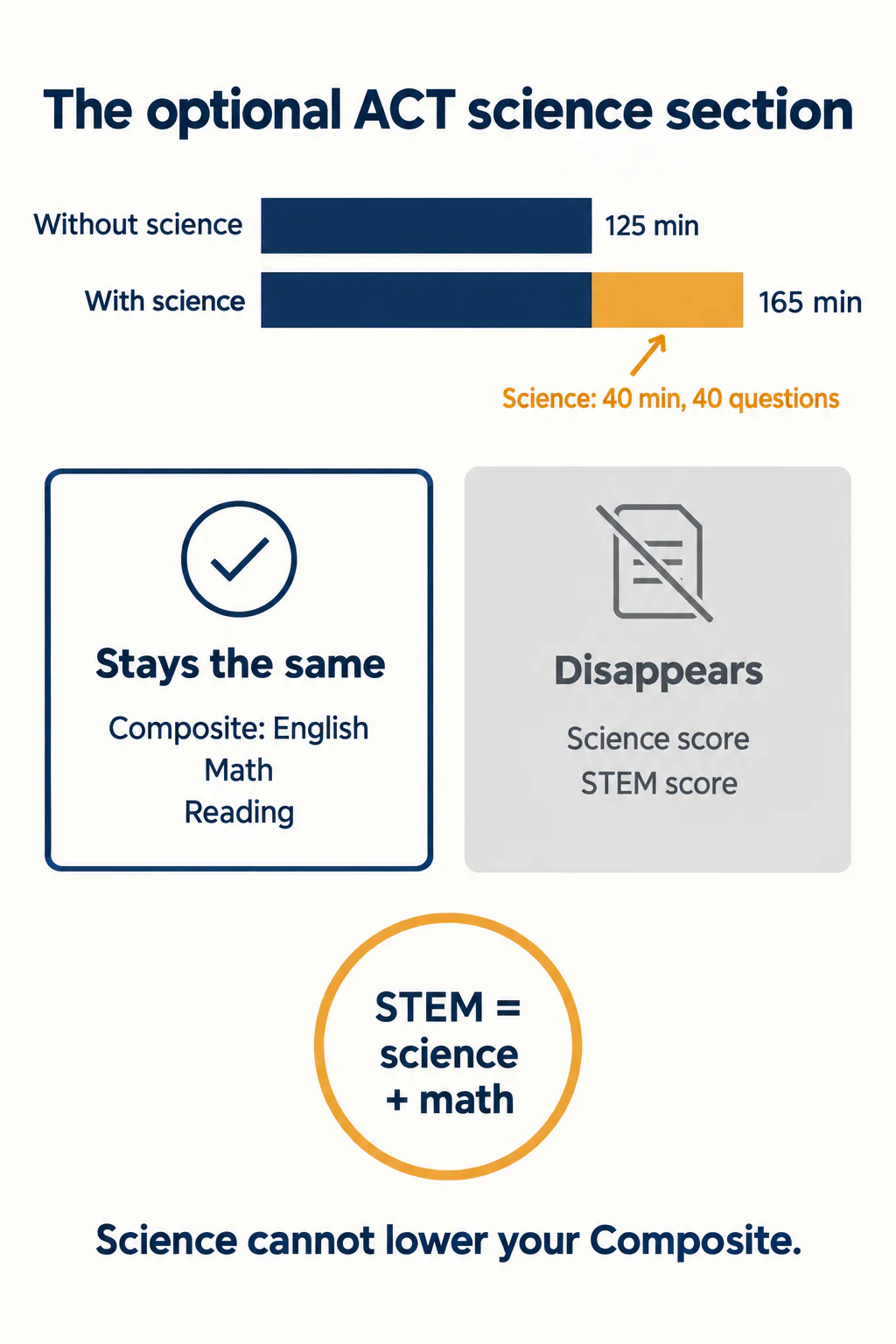
The writing section is a separate decision
Writing is also optional and also outside the Composite, but it is not the same call. Far fewer colleges ask for the ACT essay than ask about science, and where it is required the requirement is usually stated plainly. Check it the same way, on the same evening, and do not assume one policy covers both.
One practical note: adding either optional section to a sitting is a registration choice, not a test-day choice. You cannot decide in the room.
How to decide, and by when
This takes about forty minutes of research and settles the question for the whole cycle.
- List the target colleges, including the realistic and the ambitious ones.
- Open each one's testing requirements page and note what it says about ACT science specifically. Record the date you checked, because policies move.
- Check scholarship criteria separately. Financial aid and admissions pages are maintained by different offices and often disagree.
- Default to taking science if any single college or scholarship on the list wants it, or if the intended major is quantitative.
- Register before the deadline, not after. Changing a booked test date costs $44.
The 2026-27 national dates and deadlines, all published on ACT's test dates page, run as follows.
| Test date | Registration deadline | Late deadline | Scores released |
|---|---|---|---|
| October 17, 2026 | September 11, 2026 | September 29, 2026 | October 27, 2026 |
| December 12, 2026 | November 6, 2026 | November 29, 2026 | December 22, 2026 |
| February 27, 2027 | January 22, 2027 | February 9, 2027 | March 16, 2027 |
| April 10, 2027 | March 5, 2027 | March 23, 2027 | April 20, 2027 |
| June 12, 2027 | May 7, 2027 | May 25, 2027 | June 23, 2027 |
Deadlines fall at 11:59 pm Central. If the ACT versus SAT question is still open, that decision comes first, and our guide to the 2026 digital SAT sets out the alternative. Students juggling this alongside AP courses should also read how to balance test prep with school and AP exams. To model what a raw performance turns into, use our ACT score calculator.
Making the call
Three facts carry this decision. Science sits outside the Composite, so taking it cannot cost points and skipping it cannot gain any. Skipping it does delete the STEM score, which is the number quantitative programmes read. And ACT declines to say which colleges require it, which leaves the research with you.
Given that shape, the default for any student with a quantitative interest is to take it, and the default for a committed humanities student with a clean college list is to skip it. Everyone in between should spend forty minutes on the requirements pages tonight rather than guessing in the registration form.
Ready to turn a prep plan into real score gains? Catalyst's 1:1 live online SAT programme starts with a free consultation to benchmark your teen's starting point and build a personalised path to their goal score.
Book a Free Consultation