
Most families who look up ACT fee waivers are trying to work out whether they can save the registration fee. They can. They are also, usually without knowing it, leaving the more valuable half of the waiver on the table: a year of official prep and the one service that lets a student see their own test paper back.
This guide covers who qualifies, what the waiver actually includes, how the code is issued, and how the scheme differs from the SAT's. Every figure here comes from ACT's published fee waiver and fee pages.
Key Takeaways
- Eligible students get up to two waivers, each covering one full ACT registration.
- The waiver covers the science and writing add-ons, not only the base test.
- It includes a year of the official ACT self-paced course and My Answer Key, normally $36 or $44.
- Eligibility needs all three: grade 11 or 12, testing in the US, and one indicator of economic need.
- Your school counsellor issues the code. There is no family-facing application to ACT.
Who qualifies for an ACT fee waiver?
All three of the following have to be true at the same time. This is an "and", not an "or", and it is where most rejected assumptions live.
- You are currently enrolled in grade 11 or 12. Sophomores are out, whatever their circumstances.
- You are testing in the United States, a US territory or Puerto Rico. International test centres are not covered.
- You meet at least one indicator of economic need.
ACT publishes the indicators, and a single one is enough:
- Enrolment in the federal free or reduced-price lunch programme.
- Enrolment in a federally funded programme for students from low income families, such as GEAR UP or Upward Bound.
- Being a ward of the state, living in state-arranged care, or experiencing homelessness.
- Family receipt of low-income public assistance, or living in federally subsidised housing.
- Family income at or below the USDA levels for free lunch eligibility.
Note what is not on that list: any requirement to prove hardship in narrative form, and any requirement that a parent complete paperwork with ACT directly. The school confirms one of these indicators and that is the test passed.
What does an ACT fee waiver actually cover?
Rather more than the registration fee, and the difference is the point of this article.
| Item | Published fee | With a waiver |
|---|---|---|
| ACT registration, English, Math and Reading | $70 | Covered, twice |
| Science add-on | $5 | Covered |
| Writing add-on | $25 | Covered |
| Official ACT Self-Paced Course, one year | Paid product | Included |
| ACT My Answer Key | $36 before, $44 after | Included |
| Score reports at registration | Limited, then $20 each | One school, up to six colleges |
| Score reports after registration | $20 each | Unlimited, no cost |
The base test with both optional sections is listed at $100. Two waivers therefore cover two of those, and the score-report allowance alone can run to more than the test fees for a student applying to a long list.
Not sure where your teen stands? A free consultation with Catalyst Test Prep maps exactly which SAT topics need the most work, so you're never guessing about study time.
Book a Free Consultation →The two benefits families overlook
Ask a student what their fee waiver gave them and they will say the test was free. Ask what else and you usually get a blank.
A year of the official prep course
The waiver includes The Official ACT Self-Paced Course, Powered by Kaplan, for a year. ACT describes it as 30 video lessons, more than 2,000 practice questions and five full-length practice tests. Five official full-length tests is a serious amount of material, and it is exactly the resource a self-studying student otherwise pays for or does without.
This has no counterpart on the SAT side. The College Board fee waiver is generous in its own way, particularly on score sends and college application fee waivers, but it does not bundle a prep course. If the same student qualifies for both, the ACT waiver is the one that arrives with study material attached.
My Answer Key, which the SAT cannot match
My Answer Key returns the questions and your answers after the test. It is listed at $36 if you order it before the test and $44 afterwards, and it is included with a waiver.
That matters more than the money, because there is no digital SAT equivalent. The Question-and-Answer Service and the Student Answer Service were retired along with the paper SAT, so a digital SAT student cannot buy a look at their own answers at any price. We worked through that gap in our guide to what SAT score verification actually buys.
For a student who learns by reviewing their own mistakes, this is the strongest practical argument for choosing the ACT that exists, and it is stronger still when a waiver makes it free.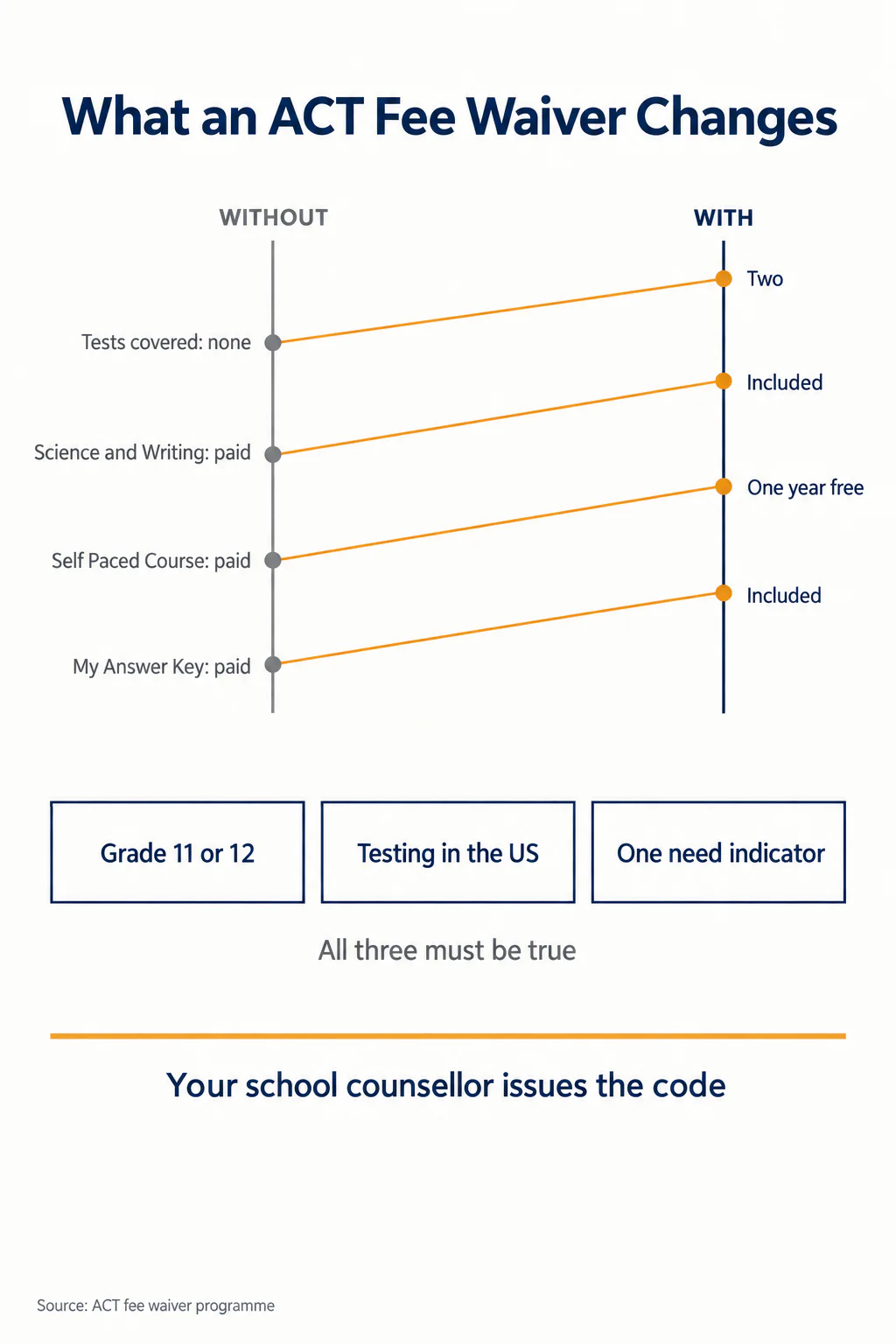
How do you get the code?
Through your school counsellor, and only through your school counsellor.
- Ask the counsellor to check your eligibility. They hold the record of free and reduced lunch enrolment and the other indicators, and they confirm against the ACT criteria.
- Collect your fee waiver code. It is issued to you individually.
- Enter the code at registration, online or on a paper form, before you pay.
Two practical notes. There is no route for a family to apply to ACT directly, so a school that is slow to respond is a blocker you have to work around rather than bypass. And the code goes in at registration: a student who pays and then produces a waiver has a refund conversation rather than a clean one, so ask early.
Ask your counsellor one more question while you are there: whether a late registration or a date change is covered. ACT's fee waiver page lists what the waiver includes and does not enumerate exclusions, and the change fee is $49, which is not a sum to discover by accident.
ACT and SAT waivers are not the same scheme
They are run by different organisations, with separate eligibility checks, separate codes and separate benefits. Qualifying for one is a very good sign you will qualify for the other, but neither triggers the other automatically.
The practical failure is one-sided claiming. A student whose counsellor is used to processing College Board fee waivers gets the SAT one, sits the SAT, and never learns that the ACT scheme exists. If money is the reason a second test is off the table, it may not need to be. The SAT scheme and everything it covers is in our guide to SAT fee waivers and who qualifies.
Where the two overlap, claim both. Where you have to choose which test to prepare for, that is a different decision, and the section-level mechanics matter more than the fee. Our guides to ACT superscoring and whether to sit the optional science section cover the two choices that move an ACT score most.
How to spend two free sittings
Badly, in most cases, and it is worth being blunt about why.
A free test invites a casual first attempt. The logic feels sound: it costs nothing, so treat it as practice and take the second one seriously. What actually happens is that the first sitting produces no useful information, because an unprepared test tells you what an unprepared student scores rather than where their weaknesses are. Then the second sitting is the only real attempt, and there is no third.
The better plan uses the pair deliberately:
- Prepare properly for the first one. It is a real score and it is the baseline everything else is measured against.
- Order My Answer Key. It is free with the waiver, and it turns the first sitting into a question-by-question map of what to fix.
- Target the second. Superscoring means only your best section results survive, so work the two sections with the most headroom rather than revising the whole test again.
Two prepared sittings with a real review in between is a materially different outcome from one throwaway and one anxious attempt, and the waiver is what makes that pattern affordable in the first place.
What to do with this
Three things carry the weight. ACT fee waivers cover two full sittings including the science and writing add-ons, not just the base registration. They come with a year of the official self-paced course and with My Answer Key, which together are worth more than the fees and have no SAT counterpart. And the whole scheme runs through your school counsellor, so the first action is a conversation, not a form.
If your family already holds an SAT fee waiver, ask about the ACT one this week. The eligibility indicators overlap almost entirely and the benefits do not. ACT publishes the current rules on its fee waiver programme page, and every figure quoted above is on its published fee schedule.
Ready to turn a prep plan into real score gains? Catalyst's 1:1 live online SAT programme starts with a free consultation to benchmark your teen's starting point and build a personalised path to their goal score.
Book a Free Consultation